Israel and the United States: perceptions of dependence
How Israelis perceive dependence on the United States in security, economics, politics and culture.
John Brighenti · CC BY 2.0 · Adapted
AuthorshipDor Moriah TeamReading time
Historical material. Dates, proposals and invitations refer to the time of the original publication.
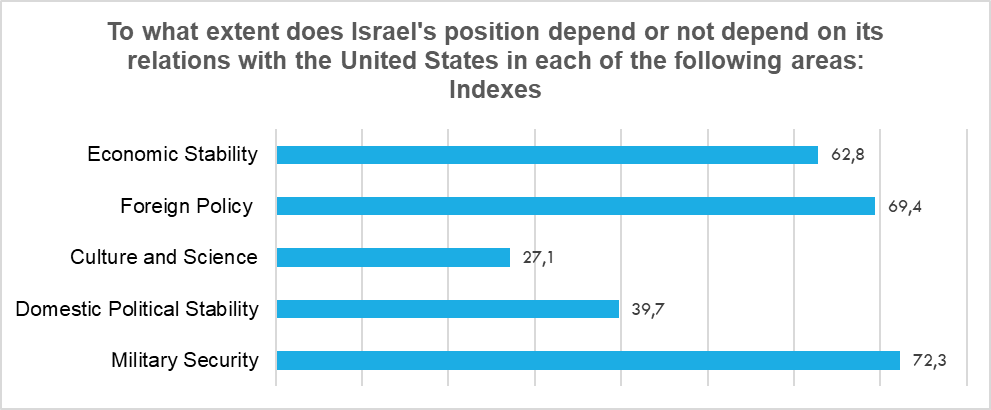
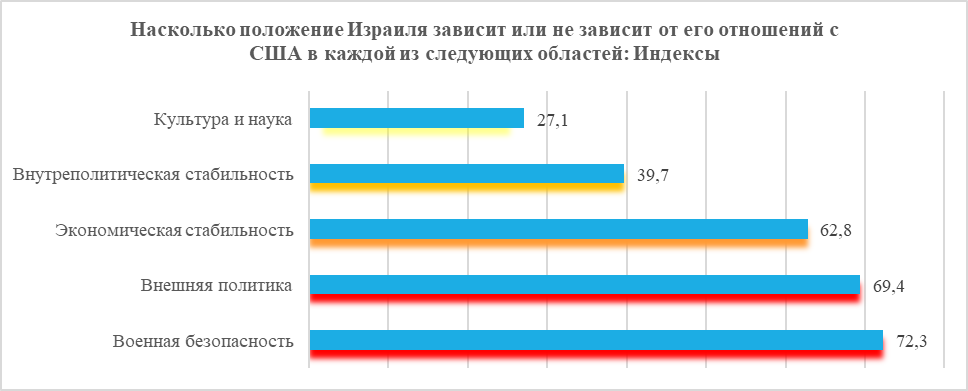
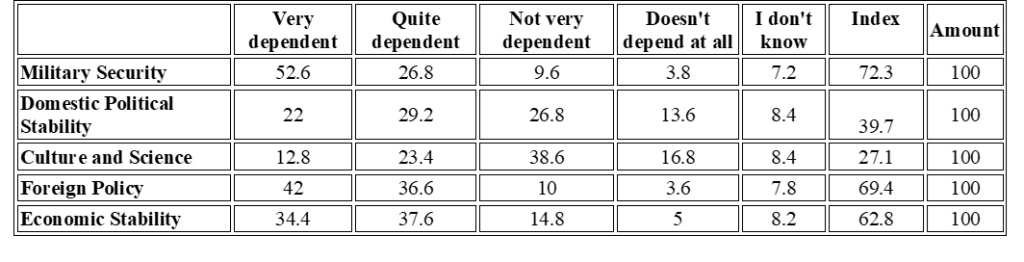
Israelis public opinion is characterized by a perception of a very high level of dependence of Israel on the USA in most key areas.In all the studied areas, the Israel dependence index has positive values, indicating dependence rather than independence. Moreover, three areas (military security, economy, and foreign policy) are characterized by a very high degree of dependence, with index values exceeding 50 percentage points on a scale ranging from 100 (maximum dependence) to -100 (maximum independence).
Dependence across five areas
Dependence by area: published indices
−1000+100
Military security
+72.3 index pts
Domestic politics
+39.7 index pts
Culture and science
+27.1 index pts
Foreign policy
+69.4 index pts
Economic stability
+62.8 index pts
The author’s weighted index ranges from −100 to +100. It is not a percentage of respondents. Published index values are retained; full responses and qualifications appear below.Original chartOriginal figure for comparisonView original ↗
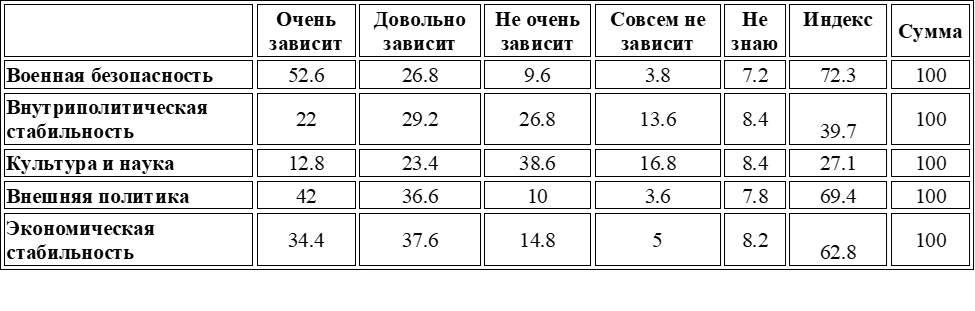
Table 6. To what extent do you think Israel’s position depends or does not depend on its relations with the United States in each of the following areas? %
Dependence by area: published indices
Category
Very dependent
Fairly dependent
Not very dependent
Not dependent
Don’t know
Index, index pts
Total
Military security
52.6
26.8
9.6
3.8
7.2
72.3
100
Domestic politics
22
29.2
26.8
13.6
8.4
39.7
100
Culture and science
12.8
23.4
38.6
16.8
8.4
27.1
100
Foreign policy
42
36.6
10
3.6
7.8
69.4
100
Economic stability
34.4
37.6
14.8
5
8.2
62.8
100
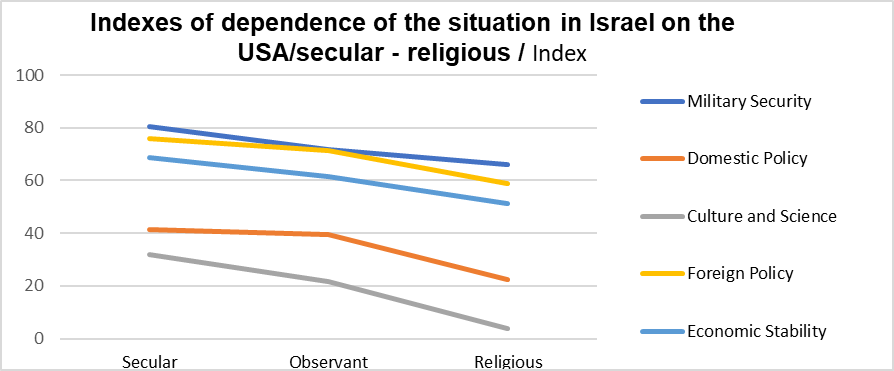
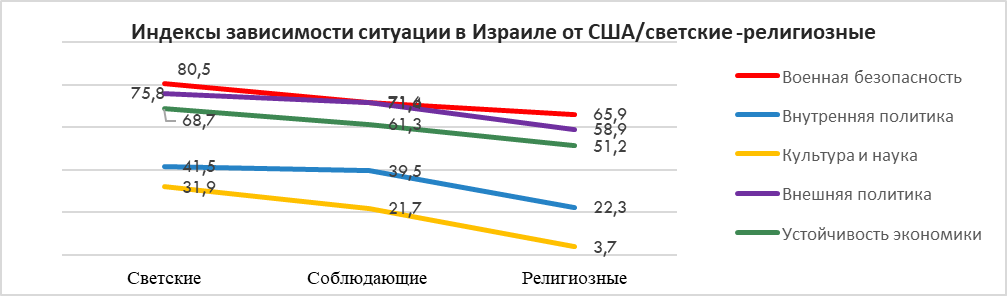
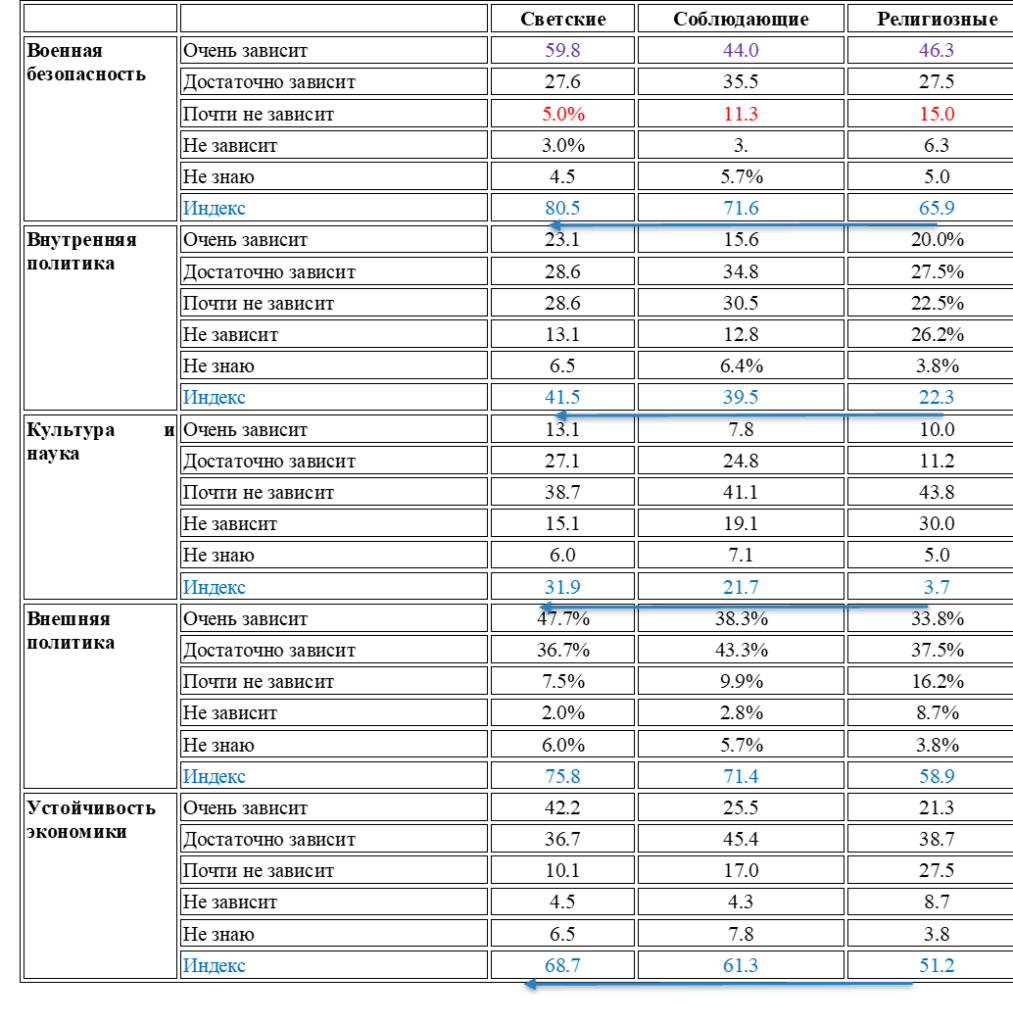
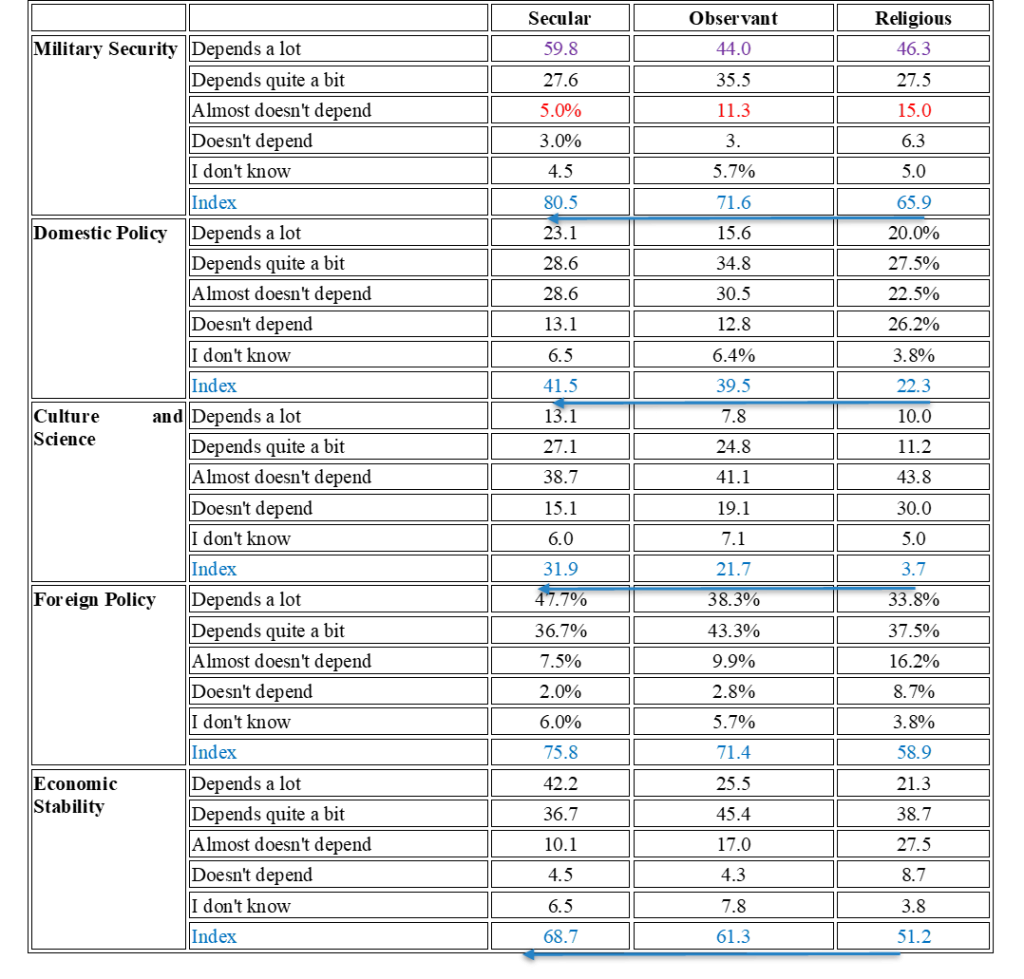
The answers regarding Israel’s independence from the United States in different areas differ significantly in the groups identified by the secularity-degree of religiosity criterion[1], but a general trend is noticeable: the values of the answers regarding Israel’s dependence on the United States increase in all areas as the degree of religiosity decreases. In other words, the highest assessments of such dependence are given by secular Israelis, and the lowest by religious ones.
Differences between groups
Dependence: secular and religious respondents
−1000+100
Military security · Secular
+80.5 index pts
Military security · Religious
+65.9 index pts
Foreign policy · Secular
+75.8 index pts
Foreign policy · Religious
+58.9 index pts
Economic stability · Secular
+68.7 index pts
Economic stability · Religious
+51.2 index pts
Three selected areas and two groups for a short comparison. All five areas and three groups are retained in tables. These are author indices, not population shares.Original chartOriginal figure for comparisonView original ↗
Table 6.2 To what extent do you think Israel’s position depends or does not depend on its relations with the US in various areas? % /secularity – religiosity
Military security · All response options
Response
Secular
Traditional
Religious
Very dependent
59.8
44
46.3
Fairly dependent
27.6
35.5
27.5
Not very dependent
5
11.3
15
Not dependent
3
3
6.3
Don’t know
4.5
5.7
5
Index, index pts
80.5
71.6
65.9
Domestic politics · All response options
Response
Secular
Traditional
Religious
Very dependent
23.1
15.6
20
Fairly dependent
28.6
34.8
27.5
Not very dependent
28.6
30.5
22.5
Not dependent
13.1
12.8
26.2
Don’t know
6.5
6.4
3.8
Index, index pts
41.5
39.5
22.3
Culture and science · All response options
Response
Secular
Traditional
Religious
Very dependent
13.1
7.8
10
Fairly dependent
27.1
24.8
11.2
Not very dependent
38.7
41.1
43.8
Not dependent
15.1
19.1
30
Don’t know
6
7.1
5
Index, index pts
31.9
21.7
3.7
Foreign policy · All response options
Response
Secular
Traditional
Religious
Very dependent
47.7
38.3
33.8
Fairly dependent
36.7
43.3
37.5
Not very dependent
7.5
9.9
16.2
Not dependent
2
2.8
8.7
Don’t know
6
5.7
3.8
Index, index pts
75.8
71.4
58.9
Economic stability · All response options
Response
Secular
Traditional
Religious
Very dependent
42.2
25.5
21.3
Fairly dependent
36.7
45.4
38.7
Not very dependent
10.1
17
27.5
Not dependent
4.5
4.3
8.7
Don’t know
6.5
7.8
3.8
Index, index pts
68.7
61.3
51.2
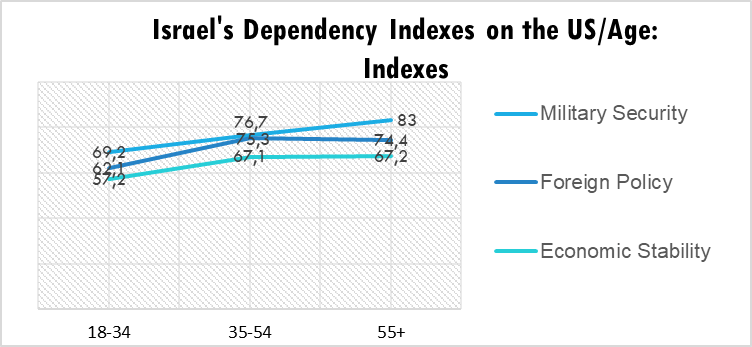
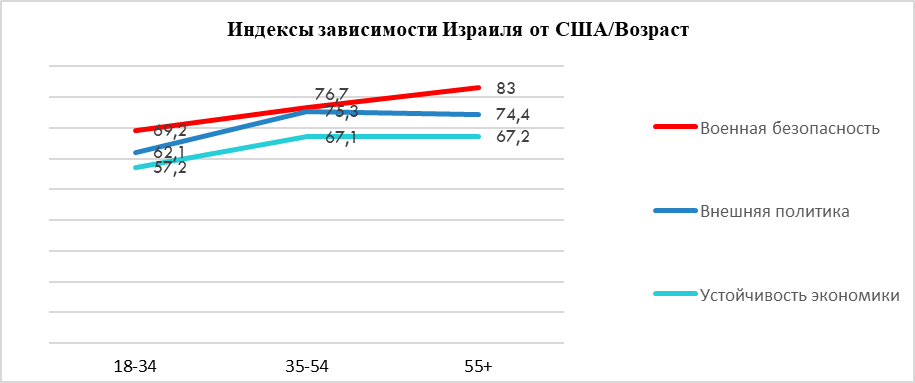
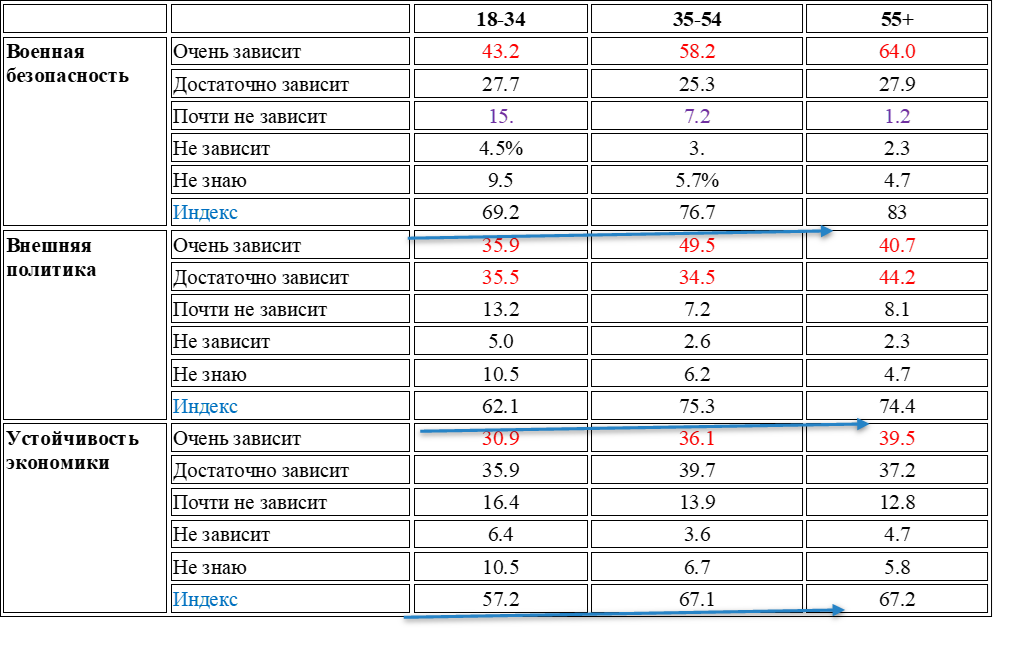
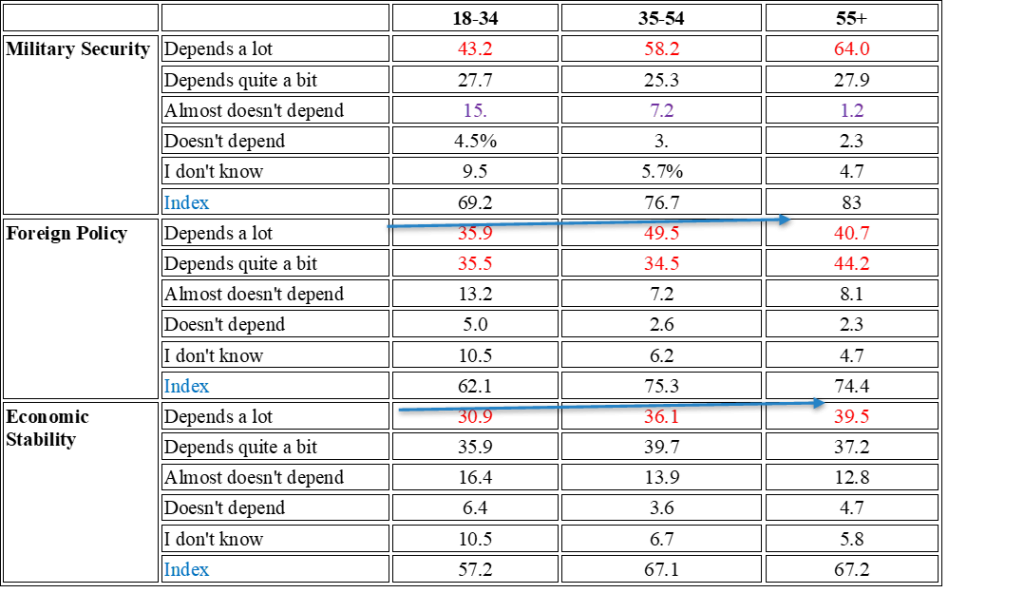
The results of the responses to this question depend little on the gender of the respondents, and on age only in certain areas – military security, foreign policy, and economics. This is likely due to the importance that respondents attribute to these areas. In any case, in the mentioned areas, the dependency index values, calculated similarly to the previous question, increase from younger age groups to older ones.
Age and perceptions of dependence
Age and perceptions of dependence
−1000+100
Military security · 18–34
+69.2 index pts
Military security · 55+
+83.0 index pts
Foreign policy · 18–34
+62.1 index pts
Foreign policy · 55+
+74.4 index pts
Economic stability · 18–34
+57.2 index pts
Economic stability · 55+
+67.2 index pts
The youngest and oldest groups are compared. The middle age group and all response options remain in the tables. Indices are reproduced from the source.Original chartOriginal figure for comparisonView original ↗
Table 6.3 To what extent do you think Israel’s position depends or does not depend on its relations with the United States in various areas? % /age
Military security · All response options
Response
18–34
35–54
55+
Very dependent
43.2
58.2
64
Fairly dependent
27.7
25.3
27.9
Not very dependent
15
7.2
1.2
Not dependent
4.5
3
2.3
Don’t know
9.5
5.7
4.7
Index, index pts
69.2
76.7
83
Foreign policy · All response options
Response
18–34
35–54
55+
Very dependent
35.9
49.5
40.7
Fairly dependent
35.5
34.5
44.2
Not very dependent
13.2
7.2
8.1
Not dependent
5
2.6
2.3
Don’t know
10.5
6.2
4.7
Index, index pts
62.1
75.3
74.4
Economic stability · All response options
Response
18–34
35–54
55+
Very dependent
30.9
36.1
39.5
Fairly dependent
35.9
39.7
37.2
Not very dependent
16.4
13.9
12.8
Not dependent
6.4
3.6
4.7
Don’t know
10.5
6.7
5.8
Index, index pts
57.2
67.1
67.2
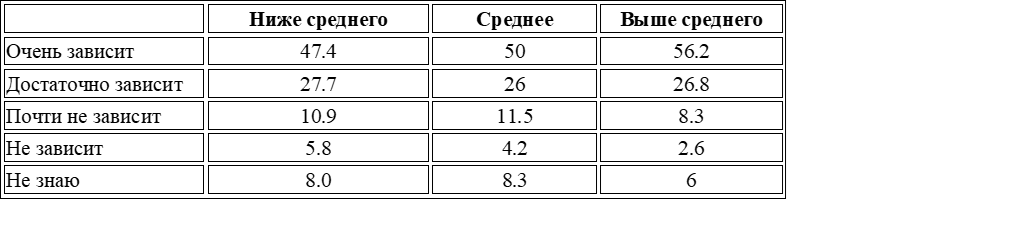
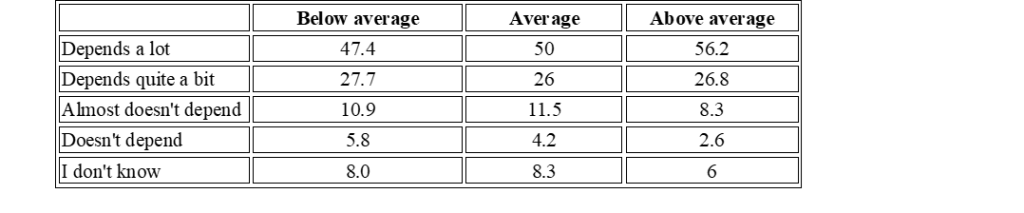
By level of education, a reliable pattern of change in position regarding Israel’s independence is noticeable only in the area of military security: the higher the level of education, the more often respondents say that it depends on the United States.
Table 6.3 To what extent, in your opinion, does Israel’s position depend or not depend on its relations with the United States in the area of military security % / education
Education and income
Education · Military security
Response
Below average
Average
Above average
Very dependent
47.4
50
56.2
Fairly dependent
27.7
26
26.8
Not very dependent
10.9
11.5
8.3
Not dependent
5.8
4.2
2.6
Don’t know
8
8.3
6
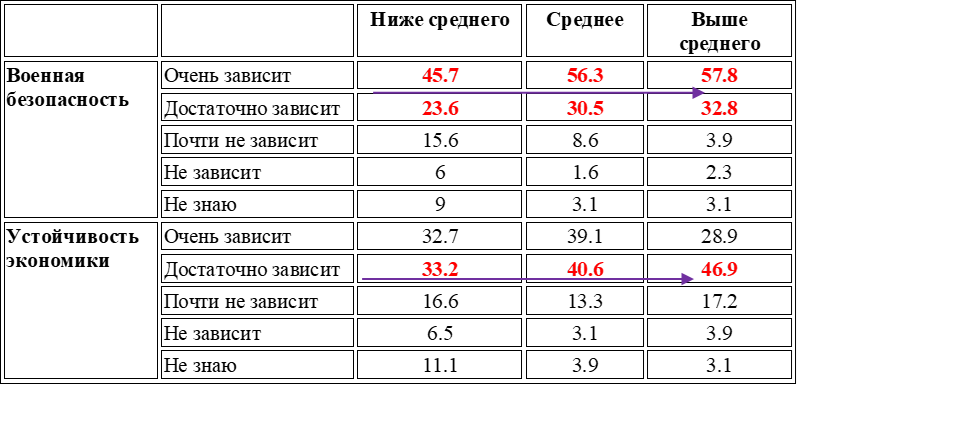
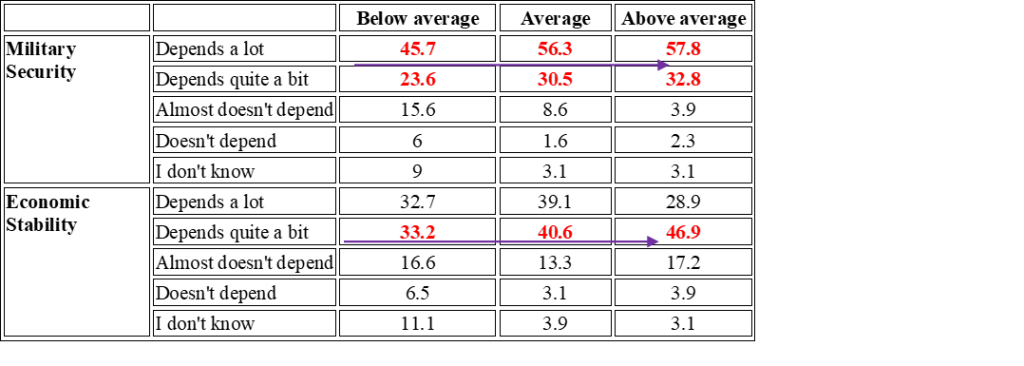
In the group of respondents, distinguished by the level of material wealth, the fundamental differences in the answers also concern mainly the military security of Israel, and, to a lesser extent, the stability of the economy. The higher its levelof material wealth, the more often there are ideas about Israel’s dependence in both of these areas.
Table 6.4 To what extent, in your opinion, does Israel’s position depend or not depend on its relations with the United States in the following areas: % /material wealth
Income · Military security
Response
Below average
Average
Above average
Very dependent
45.7
56.3
57.8
Fairly dependent
23.6
30.5
32.8
Not very dependent
15.6
8.6
3.9
Not dependent
6
1.6
2.3
Don’t know
9
3.1
3.1
Income · Economic stability
Response
Below average
Average
Above average
Very dependent
32.7
39.1
28.9
Fairly dependent
33.2
40.6
46.9
Not very dependent
16.6
13.3
17.2
Not dependent
6.5
3.1
3.9
Don’t know
11.1
3.9
3.1
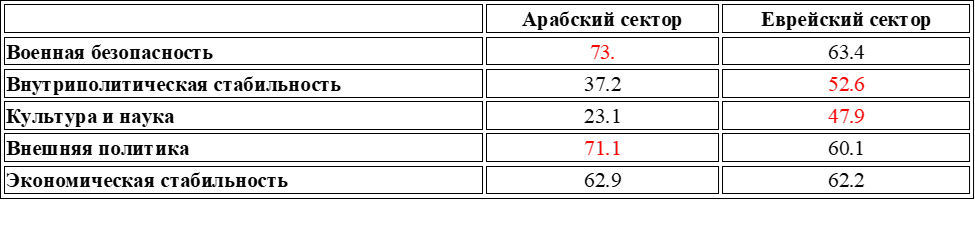
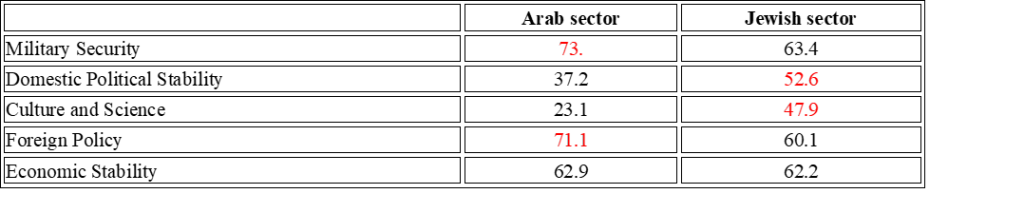
Judging by the values of the index of Israel’s dependence on the United States, the Arab sector considers it dependent in the sphere of military security and foreign policy more than the Jewish sector (the difference in the values of the corresponding index is 10 points). In the Jewish sector, the index of Israel’s dependence is significantly higher in the domestic political sphere (the difference is 15 points), culture and science (25 points).
Table 6.5 Indices of dependence of Israel’s position on its relations with the United States in various spheres: /national sector
Population sector
Population sector · Index, index pts
Category
Arab population
Jewish population
Military security
73
63.4
Domestic politics
37.2
52.6
Culture and science
23.1
47.9
Foreign policy
71.1
60.1
Economic stability
62.9
62.2
Country of birth
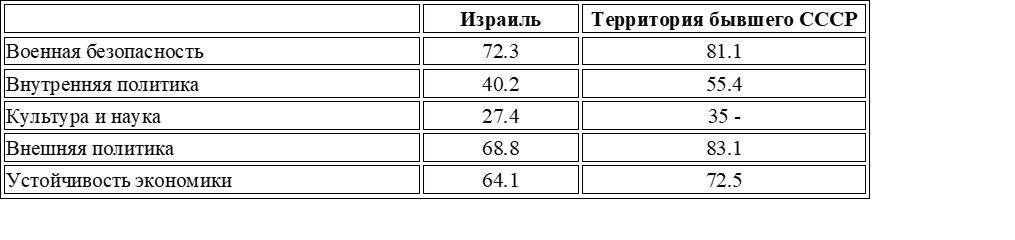
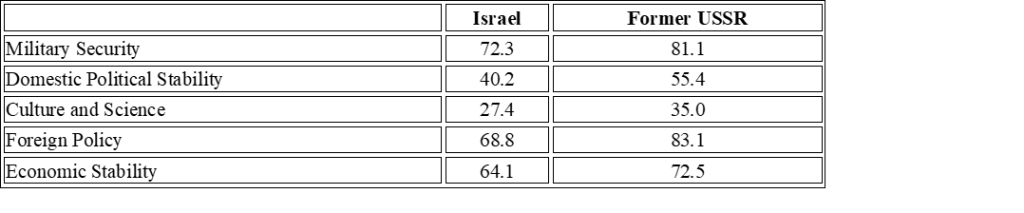
Across all five measures, Israel-born respondents perceive less dependence on the United States than former-USSR-born respondents. Published indices range from 27.4 to 72.3 and 35.0 to 83.1, respectively. The simple means of these five measures are 54.56 and 65.42.
Table 6.6. Dependence indices of Israel’s position on its relations with the USA in various spheres: /country of birth
[1] Due to the heterogeneity of the data, the Index of Israel’s dependence on the United States in different areas was calculated by assigning weights to the answer options in accordance with the degree of manifestation of the sign: it depends very much — 1, it depends enough — 0.75, almost does not depend — 0.35, does not depend (-) 1. Then the index values were calculated as the sum of the products between the fractions of the answers and the corresponding weights for each option.


 Global connections
 Research & archive