

 Global connections
 Research & archive




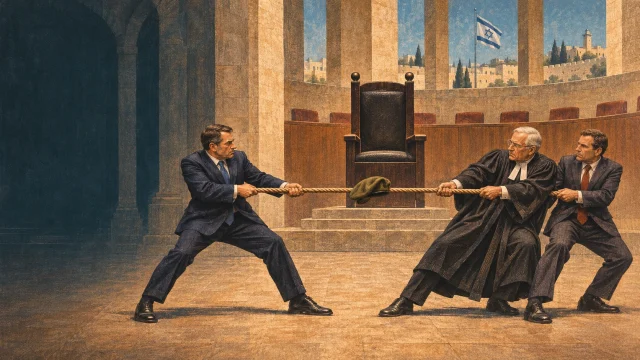

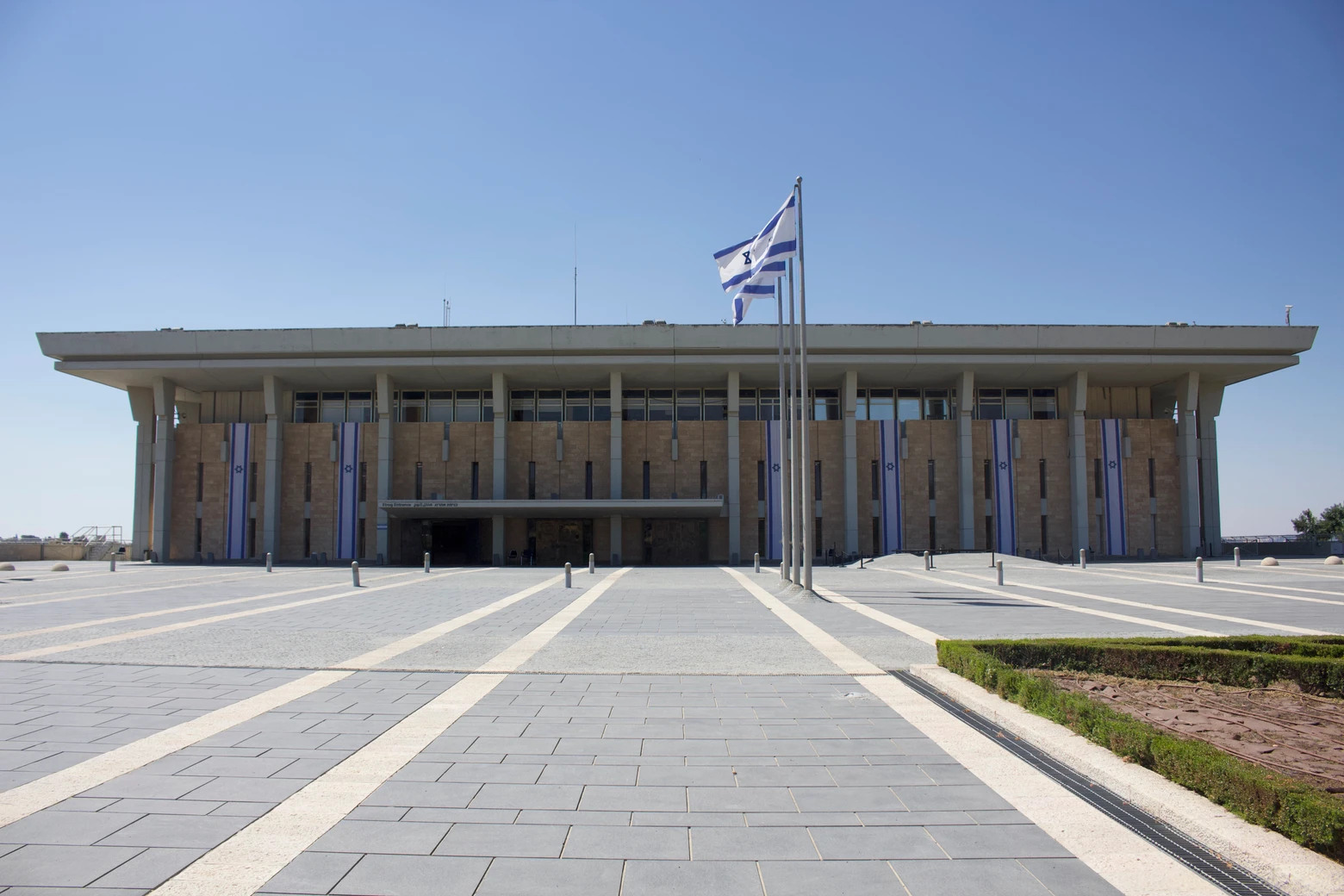
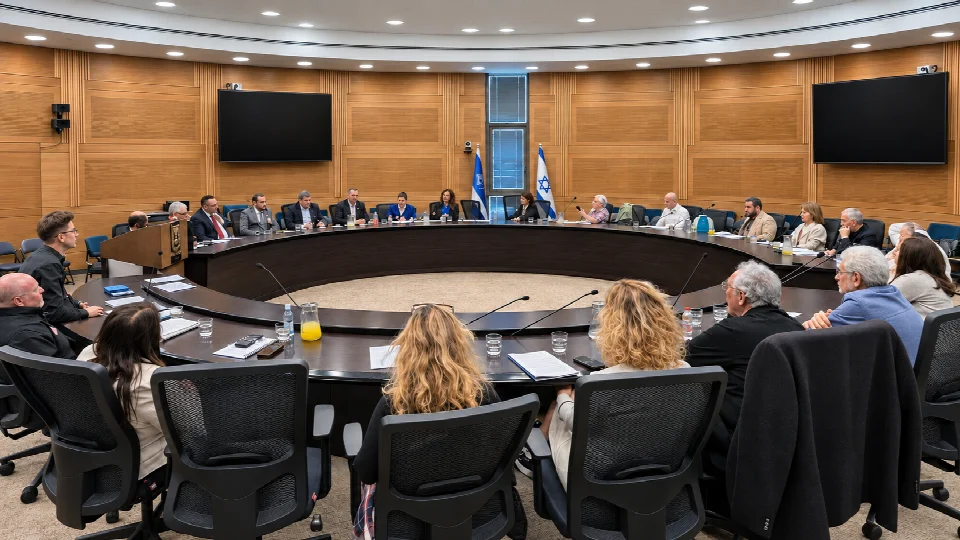
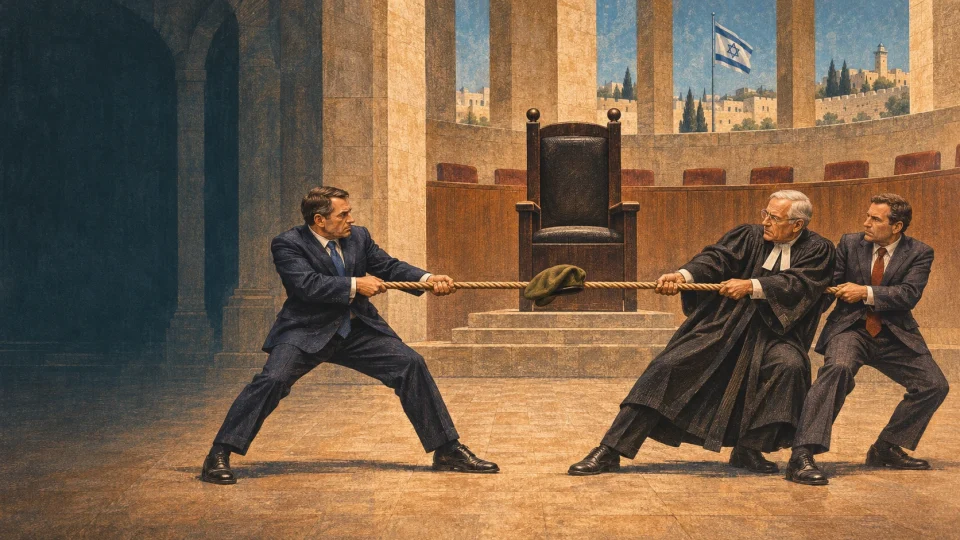


After the October 27, 2026, election, executive power remained with Benjamin Netanyahu’s caretaker cabinet, while the Knesset passed to his opponents, united in a change bloc led by former military chief of staff Gadi Eisenkot. The Supreme Court, sitting as the High Court of Justice, and the government’s attorney general ended up on the same side as the change bloc, which leaves no neutral arbiter in the dispute they would normally settle. With Eisenkot’s mandate expiring on December 6, that dispute has drawn in the army, the security services and the rabbis, and that is what puts civil peace at risk.
Without waiting for a coalition to form, the new majority on November 18 launched a fast-track repeal of the judicial overhaul in the Knesset. The goal is to restore the powers of the courts and the attorney general before Eisenkot’s mandate runs out.
On November 25, Netanyahu’s trial reached a turning point at the Jerusalem District Court. The judges suggested that Attorney General Gali Baharav-Miara consider dropping Case 4000 and reconsider Case 2000, in effect revisiting two of the three cases against the prime minister.
In the fight over the powers of the judiciary, the government and the Knesset, the High Court and the attorney general, the rabbis and the parties have all taken sides, and the army and the security services have been drawn in. The court that would normally settle a dispute between the government and parliament has itself become one of the sides, and much of the right rejects its rulings.
A Legislative Blitz That Skips the Coalition Rules
The new majority went first for the laws that define the powers of the court and the attorney general. In Israeli practice, laws on the judiciary are changed after a coalition is formed and the Knesset’s standing committees are assigned. The change bloc is doing it differently. It is using an ad hoc majority of 67 seats, 19 of them held by Arab parties, to rewrite those laws without waiting for a coalition. The change bloc’s steps:
- after taking control of the Arrangements Committee, the new majority waived the mandatory 45-day waiting period for private members’ bills, and on November 18, the day after Matan Kahana of Yashar was elected Knesset speaker, the plenum voted 63–47 to pass, in a preliminary reading, the repeal of the Judicial Selection Committee law and the attorney general law;
- because standing committees are formed only after a government is sworn in, the bloc set up four special committees for specific bills, and the overhaul repeal bills went to the committee chaired by Gilad Kariv of the Democrats, although Kariv later stepped back from the attorney general bill after a conflict-of-interest complaint;
- Yisrael Beytenu leader Avigdor Liberman took over the interim Foreign Affairs and Defense Committee, and two new committees on Arab society are to be chaired by Mansour Abbas of Ra’am and Yousef Jabareen of the Joint List;
- the Knesset’s legal advisers told the bloc that, even if Eisenkot fails to form a government and the Knesset is dissolved ahead of new elections, it can move forward with repealing four laws passed by the previous government, on the Judicial Selection Committee, on the attorney general, on the Police Internal Investigations Department and on the media.
From the Knesset podium, the new speaker said, according to Israel National News, that for as long as he holds the post the Knesset “will comply unquestioningly with court rulings.” The center-left camp calls this a restoration of democracy, while Simcha Rothman of Religious Zionism called the repeal a political power grab aimed at the next election. The right and the Haredim see the return of a decisive voice in judicial selection to judges and the Israel Bar Association, and of binding force to the opinions of government legal advisers, as the dismantling of the state’s Jewish character against the will of voters.
The High Court vs. the Trial Court: Any Ruling Can Be Appealed
The district court hearing Netanyahu’s case has cast doubt on the indictment, but the final word in the case rests with the Supreme Court. On November 25, the panel led by Judge Rivka Friedman-Feldman rejected Baharav-Miara’s request not to appear in person and, with State Attorney Amit Aisman in the courtroom, voiced serious doubts about the two main cases:
- in Case 4000 (Bezeq–Walla), the judges questioned whether the news site gave the prime minister special treatment and whether Netanyahu himself knew about it, and without that both the bribery charge, whose weakness the court has now flagged for the third time since 2023, and the breach-of-trust charge are in doubt;
- in Case 2000 (Netanyahu–Mozes), the panel questioned whether any offense was committed at all;
- the court proposed taking only Case 1000, the gifts affair, to a decision.
A trial court is publicly questioning two of the three cases on which a sitting prime minister has been tried since 2020. Friedman-Feldman added that the panel had neither written nor issued a verdict and only wished to share its impressions. Netanyahu declared the same day that the trial had collapsed, called the cases against him fabricated and demanded that the proceedings end immediately. In the same statement he offered his opponents a hand in reconciliation, yet described a bill that, he said, would allow a prime minister to be removed over an indictment as a tool of political elimination of the kind used in Iran.
The judges proposed a deal on Case 1000, but Baharav-Miara, according to Israeli press reports, will agree to a plea deal only with a finding of moral turpitude, known in Hebrew as kalon, which would end Netanyahu’s political career. The prime minister refuses, and the prosecution is prepared to wait for an acquittal on the bribery charge in order to challenge it before the Supreme Court. The appeal would go to the Supreme Court led by Isaac Amit, which in 2025 found the dismissal of Ronen Bar, head of the Shin Bet internal security service, unlawful and overturned the dismissal of Baharav-Miara herself. Meanwhile, the Knesset is restoring the attorney general’s powers on an emergency footing. The bargaining is still about Netanyahu leaving the political stage, which matches Eisenkot’s demand, reported by AFP, that Netanyahu “cannot remain at the head of the government for a minute longer.”
Since the judicial overhaul began in 2023, the High Court has blocked the Netanyahu government’s main moves. It struck down the limit on judicial review, ruled the dismissals of the Shin Bet chief and the attorney general unlawful, and, before the election, restored to the ballot the Arab parties whose votes gave the change bloc its current Knesset majority. The liberal camp, the judges and the attorney general see these rulings as protecting constitutional norms and voting rights from executive pressure. To the right half of society, the court first helped the opposition win a Knesset majority and is now getting its powers back from that majority. Decisions are now made by the Knesset, the court and the attorney general, while Netanyahu’s caretaker government answers them only with statements.
The Army and Security Services Drawn In
The final word on who heads the Shin Bet and the Mossad spy agency also rested with the High Court. The court upheld Netanyahu’s picks, David Zini and Roman Gofman, by 2–1 votes, even though Baharav-Miara had challenged the legality of Zini’s nomination and demanded that Gofman’s appointment be revoked. On these two appointments, the court sided with the government against the attorney general. Maj. Gen. Yifat Tomer-Yerushalmi, the military advocate general, admitted authorizing the leak of a video showing the abuse of a Palestinian detainee at the Sde Teiman base and resigned. Government figures then began portraying the attorney general as her ally, and Baharav-Miara recused herself from the investigation.
The fight over whom the army applies the law to is just as sharp. The High Court froze a law barring the arrest of Haredi draft evaders, which reservists had opposed, a day after it passed, and later struck it down unanimously. In the West Bank, where some 5,500 settler reservists were called up into regional defense battalions after October 7, soldiers stood by, as The Washington Post described it, while settlers besieged Palestinian homes in the village of Qusra. Defense Minister Israel Katz had earlier ended administrative detention for settlers, a measure used mainly against the hilltop youth, radical teenagers from settlement outposts, and he did so over the Shin Bet’s objections.
Whose Word Is Final
In the Knesset and in the courtroom alike, half the country does not regard the rulings of the High Court and the attorney general as neutral. In the Israel Democracy Institute’s Israeli Democracy Index (fieldwork May 4–28, 2025, 1,569 respondents), 65% of secular Jews trust the attorney general and 1% of Haredim do, while the Supreme Court is trusted by 66% and 3%. By political orientation, 84% of left-wing Israeli Jews trust the attorney general against 19% on the right. The camps give different answers to the question of whose word is final, so the same ruling is law to one side and a power grab to the other.
The right-wing and religious camp sees the elected majority and the government as the source of authority and the High Court and the attorney general as a political side that has taken powers for itself, and so it refuses to recognize specific people and decisions. Justice Minister Yariv Levin does not recognize Isaac Amit, elected while Levin boycotted the vote, as Supreme Court president, and Likud minister Yoav Kisch refers to Baharav-Miara as the dismissed attorney general. Likud has declared the current Knesset majority stolen with the help of Arab parties, although the Central Elections Committee, chaired by Noam Sohlberg, whom Levin recognizes, said after consulting the Shin Bet that it had found no evidence of vote-buying on a scale that could have affected the result. The right’s quarrel is with the High Court and the attorney general, not with the courts as such, which is why it accepts the district judges’ doubts about the indictment.
The change bloc and the liberal camp, by contrast, treat the ruling of the High Court and the attorney general as the final word, because in their view these institutions protect the rules from any majority. Yet the bloc is restoring the powers of the court and the attorney general by majority vote, the same way the overhaul was passed in 2023, with the votes of one camp over the protest of the other. For the right, which does not consider this majority legitimate, every repealed clause of the overhaul confirms its picture of a power grab.
Din Rodef
Religious leaders have always been part of the fight over the state’s Jewish character, and a coalition resting on Arab parties has split them as well. Rabbis from the national-religious camp in the Torat HaAretz HaTova organization declared such a coalition forbidden by the Torah, and Rabbi Gedalia Axelrod, a former head of the Haifa rabbinical court, published a letter invoking, in connection with such a coalition, the din rodef, the halachic law of the pursuer that permits killing someone who threatens another’s life and that Yitzhak Rabin’s assassin invoked. More than 500 rabbis and diaspora leaders, by contrast, urged the formation of a Jewish-Arab coalition. On November 10, right-wing protesters outside the Knesset warned of civil war if such a government is formed.
Until December 6, when Gadi Eisenkot’s mandate expires, the country is moving toward a point of no return, where legal mechanisms stop working. Whatever the outcome of the coalition talks, Israel finds itself in an institutional deadlock:
- If Eisenkot forms a government, Yariv Levin leaves the Justice Ministry and the boycott of the Supreme Court ends. But repealing the judicial overhaul will not heal the rift. It will freeze it, because much of the right recognizes neither a coalition resting on Arab parties nor the court that coalition is handing power back to. An attempt to force High Court rulings on a camp that considers them illegitimate, after the trial court’s doubts about the cases against Netanyahu and the invocation of din rodef, risks carrying the conflict from the Knesset chamber into the street.
- If no coalition emerges, the country enters an election period under dual power, with Netanyahu’s caretaker government pitted against the Knesset, the High Court and the attorney general. When contradictory orders are issued, the deciding factor becomes whose orders the IDF, the Shin Bet and the police will obey. All three are already divided and drawn into the political confrontation.
In both scenarios, the central question remains unanswered. Who in Israel holds the legitimate right to enforce the law on the half of society that no longer considers that law its own? Eleven days remain to find the answer.
Timeline
- November 21, 2019: Attorney General Avichai Mandelblit announces the indictment of Netanyahu;
- May 24, 2020: the trial opens;
- June 2023: the panel advises dropping the bribery charge;
- January 1, 2024: the High Court, 8–7, strikes down the amendment barring courts from voiding government decisions as extremely unreasonable;
- January 26, 2025: Levin refuses to recognize Amit as Supreme Court president;
- March 27, 2025: the Knesset passes the Judicial Selection Committee law;
- May 21, 2025: the High Court finds the dismissal of Shin Bet chief Ronen Bar unlawful;
- August 4, 2025: the government fires the attorney general;
- November 30, 2025: Netanyahu requests a pardon;
- December 14, 2025: the High Court overturns the attorney general’s dismissal, and Levin calls for the ruling to be ignored;
- December 28, 2025: the High Court upholds Zini’s appointment as Shin Bet chief;
- June 1, 2026: the High Court upholds Gofman’s appointment as Mossad chief;
- June 29, 2026: the panel repeats its assessment of the bribery charge;
- July 15, 2026: the Knesset passes the attorney general law;
- September 3, 2026: the High Court strikes down the law barring the arrest of Haredi draft evaders;
- October 2, 2026: the Supreme Court overturns the ban on the Joint List and Ra’am running in the election;
- October 27, 2026: election day, and the next day Likud declares the result stolen;
- November 8, 2026: President Isaac Herzog tasks Eisenkot with forming a government;
- November 10, 2026: Eisenkot’s bloc submits bills to repeal the judicial overhaul;
- November 17, 2026: Matan Kahana is elected Knesset speaker;
- November 18, 2026: the plenum passes the repeal in a preliminary reading;
- November 25, 2026: the attorney general appears in court in person.
Sources
- I. Kaminnik. The Change Bloc Against Change. Dor Moriah, 20 November 2026.
- Supreme Court unanimously overturns election panel's ban on Arab parties // The Times of Israel. 02.10.2026.
- רבנים דתיים במכתב חריג לגדולי ישראל: "אל תקימו ממשלה עם נוכרים" // Kikar HaShabbat. November 2026.
- Over 500 Rabbis, Diplomats and Jewish Diaspora Leaders Urge Israeli Opposition to Form Jewish-Arab Coalition // Haaretz. 06.11.2026.
- [Complaint against Rabbi Axelrod] // Israel National News. 12.11.2026.
- Religious ruling revives memories in Israel of Rabin assassination // Al Jazeera. 17.11.2026.
Show all sources (65)Collapse sources
- Right-wing protesters warn of 'civil war' if government formed with Arab-party support // The Times of Israel. 10.11.2026.
- Sharon J. High Court rejects petitions against Shin Bet chief’s appointment // The Times of Israel. 28.12.2025.
- Sharon J. High Court rejects petitions against Gofman’s appointment as Mossad chief // The Times of Israel. 01.06.2026.
- IDF troops stood by as West Bank settlers besieged Palestinian homes // The Washington Post (Anchorage Daily News). 14.08.2026.
- West Bank: Israel-Backed Settler Violence Drives Displacement // Human Rights Watch. 20.08.2026.
- Katz halts use of administrative detention orders against West Bank settlers // Ynetnews. November 2024.
- Israel orders release of settlers under administrative detention in the West Bank // The Jewish Chronicle. 18.01.2025.
- Knesset legal advisers: Repeal of judicial reform laws can proceed even if Knesset dissolves [citing Kan Reshet Bet] // Israel National News. November 2026.
- [Statement by Benjamin Netanyahu after the district court hearing, 25.11.2026; Hebrew text supplied by the author]
- High Court rules Shin Bet head’s dismissal ‘unlawful’, PM had ‘conflict of interest’ // The Times of Israel. 21.05.2025.
- High Court annuls firing of attorney general; cabinet ministers urge defiance of ruling // The Times of Israel. 14.12.2025.
- Israel’s Shin Bet Saga, Continued // Lawfare. May 2025.
- Eisenkot says Netanyahu cannot stay in office 'a minute longer' // AFP (Ahram Online). 16.11.2026.
- Kariv steps back from attorney general bill // JFeed. 19.11.2026.
- [Full text of Knesset Speaker Matan Kahana’s speech] // Israel National News. 17.11.2026.
- Fabian E. IDF’s top lawyer quits, says she approved leak of detainee abuse video // The Times of Israel. 31.10.2025.
- Zimuky T. Sde Teiman leak affair throws Judiciary into turmoil, bolstering Levin’s push to weaken oversight // Ynetnews. 09.11.2025.
- Attorney general recuses herself from leak probe into former IDF legal chief // Ynetnews. November 2025.
- Knesset passes law banning arrests of Haredi draft dodgers, legitimizing ongoing mass non-enlistment // The Times of Israel. July 2026.
- Ben-Nun S. High Court strikes down haredi draft enforcement freeze // The Jerusalem Post. 03.09.2026.
- Israeli lawmakers approve key aspect of Netanyahu’s judicial overhaul despite mass protests // AP, PBS NewsHour. 24.07.2023.
- Yafe Y. חסר תקדים: בהרב-מיארה הגיעה לדיון במשפט נתניהו // N12 (mako.co.il). 25.11.2026.
- [Report on the Netanyahu trial hearing] // Arutz Sheva (inn.co.il). 25.11.2026.
- Netanyahu trial: Judges highlight difficulties in Cases 4000 and 2000 // Israel National News. 25.11.2026.
- יום שחור לפרקליטות: השופטים לבהרב-מיארה: למחוק את תיק 4000, לבדוק את תיק 2000, להגיע להסדר בתיק 1000 // Bizportal (Takdin). 25.11.2026.
- דרמה במשפט נתניהו: השופטים מציעים לפרקליטות לוותר על תיק 4000 ולהגיע להבנות בתיק 1000 // Walla. 25.11.2026.
- הפרקליטות לשופטי נתניהו: היועמ"שית לא תתייצב לדיון // Globes. November 2026.
- [Judges order the attorney general to appear in court] // Kan News. November 2026.
- [Attorney general will not appear at the Netanyahu hearing] // The Jerusalem Post. November 2026.
- דיון חריג במשפט נתניהו: היועמ"שית מתייצבת מול השופטים // Ynet. 25.11.2026.
- Bandel N. לא עדות, "דיאלוג" עם השופטים: היועמ"שית בהרב-מיארה מגיעה למשפט נתניהו // Ynet. 24.11.2026.
- Sharon J. Court recommends dropping or reconsidering 2 out of 3 cases against Netanyahu // The Times of Israel. 25.11.2026.
- Judges in Netanyahu trial reportedly urge deal due to low chances of conviction // Israel Hayom. 23.06.2023.
- Bombshell in Netanyahu trial: Judges again urge prosecution to drop bribery charge // Yeshiva World News. 29.06.2026.
- On 1st day of Knesset, Eisenkot bloc submits bills to form Oct. 7 state inquiry, nix judicial overhaul // The Times of Israel. 10.11.2026.
- Democrats MK Kariv says Eisenkot-led bloc will move rapidly to repeal judicial overhaul laws // The Times of Israel. November 2026.
- Knesset panel waives waiting period, allowing Eisenkot bloc to advance repeal of judicial overhaul // The Times of Israel. 18.11.2026.
- מפרקים את חוקי ההפיכה המשטרית: שלוש הצעות ביטול אושרו בקריאה טרומית // Calcalist. 18.11.2026.
- Almagor T. Eisenkot exerts control over the Knesset, seeks to undo Netanyahu's judicial reform // JTA. 23.11.2026.
- High Court rules Shin Bet head's dismissal unlawful, PM had conflict of interest // The Times of Israel. May 2025.
- בתמיכת המפלגות הערביות: זו הממשלה אליה מכוון גדי איזנקוט // JDN. 20.11.2026.
- ועדה לביטול כל חוק: אלו ארבע הוועדות המיוחדות שהקים גוש השינוי // N12 (mako.co.il). November 2026.
- Liberman approved as chair of Foreign Affairs and Defense Committee // The Times of Israel. 16.11.2026.
- 'End sham talks': Golan presses Eisenkot as Likud negotiations continue // Ynetnews. 23.11.2026.
- Opposition parties get green light for repeal of judicial reform // Israel National News. 18.11.2026.
- Levin refuses cooperation with Supreme Court president // Globes. 27.01.2025.
- In scathing rebuke, High Court rules Levin must cooperate with Court President Amit // The Times of Israel.
- High Court strikes down reasonableness amendment // Globes. 01.01.2024.
- [High Court unanimously voids government decisions to dismiss the attorney general] // The Jerusalem Post. 14.12.2025.
- High Court unanimously annuls government decision to dismiss attorney general // Ynetnews. 14.12.2025.
- Gali Baharav-Miara // Wikipedia (dates 23.03.2025, 04.08.2025, 10.08.2025).
- Trial of Benjamin Netanyahu // Wikipedia (dates 21.11.2019, 24.05.2020).
- Hermann T. et al. The Israeli Democracy Index 2025. Jerusalem: Israel Democracy Institute, 2025.
- [Likud accuses Arab parties of stealing the election] // The Jerusalem Post. 28.10.2026.
- Right-wing bloc wins Israeli election with 53 seats // JNS. 30.10.2026.
- Netanyahu Names New Shin Bet Chief in Defiance of Legal Guidance // Bloomberg. 22.05.2025.
- Lidman M. Claims by Netanyahu's party of a 'stolen' Israeli election unravel // AP. 17.11.2026.
- Zilberberg E., Sultan L. Eisenkot tasked with forming government, calls for unity // Israel Hayom. 08.11.2026.
- Amori S., Abushamala R. Israel's president says will task Eisenkot with forming next government // Anadolu Agency. 07.11.2026.