

 Global connections
 Research & archive













Historical material. Dates, proposals and invitations refer to the time of the original publication.
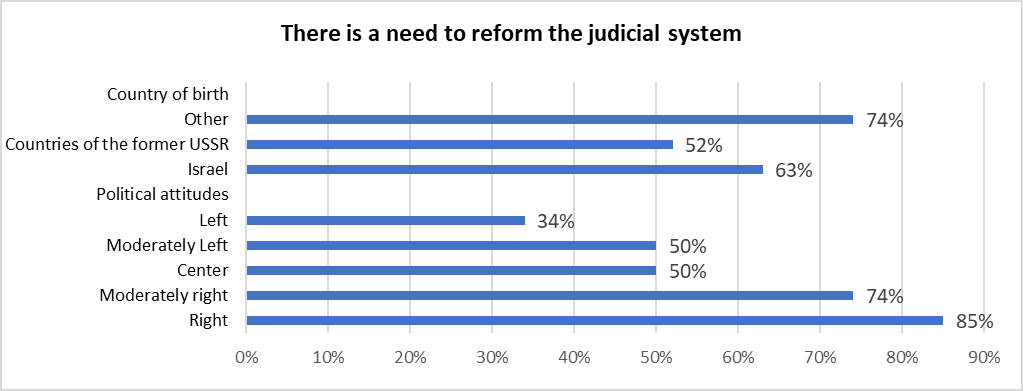
63% of population is convinced in the need for legal reform, and among those who have its own opinion on this matter — 72%. Less often than others, respondents born in the countries of the former USSR speak of such a need (52% versus 63% and 74% born in Israel and other countries, respectively), who are also more likely than others to report not knowing the answer to this question (19% versus 6% and 12%, respectively). (Table 2.1. Diagram 2)
In general, do you think there is a need for any reform of Israel legal system or not?
| From those who have an opinion | Total by sample | |
|---|---|---|
| 72% | 63% | There is a need |
| 28% | 25% | No need |
| — | 12% | Don’t know |
| 100% | 100% | Total |
(Table 2)
If we talk about political attitudes, then we should note the trend of strengthening the demand for judicial system reforming from the far left to the far right. Thus, the results of calculating the Pearson correlation coefficient (-0.94) between political attitudes (from right to left) and the assessment of judicial reform need indicate a strong negative linear relationship between these variables. This means that with an increase in political attitude from right to left, the proportion of respondents who believe that judicial reform is necessary decreases, while the proportion of respondents who believe that such a need is absent increases. The correlation coefficient of -0.94 suggests that this association is high and statistically significant.
Also of interest is the fact that people born in the countries of the former USSR see less than others the need for reform (52% agree with this against 63% and 74% born in Israel and other countries), more often — that there is no need for reform (29% against 26% and 20%, respectively) and more often than others find it difficult to answer this question (19% against 12% and 6%, respectively). Given the lowest values of the index of interest in this group in the topic of judicial reform, the data on the lowest awareness in the topic seem quite logical.
Distribution of responses regarding the legal reform need (by age, country of birth and political position):
| Total | Don’t know | No need | There is a need | Age |
|---|---|---|---|---|
| 100% | 14% | 18% | 68% | 17-30 |
| 100% | 16% | 26% | 58% | 31-49 |
| 100% | 9% | 30% | 61% | 50-64 |
| 100% | 5% | 28% | 67% | 65+ |
| Country of birth | ||||
| 100% | 12% | 25% | 63% | Israel |
| 100% | 19% | 29% | 52% | Countries of the former USSR |
| 100% | 6% | 20% | 74% | Other |
| Political attitudes | ||||
| 100% | 7% | 8% | 85% | Right |
| 100% | 10% | 16% | 74% | Moderately right |
| 100% | 15% | 35% | 50% | Center |
| 100% | 15% | 35% | 50% | Moderately Left |
| 100% | 16% | 50% | 34% | Left |
| 100% | 36% | 42% | 22% | Others |
Need for reform: birthplace
| Born in Israel |
63.0%
|
|---|---|
| Born in the USSR |
52.0%
|
| Other countries |
74.0%
|
Original chart
Need for reform: political views
| Right |
85.0%
|
|---|---|
| Moderate right |
74.0%
|
| Centre |
50.0%
|
| Moderate left |
50.0%
|
| Left |
34.0%
|
Original chart
Diagram 2.
The fact that Israel justice system is not effective or little effective is reported by 60% of respondents in total by sample, and 67% of those who have an opinion on this matter.
In your opinion, how effective or ineffective does the Israel justice system work today?
| From those who have an opinion | Total by sample | |
|---|---|---|
| 67% | 23% | Not effective at all |
| 37% | Little effective | |
| 33% | 24% | Quite effective |
| 5% | Fully effective | |
| 11% | Don’t know | |
| 100% | 100% | Total |
(Table 3)
In estimates of justice system effectiveness, as in the previous question, respondents born in the countries of the former USSR give the most different answers. They talk more often about its effectiveness (35% versus 19% and 24% among those born in Israel and other countries), and less often about non-effectiveness (14% versus 23% and 33%, respectively).
Assessments of judicial system effectiveness are also related to political attitudes. From respondents with right-wing views to respondents with left-wing performance scores, this is clearly seen in Diagram 3.
- Assessing the effectiveness of Israel justice system?
| Total | Don’t know | Not effective at all | Little effective | Quite effective | Fully effective | Country of birth |
|---|---|---|---|---|---|---|
| 100% | 11% | 23% | 37% | 24% | 5% | Israel |
| 100% | 13% | 14% | 36% | 35% | 2% | Countries of the former USSR |
| 100% | 8% | 33% | 37% | 19% | 3% | Other |
| Political attitudes | ||||||
| 100% | 8% | 39% | 39% | 13% | 1% | Right |
| 100% | 8% | 24% | 47% | 19% | 2% | Moderately right |
| 100% | 12% | 14% | 36% | 33% | 5% | Center |
| 100% | 6% | 7% | 35% | 40% | 12% | Moderately Left |
| 100% | 16% | 7% | 21% | 46% | 10% | Left |
| 100% | 35% | 27% | 20% | 11% | 7% | Others |
(Table 3.1)
Perceived court efficiency
| Right |
Fairly or fully effective14.0%
Slightly effective or ineffective78.0% |
|---|---|
| Moderate right |
Fairly or fully effective21.0%
Slightly effective or ineffective71.0% |
| Centre |
Fairly or fully effective38.0%
Slightly effective or ineffective50.0% |
| Moderate left |
Fairly or fully effective52.0%
Slightly effective or ineffective42.0% |
| Left |
Fairly or fully effective56.0%
Slightly effective or ineffective28.0% |
Original chart
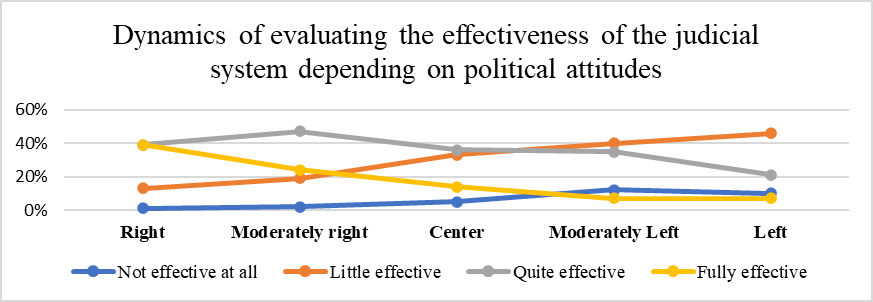
Diagram 3.
From the data presented in Table 4, it can be seen that most often respondents agree that there is excessive bureaucracy, procrastination and many delays in judicial system, as reported by 61% of respondents. The second most important problem is judicial system opacity (36%), and about a third of the respondents are convinced that some of the judges are not professional enough, and some judges are corrupt.
To what extent do you agree or disagree with each of the following statements about the characteristics of the modern legal system?
| Index | Total | Don’t know | Agree | Agree partly | Disagree | Characteristics |
|---|---|---|---|---|---|---|
| 68 | 100% | 10% | 61% | 24% | 5% | The judicial system has excessive bureaucracy, procrastinations, many delays |
| 27,5 | 100% | 16% | 34% | 29% | 21% | Some judges are not professional enough |
| 16,5 | 100% | 17% | 32% | 23% | 27% | Some judges are corrupt |
| 28,5 | 100% | 13% | 36% | 29% | 22% | The judicial system is not transparent enough |
| -0,5 | 100% | 18% | 19 | 29% | 34% | The judicial system cannot withstand pressure from Knesset and government |
| 3 | 100% | 15% | 26% | 24% | 35% | The judicial system does not control the democracy of political decisions |
Table 4
We conducted a more detailed assessment of problematic nature of various aspects of legal system functioning based on the calculation of problem index[1]. Diagram 4 shows the calculations results showing that the greatest claim of Israelis against judicial system is related to the bureaucracy and slowness of the system. As for its ability to withstand pressure from Knesset and control the democratic nature of political decisions, this aspect of its functioning rather satisfies the bulk of the population and is certainly not among the key problems.
[1] Index calculation formula: n1 + ½ n2 – n3.
Judicial system problem indices
| Bureaucracy and delays | +68.0 index pts |
|---|---|
| Insufficient professionalism | +27.5 index pts |
| Corruption | +16.5 index pts |
| Lack of transparency | +28.5 index pts |
| Knesset and government pressure | -0.5 index pts |
| Scrutiny of democratic decisions | +3.0 index pts |
Original chart
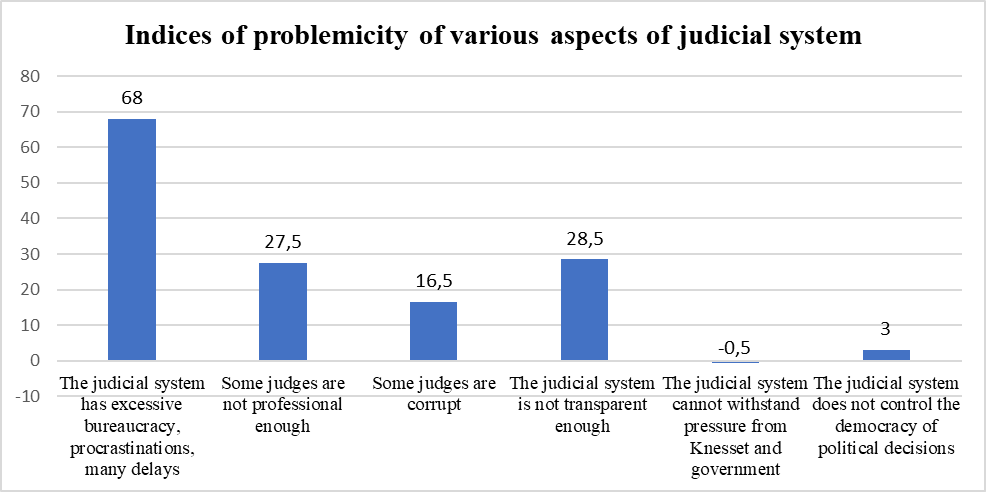
Diagram 4.
The diagram of judicial system problems indices also shows an interesting, in our opinion, thing. Netanyahu’s government justifies the need for judicial reform topics to curb the excessive influence of the judiciary on the laws adoption. The ruling coalition members explain that they seek to transfer more power from an unelected panel of judges in favor of elected officials. This justification comes with the reference to international experience, but not to the needs and demands of the Israel population — indices calculated by us based on judicial system problems estimates given by respondents show that the main claim to the courts is excessive bureaucracy, procrastination and many delays. Issues related to current judicial system control over political decisions, and in general, its relations with the political system are called the least common problem — this problem was updated only in connection with the new reform promotion. Therefore, it is quite logical that the reform, at least, did not cause the population support, but gave rise to regard it as a means of solving private problems.
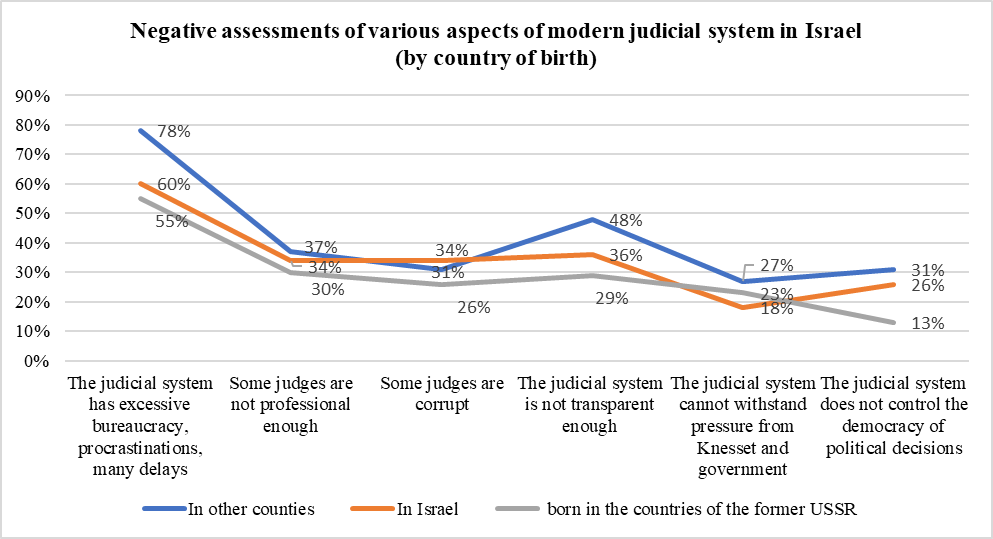
It is noteworthy that, according to most parameters, the smallest share of claims to judicial system is registered with respondents born in the countries of the former USSR. (Table 4.1.) In particular, in Diagram 5, we see that the gray curve characterizing the dynamics of responses of respondents from the countries of the former USSR is located below others. This is a visual reflection of the lowest values of negative assessments of modern Israel judicial system among the «conditionally Russian-speaking» population.
Distribution of «Agree» responses regarding each of the following statements about the characteristics of the modern legal system? (by country of birth)
| Other countries | Israel | Countries of the former USSR | |
|---|---|---|---|
| 78% | 60% | 55% | The judicial system has excessive bureaucracy, procrastinations, many delays |
| 37% | 34% | 30% | Some judges are not professional enough |
| 31% | 34% | 26% | Some judges are corrupt |
| 48% | 36% | 29% | The judicial system is not transparent enough |
| 27% | 18% | 23% | The judicial system cannot withstand pressure from Knesset and government |
| 31% | 26% | 13% | The judicial system does not control the democracy of political decisions |
Table 4.1.
Criticisms of courts: comparing groups
| Bureaucracy and delays |
Born in Israel60.0%
Born in the USSR55.0% |
|---|---|
| Insufficient professionalism |
Born in Israel34.0%
Born in the USSR30.0% |
| Corruption |
Born in Israel34.0%
Born in the USSR26.0% |
| Lack of transparency |
Born in Israel36.0%
Born in the USSR29.0% |
| Knesset and government pressure |
Born in Israel18.0%
Born in the USSR23.0% |
| Scrutiny of democratic decisions |
Born in Israel26.0%
Born in the USSR13.0% |
Original chart
Criticisms among those born in other countries
| Bureaucracy and delays |
78.0%
|
|---|---|
| Insufficient professionalism |
37.0%
|
| Corruption |
31.0%
|
| Lack of transparency |
48.0%
|
| Knesset and government pressure |
27.0%
|
| Scrutiny of democratic decisions |
31.0%
|
Original chart
Diagram 5.
With the above-mentioned responses characterizing dissatisfaction with justice system functioning, it is predictable that the values of distrust in it prevail significantly over the values of trust. More than half of the respondents report different degrees of distrust to the courts (moreover, every fifth — in a categorical form — does not trust at all). About different degrees of trust — only a few more than a third and only 9% of respondents fully trust them.
5. How much do you currently trust or distrust the judiciary?
| In total, among those who have an opinion | In total, overall by sample | By sample as a whole | |
|---|---|---|---|
| 60% | 55% | 21% | Completely distrust |
| 34% | Rather not trust | ||
| 40% | 37% | 28% | Rather trust |
| 9% | Trust fully | ||
| — | 8% | Don’t know | |
| 100% | 100% | Total |
Table 5
As stated above, respondents born in the countries of the former USSR have fewer other claims to judicial system, have the lowest level of interest in the topic of reform, awareness of it, and, judging by the data presented in table 5.1, have the highest level of confidence in this institution.
This is more clearly reflected by the indices of (dis)trust for each of the population groups, calculated as the difference between varying degrees of positive and negative responses. Negative index values reflect a prevailing distrust of courts. Therefore, in the case of negative ratings, it is more correct to talk about the distrust index.
The index of distrust of courts among respondents born in the countries of the former USSR is -7, while among respondents born in Israel and in other countries is 2.5 and 4 times higher (-17 and -29, respectively).
5.1. How much do you currently trust or distrust the judiciary? (Country of birth distribution)
| Total | Index of (dis)trust | Don’t know | Distrust | To a small extent | To a large extent | Trust fully | Country of birth |
|---|---|---|---|---|---|---|---|
| 100% | -17 | 9% | 21% | 33% | 27% | 10% | Israel |
| 100% | -7 | 7% | 10% | 40% | 40% | 3% | Countries of the former USSR |
| 100% | — 29 | 3% | 27% | 36% | 26% | 8% | Other countries |
Table 5.1
Trust balance: birthplace
| Born in Israel | -17.0 index pts |
|---|---|
| Born in the USSR | -7.0 index pts |
| Other countries | -29.0 index pts |
Original chart
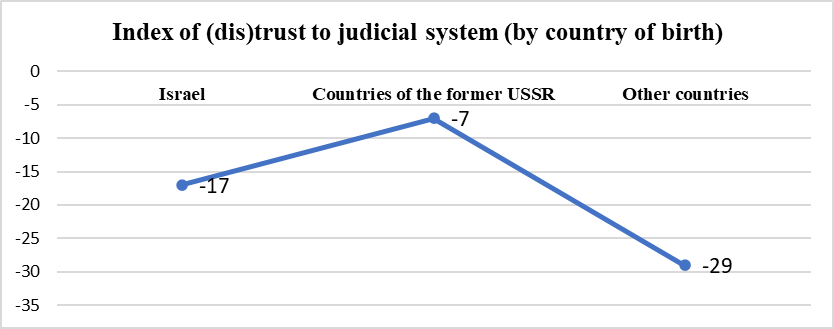
Diagram 5.1.
Recalculating the trust balance from original Table 5.2 gives −32 points for ages 17–30, −19 for 31–49, −12 for 50–64 and +10 for respondents aged 65+. The balance is more favourable in older groups. The source prose’s 17–39 boundary and −37/−10 values disagree with the table; its explicit shares are used here. The original remains available for comparison.
Trust balance: age
| 17–30 | -32.0 index pts |
|---|---|
| 31–49 | -19.0 index pts |
| 50–64 | -12.0 index pts |
| 65+ | +10.0 index pts |
Original chart
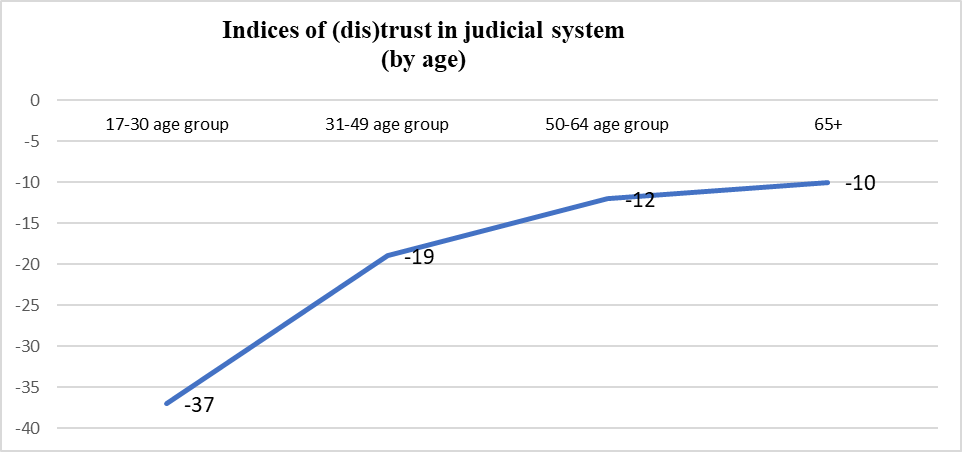
Diagram 5.2.
How much do you currently trust or distrust the judiciary? (by age, political attitudes, religiosity)
| Total | Distrust | To a small extent | To a large extent | Trust fully | Don’t know | Age |
|---|---|---|---|---|---|---|
| 100% | 25% | 35% | 21% | 7% | 12% | 17-30 |
| 100% | 20% | 35% | 29% | 7% | 9% | 31-49 |
| 100% | 25% | 28% | 25% | 16% | 6% | 50-64 |
| 100% | 10% | 34% | 42% | 12% | 2% | 65+ |
| Political attitudes | ||||||
| 100% | 39% | 40% | 13% | 1% | 7% | Right |
| 100% | 20% | 42% | 29% | 5% | 4% | Moderately right |
| 100% | 13% | 24% | 38% | 14% | 11% | Center |
| 100% | 1% | 28% | 44% | 22% | 5% | Moderately Left |
| 100% | 7% | 24% | 40% | 19% | 10% | Left |
| 100% | 29% | 26% | 11% | 7% | 27% | Others |
| Religiosity — secularism | ||||||
| 100% | 10% | 32% | 36% | 16% | 6% | Secular, non-religious |
| 100% | 23% | 44% | 26% | 3% | 4% | Observing traditions |
| 100% | 48% | 29% | 14% | 2% | 7% | Knitted kippah |
| 100% | 60% | 32% | 4% | 0% | 4% | Ultra-religious |
| 100% | 14% | 25% | 29% | 14% | 18% | Arab Christian, Muslim |
Table 5.2.
According to political attitudes, the Right Wing differs most of all in distrust of courts, and the Left Wing, whose representatives have a positive index, has a positive value. (Table 5.2. Diagram 5.3)
Trust balance: political views
| Right | -65.0 index pts |
|---|---|
| Moderate right | -28.0 index pts |
| Centre | +15.0 index pts |
| Moderate left | +37.0 index pts |
| Left | +28.0 index pts |
| Other | -37.0 index pts |
Original chart
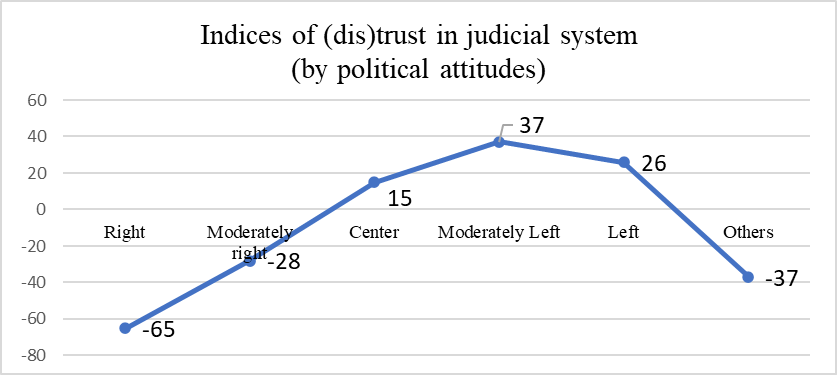
Diagram 5.3.
It is also interesting that the secular part of the population is characterized by trust rather than distrust of courts, as evidenced by the positive value of the corresponding index (10), while in all other groups of respondents the values of this index are either in the region of zero (4 — Christian Arabs, Muslims) or sharply negative (- 38 — observing traditions; -61 — Knitted kippah, — 88 — ultra-religious). (Diagram 5.4.)
Trust balance: religiosity
| Secular | +10.0 index pts |
|---|---|
| Traditional | -38.0 index pts |
| Religious | -61.0 index pts |
| Ultra-Orthodox | -88.0 index pts |
| Arab population | +4.0 index pts |
Original chart
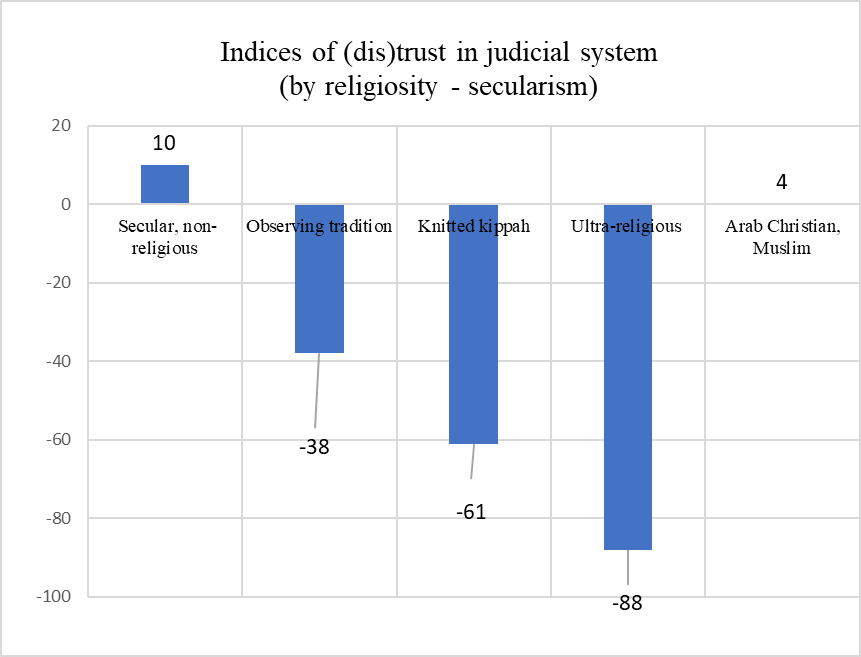
Diagram 5.4.
A wide range of responses across different groups, which is especially clearly demonstrated by the values of indices and their visualization in diagrams («spread of peaks»), indicates a deep split in society, at least in studied groups and topic. However, of course, behind this topic and behind these disagreements there are deeper contradictions that cause the risks of social and political destabilization.
Of course, the distrust of the population majority towards the courts (Table 5), adding the courts assessment as not effective or little effective (Table 2), is an indicator of the judicial system crisis state, and it is part of the crisis of state and political power system. Indeed, in a democratic society (to which Israel declares itself), the judiciary is one of the three branches of state power. In turn, the state and political system represent various aspects of one common system of power, management and settlement of internal and external affairs of the state, jointly forming legal, political and managerial processes within the state.
To what extent does such logic correspond to process understanding of the population? — Almost half of the respondents (49%) unequivocally declare the presence of a deeply systemic crisis in Israel political system, and only 10% declare its absence. A third of the respondents unequivocally agrees with the crisis presence, but do not consider it systemic, but one of the many political crises that have been successfully overcome, and another 16% are convinced that this crisis is the result of a global crisis of parliamentary democracies.
To what extent do you agree or disagree with each of the following statements regarding the current political situation in Israel:
| Total | Index | Don’t know | Disagree | Agree partly | Agree completely | |
|---|---|---|---|---|---|---|
| 100% | 27 | 10% | 23% | 34% | 33% | This is one of many political crises in Israel that have been overcome in the past |
| 100% | 47.5 | 9% | 15% | 27% | 49% | This is a deep systemic crisis |
| 100% | -7,5 | 17% | 38% | 29% | 16% | The crisis is part of the global crisis of parliamentary democracies |
| 100% | -44.5 | 10% | 63% | 17% | 10% | There is no political crisis in Israel today |
Table 6
Somewhat, although not much differently, the answers hierarchy about the presence or absence of one or another crisis of political system in Israel will look if we calculate the indices of the «crisis of the system.»
Applying one consistent index formula—full agreement + 0.5 × partial agreement − disagreement—gives the highest value to the statement about a deep systemic crisis: +47.5 percentage points. The statement about one of the political crises that can be overcome has an index of +27 points.
Regarding the statement «The crisis is part of the global crisis of parliamentary democracies,» disagreement prevails among the respondents; its index is -7.5.
And only a small proportion of respondents say that there is no political crisis, as evidenced by a significant prevalence of negative estimates of the indicated index (-44.5). (Table 6).
So, the vast majority of respondents agree that a political crisis exists in Israel, and the main division in its estimates concerns whether it is a manifestation of deeper systemic crisis or whether it is an «ordinary» crisis. Moreover, media declares a topic about the constitutional crisis in Israel presence, which implies an event in which the state acts in a way that contradicts its constitution[1], thereby changing the state essence and damaging democracy
[1] Despite the Constitution absence in Israel, it is possible to talk about such a crisis, since in practice Supreme Court, in its interpretation of basic laws, in practice drew up a constitution.