

 Global connections
 Research & archive









Historical material. Dates, proposals and invitations refer to the time of the original publication.
So, in Israelis opinion, the main participation of Israel in the situation around Russian-Ukrainian conflict is associated with the humanitarian assistance provision to victims, the repatriates’ reception, and granting political asylum. The actual military aspect is manifested in the answers minimally.
To what extent, according to Israelis, this practice is the norm for Israel in international conflicts? To what extent does this state of affairs satisfy Israelis?
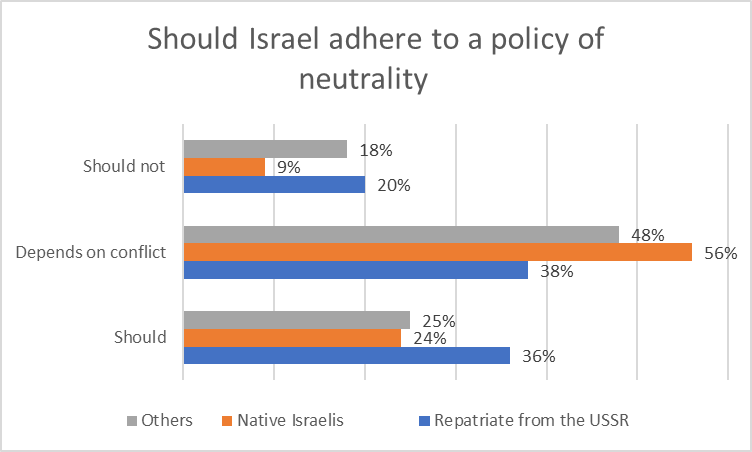
Answering the question whether or not Israel should be a neutral country in attitude to military conflicts taking place in other countries, 28% of respondents said that Israel should adhere to neutrality (mainly repatriates from the USSR — 36% versus 24-25% from other groups). The bulk of respondents (50%) believe that Israel needs to take this position depending on the circumstances, which is fundamentally more often spoken by native Israelis (56% of them against 38-48% in other groups).
Repatriates from the USSR are much less often adhere to a “situational” approach and are more focused on neutrality.
Foreign-policy principles
Neutrality: principle or circumstances
| Born in Israel |
Should be neutral24.0%
Depends on the conflict56.0% |
|---|---|
| Born in the USSR |
Should be neutral36.0%
Depends on the conflict38.0% |
| Other countries |
Should be neutral25.0%
Depends on the conflict48.0% |
Original chart
The «situational» position is held more by representatives of the right wing, and the neutrality-oriented — by the ultra-left and ultra-right.
Left and ultra-left wings are more categorical that Israel should not be a neutral country (21-22% versus 8-13% in other groups singled out for political views).
Do you think Israel should or should not be a neutral country regarding to military conflicts taking place in other countries?
| Political attitudes | Country of birth | By sample in total | |||||||
|---|---|---|---|---|---|---|---|---|---|
| Ultra-right | Right | Center | Left | Ultra-left | Others | Israel | USSR | ||
| 38% | 25% | 22% | 20% | 24% | 25% | 24% | 36% | 28% | Should |
| 42% | 61% | 55% | 54% | 45% | 48% | 56% | 38% | 50% | Depends on conflict |
| 13% | 8% | 13% | 21% | 22% | 18% | 9% | 20% | 13% | Should not |
| 7% | 6% | 10% | 5% | 9% | 9% | 11% | 6% | 9% | Do not know |
| 100% | 100% | 100% | 100% | 100% | 100% | 100% | 100% | 100% | Total |
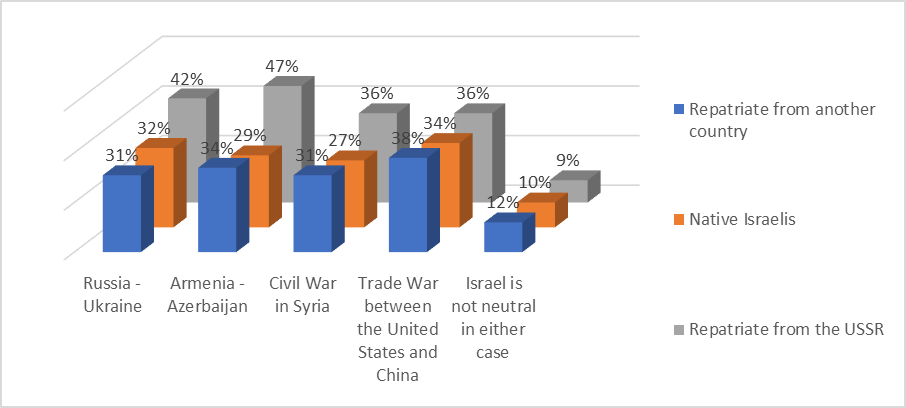
In Israelis opinion, neutrality is a characteristic practice for Israel: only 10% of respondents say that Israel is not neutral in any of the military conflicts listed below (Russia — Ukraine, Armenia — Azerbaijan, Civil War in Syria, Trade War between the United States and China). Meanwhile, about a third of respondents on average believe that Israel does not adhere to neutrality in these situations.
In which of the following conflicts does Israel currently adhere to neutral policy?
| Repatriate from another country | Native Israelis | Repatriate from the USSR | By sample in total | |
|---|---|---|---|---|
| 31% | 32% | 42% | 33% | Russia — Ukraine |
| 34% | 29% | 47% | 34% | Armenia — Azerbaijan |
| 31% | 27% | 36% | 30% | Civil War in Syria |
| 38% | 34% | 36% | 36% | Trade War between the United States and China |
| 12% | 10% | 9% | 10% | Israel is not neutral in either case |
| 28% | 28% | 15% | 27% | Do not know |
Repatriates from the USSR mention that Israel adheres to neutrality more often (36-47% versus 27-34% in other groups).
In which of the following conflicts does Israel currently adhere to neutral policy?
Where Israel is perceived as neutral
| Russia–Ukraine |
Born in Israel32.0%
Born in the USSR42.0% |
|---|---|
| Armenia–Azerbaijan |
Born in Israel29.0%
Born in the USSR47.0% |
| Syrian civil war |
Born in Israel27.0%
Born in the USSR36.0% |
| US–China trade war |
Born in Israel34.0%
Born in the USSR36.0% |
| None of these |
Born in Israel10.0%
Born in the USSR9.0% |
Original chart
On political attitudes, the ultra-left wing representatives less often than others report about Israel’s neutral position in each of the listed international conflicts (14-33% versus 28-44% in other groups), and they most often answer that Israel is not neutral in any of the listed cases (18% versus 7-12% in other groups)
In which of the following conflicts does Israel currently adhere to neutral policy?
| Ultra-right | Right | Center | Left | Ultra-left | |
|---|---|---|---|---|---|
| 33% | 39% | 28% | 41% | 33% | Russia — Ukraine |
| 34% | 38% | 36% | 37% | 31% | Armenia — Azerbaijan |
| 30% | 37% | 29% | 32% | 24% | Civil War in Syria |
| 38% | 44% | 40% | 42% | 14% | Trade War between the United States and China |
| 7% | 8% | 12% | 11% | 18% | Israel is not neutral in either case |
| 31% | 21% | 25% | 18% | 24% | Do not know |
There is no more or less general opinion on sufficiency of Israel’s humanitarian assistance to military conflicts victims. One in five found it difficult to answer this question. However, the relative majority of respondents (39%) believe that Israel’s humanitarian assistance is sufficient, and 29% — «more or less sufficient».
Assistance to Ukraine
Is humanitarian aid sufficient?
| Insufficient |
17.0%
|
|---|---|
| More or less sufficient |
29.0%
|
| Sufficient |
34.0%
|
| Do not know |
20.0%
|
Original chart
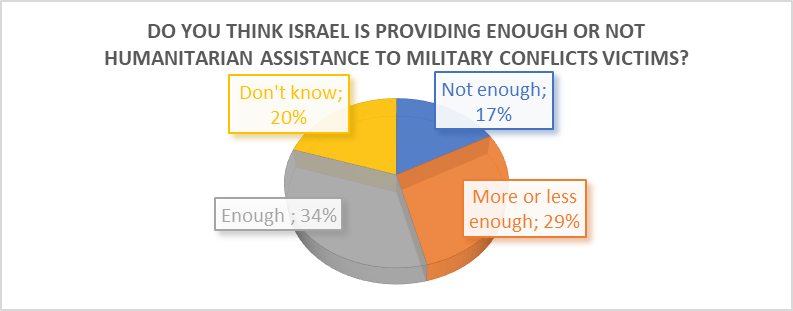
Respondents born in the USSR speak of the humanitarian aid lack less often than others (12% versus 17-18% in other groups), more often than others reporting its sufficiency (43% versus 33-35%). The answers in other groups are not fundamentally different from each other.
Does Israel use humanitarian aid enough to reduce damage to civilians during international conflicts?
| Other | Born in Israel | Born in the USSR | |
|---|---|---|---|
| 17% | 18% | 12% | Not enough |
| 27% | 29% | 30% | More or less enough |
| 35% | 33% | 43% | Enough |
| 21% | 20% | 15% | Do not know |
| 100% | 100% | 100% | Total |
Respondents with ultra-left and left-wing political attitudes are significantly more often than others say that the humanitarian assistance provided by Israel is insufficient (37% and 27% against 9-18% in other groups). In turn, the far right and right are more often than others convinced of its sufficiency (47% and 39%).
Does Israel provide enough or not humanitarian assistance to military conflicts victims?
Aid assessments and political views
| Far right |
Insufficient9.0%
Sufficient47.0% |
|---|---|
| Right |
Insufficient12.0%
Sufficient39.0% |
| Centre |
Insufficient18.0%
Sufficient29.0% |
| Left |
Insufficient27.0%
Sufficient24.0% |
| Far left |
Insufficient37.0%
Sufficient17.0% |
Original chart
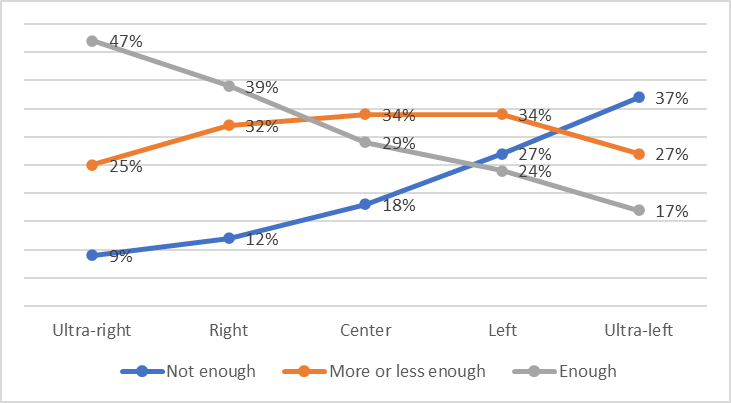
| Ultra-right | Right | Center | Left | Ultra-left | Political attitudes |
|---|---|---|---|---|---|
| 9% | 12% | 18% | 27% | 37% | Not enough |
| 25% | 32% | 34% | 34% | 27% | More or less enough |
| 47% | 39% | 29% | 24% | 17% | Enough |
| 19% | 17% | 19% | 15% | 19% | Do not know |
| 100% | 100% | 100% | 100% | 100% | Total |
Regarding Israel’s peacekeeping prospects, there is a significant split in opinions among the respondents. Only 20% of them are convinced that Israel is ready to take a course towards peace within the framework of its foreign policy today, 35% — which is partially ready, and 27% — which is not ready.
Native Israelis more often claim about Israel’s unreadiness to pursue peace as part of its foreign policy and less often about its readiness.
In your opinion, is Israel ready or not ready today to take a course towards striving for peace within the framework of its foreign policy?
| Country of birth | By sample in total | |||
|---|---|---|---|---|
| Other | Israel | USSR | ||
| 20% | 23% | 30% | 27% | Not ready |
| 37% | 30% | 35% | 35% | Partially ready |
| 25% | 27% | 17% | 20% | Ready |
| 18% | 20% | 18% | 18% | Do not know |
| 100% | 100% | 100% | 100% | Total |
Taking into account political attitudes, it should be noted that from ultra-left to centrists and then to ultra-right, from 47% to 13%, the proportion of answers decreases that Israel is not ready today to take a course towards peace within the framework of its foreign policy. The values of readiness for such a course, although not to such extent, nevertheless increase from 10-13 to 29% — from ultra-left to ultra-right.
Scope for mediation
Readiness for a peaceful foreign policy
| Far right |
Not ready13.0%
Ready29.0% |
|---|---|
| Right |
Not ready23.0%
Ready21.0% |
| Centre |
Not ready35.0%
Ready15.0% |
| Left |
Not ready42.0%
Ready10.0% |
| Far left |
Not ready47.0%
Ready13.0% |
Original chart
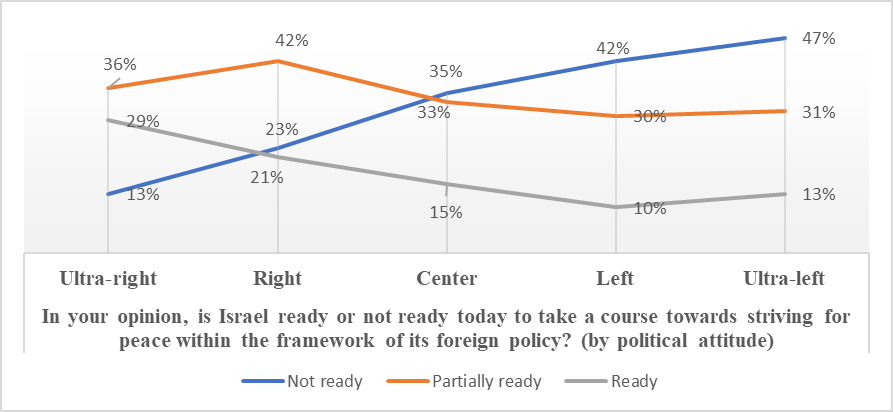
In your opinion, is Israel ready or not ready today to take a course towards striving for peace within the framework of its foreign policy?
| Ultra-right | Right | Center | Left | Ultra-left | |
|---|---|---|---|---|---|
| 13% | 23% | 35% | 42% | 47% | Not ready |
| 36% | 42% | 33% | 30% | 31% | Partially ready |
| 29% | 21% | 15% | 10% | 13% | Ready |
| 22% | 14% | 17% | 18% | 9% | Do not know |
| 100% | 100% | 100% | 100% | 100% | Total |
The overwhelming majority of respondents (54%) agree that the state of Israel should remain neutral in international conflicts in order to maintain its relations with other countries and pursue an independent policy. 24% of respondents disagree with this and another 22% found it difficult to answer this question.
The answers to this question do not differ among respondents from groups that differ in country of birth.
Should or should not the state of Israel remain neutral in international conflicts in order to maintain its relations with other countries and pursue an independent policy?
| Country of birth | By sample in total | |||
|---|---|---|---|---|
| Other | Israel | USSR | ||
| 53% | 54% | 53% | 54% | Should |
| 25% | 24% | 24% | 24% | Should not |
| 22% | 22% | 23% | 22% | Do not know |
| 100% | 100% | 100% | 100% | Total |
Respondents of right and ultra-right political affiliations are more unanimous in the position that Israel needs a focus on neutrality, (61-62% versus 38-49% in other groups), and the greatest disagreement on this issue is in the left wing, whose representatives are also more than others speak out for the fact that Israel should not remain neutral (42% versus 19-31% in other groups).
Should Israel remain neutral in international conflicts in order to maintain relations with other countries and pursue an independent policy?
Neutrality and an independent policy
| Far right |
Should maintain neutrality62.0%
Should not19.0% |
|---|---|
| Right |
Should maintain neutrality61.0%
Should not19.0% |
| Centre |
Should maintain neutrality48.0%
Should not25.0% |
| Left |
Should maintain neutrality38.0%
Should not42.0% |
| Far left |
Should maintain neutrality49.0%
Should not31.0% |
Original chart
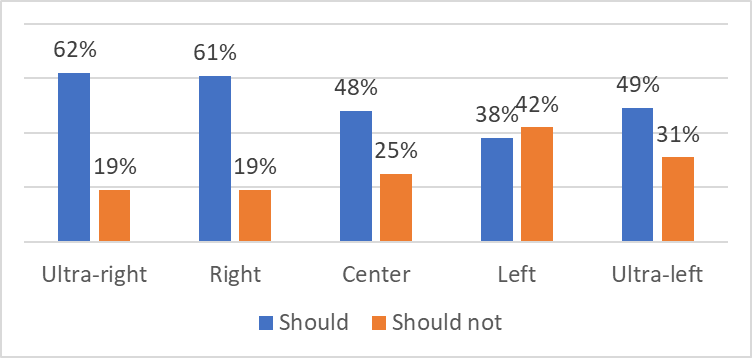
Should Israel remain neutral in international conflicts in order to maintain its relations with other countries and pursue an independent policy?
| Ultra-right | Right | Center | Left | Ultra-left | Political attitudes | |
|---|---|---|---|---|---|---|
| 62% | 61% | 48% | 38% | 49% | Should | |
| 19% | 19% | 25% | 42% | 31% | Should not | |
| 19% | 20% | 27% | 20% | 20% | Do not know | |
| 100% | 100% | 100% | 100% | 100% | Total | |
In such cases where Israel refuses to supply weapons to countries in a state of military conflict, estimates of this position reasons are equally divided. The fact that this is done to comply with neutrality is reported by 42% of respondents, for other reasons — 40%.
Respondents born in the USSR are a little more convinced than others that this is done in order to comply with neutrality (48% versus 41-42% in other groups). Those who find it difficult to answer this question are most registered among native Israelis (19% versus 14%).
The reasons why Israel refuses to supply weapons to countries in a state of military conflict
| Country of birth | By sample in total | |||
|---|---|---|---|---|
| Other | Israel | USSR | ||
| 42% | 41% | 48% | 42% | Maintains neutrality |
| 44% | 40% | 41% | 40% | Other reasons |
| 14% | 19% | 11% | 18% | Do not know |
| 100% | 100% | 100% | 100% | Total |
Left and center political wings representatives are less often than others believe that Israel refuses to supply weapons in order to maintain neutrality (36-37%), while ultra -left, right and ultra -right talk about it more often in equal measure (45-47%).
The reasons why Israel refuses to supply weapons to countries in a state of military conflict, by political attitude
| Ultra-right | Right | Center | Left | Ultra-left | ||
|---|---|---|---|---|---|---|
| 47% | 46% | 36% | 37% | 45% | Maintains neutrality | |
| 37% | 40% | 43% | 50% | 37% | Other reasons | |
| 16% | 14% | 21% | 13% | 18% | Do not know | |
| 100% | 100% | 100% | 100% | 100% | Total | |