
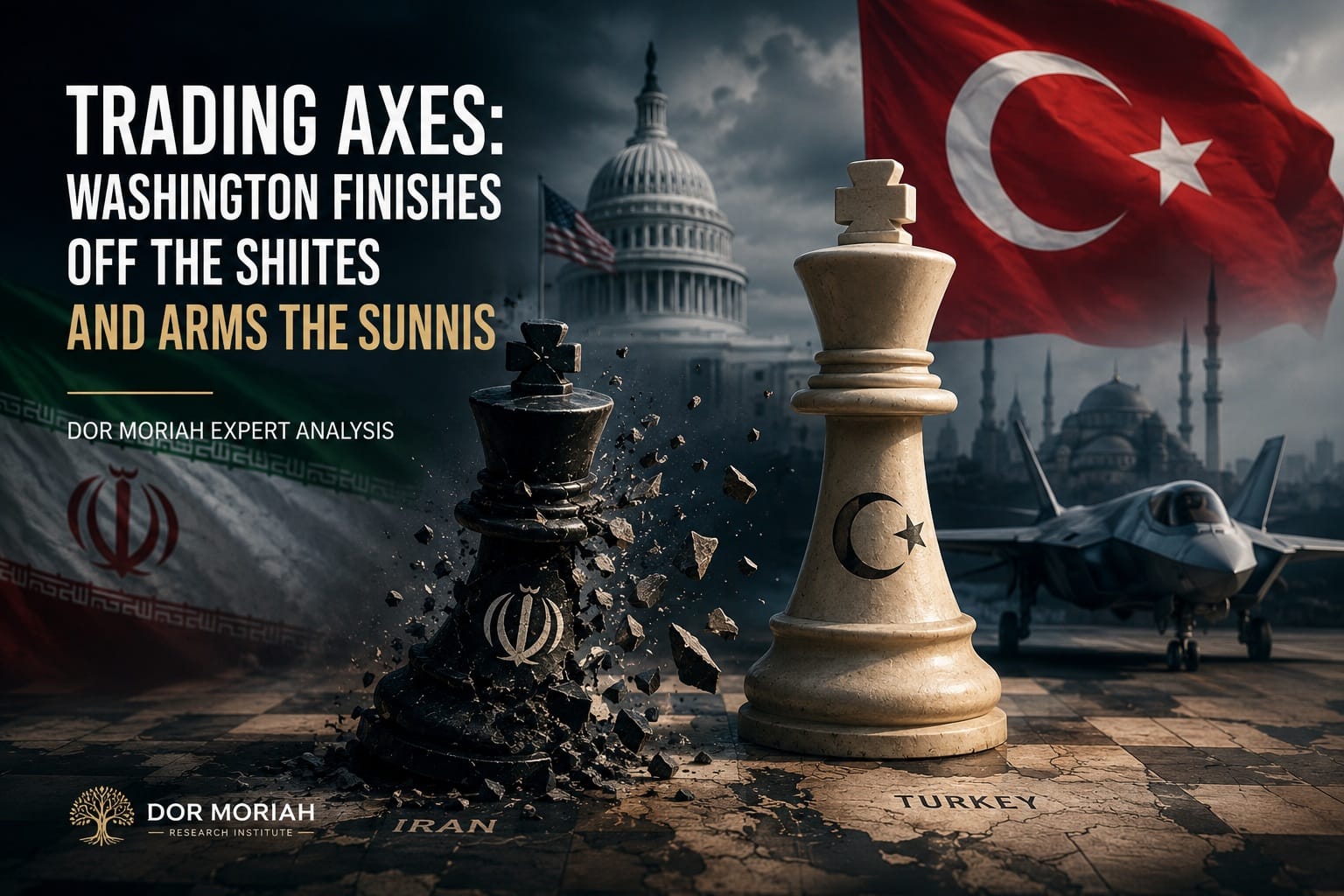
Trump is dismantling the Iranian axis — and with the same motion strengthening the Turkish one, which openly names Israel a threat
On June 24, the Trump administration notified Congress of its intent to sell Turkey a batch of General Electric F110 aircraft engines for more than $700 million. The engines are meant for KAAN — Turkey’s fifth-generation fighter, the flagship of its national defense industry. Two weeks later, on July 7–8, Ankara hosts the NATO summit, where the alliance promises “tens of billions” in new defense contracts. And a few days before that, on June 26–27, President Erdogan delivered a line worth reading slowly: “The genocidal, occupying, expansionist ideology called Zionism threatens not only me… it threatens everyone.” And he added: “When we wage the struggle against Zionism, we do it for our own survival and the survival of our nation.”
Put the three dates together, and a logic emerges that the Israeli debate has yet to name. With one hand Washington is dismantling the Shiite axis built against Israel — and with the other it is arming the Sunni-Turkish axis, which folds anti-Zionism into the category of Turkey’s state self-preservation. This is not a double game and not a betrayal. It is a trade of axes: one axis of threat is put out, the vacated place is taken by another, and both operations are signed off from the same office.
The fall of the Shiite axis
Eighteen months ago the Iranian axis looked like the load-bearing structure of the region’s entire anti-Israel architecture. Tehran financed and armed Hezbollah, Hamas, and the Houthis, building an arc of proxies from Lebanon to Yemen. Trump’s “maximum pressure” strategy aimed at exactly this — to exhaust Iran economically and politically, cutting it off from the means to sustain its proxies.
By mid-2026 this axis is broken. Hezbollah has been bled white, Iran’s military program set back by years, Tehran’s patronage network shrunken. In terms of the immediate threat, this is an Israeli victory. But victory over one axis does not mean the threat has vanished — it means the threat has rotated. And the Dor Moriah national survey (May–June 2026, 1,007 respondents, sampling error ±3.1%) shows that the public already senses this rotation, however dimly.
In the scenario where Turkey gains a significant role amid possible U.S.–Iran talks on a regional settlement, 39.3% of Israelis answered that it would strengthen Ankara’s position, raising both the risks to Israel’s security and the influence of hostile Islamist forces. Another quarter see risks that international guarantees might contain. In other words, the public intuitively grasps it: into the place of the departing Shiite patron steps a Sunni-Turkish one — and that is not relief but replacement.
The price of neutrality
Why is Washington paying Ankara in advance, and so generously? Trump gave the answer himself, in the Oval Office, standing beside the NATO secretary general. Erdogan, by the president’s account, was the leading candidate to enter the war on Iran’s side — “because he’s not a big fan of Israel.” Trump asked him to stay out. Erdogan stayed out. And now Washington is paying the bill: F110 engines up front, talks on Turkey’s return to the F-35 program (from which it was expelled in 2019 for buying Russian S-400s), and the ceremonial frame of the NATO summit as the capstone.
“I just want their loyalty,” Trump let slip about the Turks. That is the formula of the trade in its purest form. Turkish neutrality in the Iran war is paid for with Turkish rearmament after it.
The split inside the administration is telling. Vice President Vance speaks of Turkey’s possible return to the F-35 and of “confirming that obligations have been met” — even though the S-400s still sit on Turkish soil and no certified guarantees of non-acquisition exist. Secretary of State Rubio is blunter: “we don’t have a choice, because this is governed by law.” When the vice president and the secretary of state hold mutually exclusive positions on the same question, it is not chaos. It is latitude: the president keeps room to maneuver for himself, and a U.S. president’s room to maneuver is a structural variable Israel cannot control.
What the experts saw
Here the experts pick up where public intuition leaves off. In May 2026, Dor Moriah ran an expert survey, “Turkey and Israel’s Geopolitical Environment” — eleven specialists, from secular leftists to the religious right. The convergence of assessments across the ideological spectrum is the main result: not a partisan reading but a structural diagnosis.
The diagnosis on the United States is unanimous and unwelcome. The United States is not a partner in containing Ankara. CAATSA, the sanctions law that in theory should punish Turkey for its Russian S-400s, remains a tool the administration applies at its own discretion and systematically declines to use against Turkey. The pendulum dynamic of U.S.–Turkish relations is itself a structural vulnerability for Israel. And, crucially, Washington can trade away part of Israel’s objections for Turkish cooperation — on Gaza, Syria, NATO. The one conclusion shared by all the experts: Israel must insure itself through an architecture of its own rather than count on American pressure on Turkey and Erdogan.
The events of the past two weeks are a literal confirmation of that thesis. The experts described the mechanism of the trade in May. In June, Trump executed it in practice: Israel’s objections to arming Turkey were traded for Turkish neutrality in the Iran campaign. The panel was proved right before the ink on the report had dried.
The asymmetry of the two axes
There is a temptation to equate the two axes: there was a Shiite threat, now there is a Sunni one, and the difference is merely confessional. This is a mistake, and a dangerous one.
The Shiite axis could be contained with a toolkit Israel had mastered: sanctions, strikes on infrastructure, work against a regime tied to a specific power in Tehran. The Turkish axis does not yield to that toolkit. Turkey is a NATO member. Sanctions against Ankara on the Iranian scale are politically impossible. A military strike on Turkish infrastructure is ruled out in any foreseeable scenario. What remains is what Israel is not used to leaning on: long diplomacy with no final guarantees, regional coalitions in which Turkey is present as a force to be limited rather than deterred.
In other words, Israel has crushed the axis it was allowed to crush — and is getting the axis it cannot touch. The departing threat was military and yielded to force. The incoming one is institutional, embedded in the Western alliance, and does not.
The experts, at the same time, warn against panic in the other direction: the pan-Turkic military vector is overrated, and direct Turkish intervention is not to be expected in the foreseeable future. The real threat is not tanks but networks: ideological and proxy patronage, the accumulation of political capital through humanitarian and religious channels. The trade of axes is dangerous not because Turkey will attack tomorrow but because it is taking the field — with American weapons in hand and American legitimacy at its back.
What Israel has yet to formulate
The summit in Ankara will go as planned. Erdogan will receive thirty-two heads of state — with F110 engines as the aperitif, the prospect of the F-35 as the main course, and the rhetoric of existential anti-Zionism as a garnish for the home audience. Turkey will turn out to be what it has become: a recipient of Western arms embedded in the Western alliance, running all the while a state rhetoric that Israel’s prime minister classifies as calls for destruction.
The structure of this contradiction will be resolved neither in Ankara nor in Washington. Appeals to American pressure, as both the expert survey and June itself have shown, run up against the personal discretion of the U.S. president. What remains is what the experts called the only working conclusion: a deterrence architecture of Israel’s own.
Israel won the war against the axis that could be beaten by force. It has yet to formulate what it will do with the axis that cannot be beaten by force — and that its own chief ally is arming.