
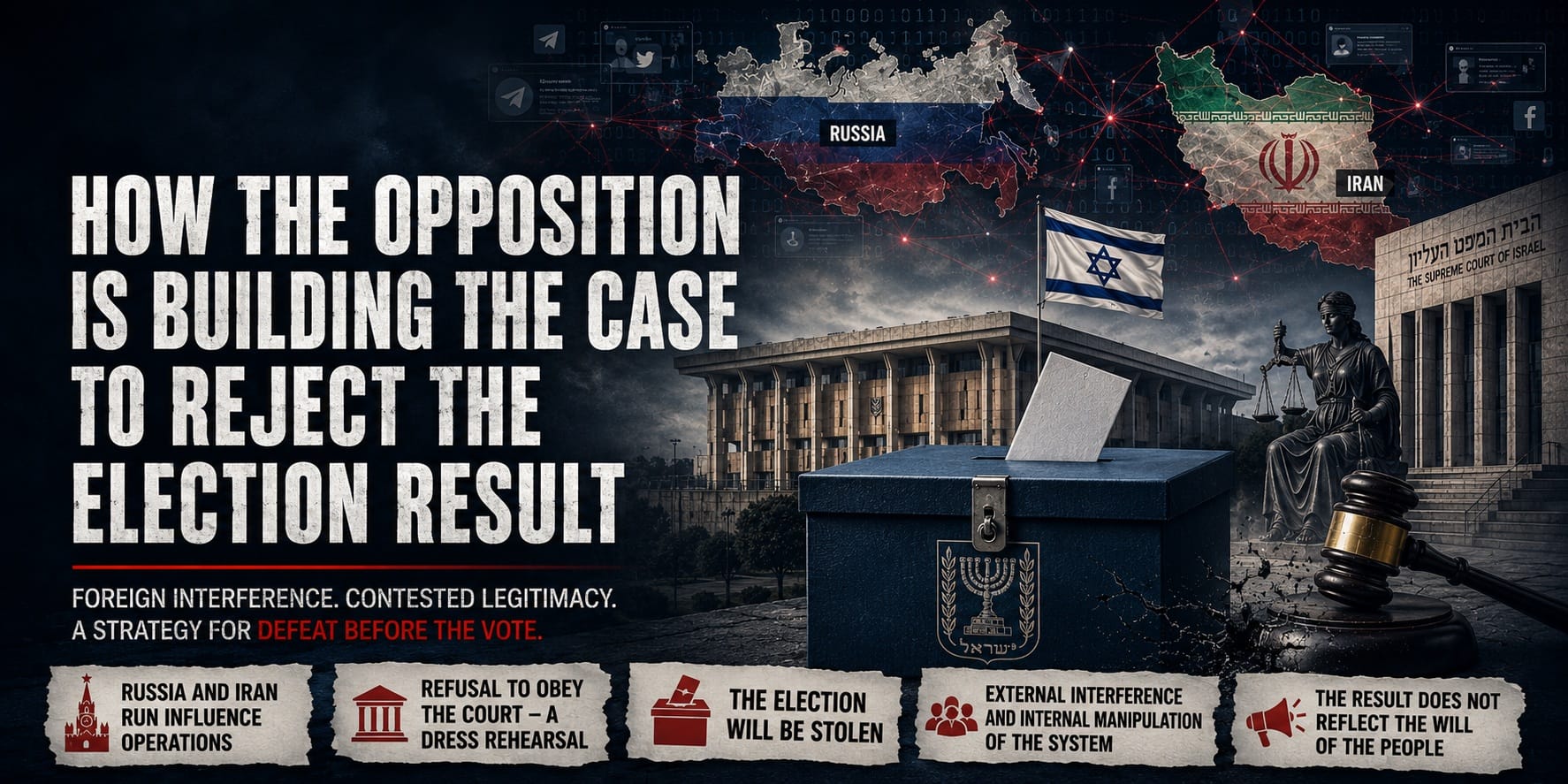
In the Knesset today, opposition leader Yair Lapid declared: “Russia and Iran are running influence operations against the Israeli public in the run-up to the election.”
The theme of a future stolen election is being introduced not by a fringe voice but by the leader of the anti-Bibi camp, Yair Lapid. He cast the government’s July 5 refusal to comply with the High Court’s ruling on the broadcast regulator as part of a strategy to “steal” the election: the coalition’s real target, he argued, is not the regulator itself but the vote — to “go into the election without a court.” Without a court, the government could postpone the vote on a manufactured “security event” and then refuse to accept the result — declaring itself the winner even in defeat.
Democrats leader Yair Golan called the refusal to obey the court a “dress rehearsal” for a government refusing to bow to “the will of the people.” These are not stray remarks but a frame assembled before the vote, through which any future result is meant to be read.
A Coalition That Won’t Come Together
The opposition needs the theme of a contested election because the anti-Bibi camp cannot coalesce into a single force. It faces three basic problems.
The first: three contenders for prime minister. Eisenkot, Bennett, and Liberman have each staked a claim to the premiership, and there is no agreed candidate. The field is crowded with right-wing and center-right projects fighting over the same electorate; the opposition itself labels the new right-wing lists (Erdan, Edelstein, Haskel) “Likud B” — satellites capable of returning a right-wing coalition to power. Liberman has lifted his veto on Likud but not on Netanyahu personally: the party is a legitimate partner, but Netanyahu, responsible for October 7, is not.
The second: an anti-religious thrust. A bet on secular mobilization and a boycott of the Haredi parties — a pledge to repeal the benefit laws, a refusal to sit with the Haredim in one coalition — narrows the room for bargaining and cuts off some potential partners.
The third, and decisive: without the Arab parties, no working coalition can be built. Hadash-Ta’al and Ra’am together hold roughly 10 seats, indispensable to any anti-Bibi majority, yet the very inclusion of the Arab lists is something the coalition immediately turns into a liability — while the BeYachad (Together) slate builds its campaign on the formula of “80 percent of the country,” from which the Arab voter is subtracted.
The Hungarian Precedent Can’t Be Repeated
What an assembled coalition looks like is on display in the Hungarian precedent of 2026. Péter Magyar — a product of Orbán’s own circle who broke with Fidesz — built Tisza, a single center-right vehicle that pulled voters away from Orbán on the right rather than mobilizing the left. The remaining opposition parties withdrew their candidates to avoid splitting the vote, and consolidation around one figure produced a rout on April 12, 2026, ending sixteen years of Orbán’s rule.
The mechanism is the point: an entrenched right-wing government loses not to the left but to an alternative right-wing movement that has cleared the field. The anti-Bibi camp cannot reproduce it — three figures instead of one, a crowded field of competing ambitions instead of a cleared one. The constructive path to power is blocked.
These problems make it likely that the opposition will not convert an anti-Bibi majority into a coalition.
So the opposition is pre-justifying defeat through foreign interference and internal sabotage. Its own weakness is swapped out for an external cause.
The result is declared illegitimate in advance on the grounds that “the electoral field is under pressure” — from external interference (Russia, Iran) and from the coalition’s internal reengineering of state institutions (the fight with the High Court over the broadcast regulators, the media bill, a possible “emergency” pretext for postponement, the capture of the security services, the Shin Bet and Mossad).
This linkage yields a ready-made formula: not “the opposition lost,” but “the result does not reflect the will of the people, because the electoral rules were changed in advance.” In this scheme the voter shifts from subject to object: first he is “worked on” by outside players, and then the result is declared unreliable precisely because the audience was “hacked.”
The Romanian Precedent as the Blueprint
The second precedent is the Romanian one. Romania in 2024–2025 was the first case in the EU in which a constitutional court annulled the first round of a presidential election, citing Russian digital interference and the suspicious financing of an ultranationalist’s campaign. Relying on intelligence reports of a coordinated operation across TikTok, Telegram, and Facebook, the court ordered a rerun and barred the candidate from taking part in it.
What matters is not the fact of interference but its procedural consequence: once the phrase “the election was annulled over interference” enters the vocabulary, every subsequent vote becomes both vulnerable and convenient for justifying any outcome. The precedent legitimizes not interference itself but the right of system insiders to assess its scale on their own and to change procedure on the basis of that assessment.
In Israel it has already moved from the op-ed pages into the institutions: debating protective measures, members of the Central Elections Committee pointed directly to the Romanian annulment — meaning the premise “interference → revisit the procedure” is now voiced inside the very body responsible for running the election.
The Information Space: “Confirmations” and Interpretations
The Israeli information space keeps foregrounding the point that the external operations are real. Iran is deepening its information interference: cyberattacks, fake accounts, operations aimed at the Arab sector, campaigns about the “pointless war” and the “corrupt elite.” Russia operates at low intensity — Doppelganger-type networks, the testing of narratives, targeted outreach to Russian-speaking and Arab audiences — which analysts read as preparation for the 2026 cycle.
Yet there is no neutral assessor. No single body empowered to establish the fact and scale of interference has been created in Israel, and the Shin Bet’s authority in the domestic information space is legally incomplete. So the conclusion that “there was interference, and it was decisive” is not a measurement but a value judgment made by the very security and political structures that are party to the fight for power. Scale is less established than assigned, and the argument over it is not closed by facts.
Official language has already absorbed the frame. State Comptroller Englman documents serious gaps in Israel’s readiness for digital interference and warns of the risks of chaos on election day, a breakdown in the count, and a collapse of trust in the result. The leadership of the Central Elections Committee speaks of the adversary’s attempt to “preemptively delegitimize the result,” stressing that the danger is not technical fraud but the public’s conviction of the opposite; in response, the committee promises maximum transparency in the count — against a backdrop of pressure that drove the previous CEC director to resign. The formula “they are trying to declare the election illegitimate in advance” now comes from the organizers as well — and it cuts both ways.
The internal problems of electoral “integrity” are concrete. The dispute over the Second Authority Council, the regulator of commercial broadcasting, has escalated into a constitutional crisis: the government has openly refused, for the first time, to recognize a High Court ruling that let the council’s previous lineup operate without a quorum. At stake are the sale of Channel 13 and the preferential status of the pro-government Channel 14; the court had earlier pointed to the communications minister’s efforts to paralyze the council through managed resignations. Meanwhile, the media bill — which expands the government’s control over broadcast and news outlets — is moving forward, on a shaky majority and with a dependent religious partner.
It is on this layer that Lapid rests his claim that “the coalition is breaking the institutions that shape the information space,” tying it to the external operations: the distortion comes from both inside and out at once.
Distrust of State Institutions
The case for annulling the election is being built for the public systematically. According to the IDI Democracy Index, 65.5 percent consider the coming election free and fair — meaning nearly a third already doubt the process before the campaign has begun (Jews 68 percent, Arabs about half). Half or more expect attempts to sway the vote: domestic forces are named by 58 percent of Jews and 51 percent of Arabs, foreign ones by 50 and 47 percent.
The asymmetry between the camps is what counts. Trust in the government stands at 25 percent among Jews and 17.5 percent among Arabs, and in the Knesset at about 11 percent; roughly a quarter of Jews, 12 percent of Arabs, and only about 10 percent of opposition voters rate the state of their democracy as good. The opposition voter expects manipulation from the government; the coalition voter mirrors him, expecting it from the opposition. The claim that “the result was rigged” does not need to be planted from scratch — it is enough to activate a predisposition that is already there.
The secular voter matters separately: trust in institutions falls as one moves from the religious pole to the secular one, and among secular Israelis the conviction runs stronger that the real decisions are made by the external and security apparatus rather than by the elected government. Hence a particular form of distrust — “elections decide nothing; it’s already been decided for us” — no less corrosive to legitimacy than a charge of fraud, and more receptive to the frame that “the system has been captured from within and without.”
For Lapid, foreign interference widens the electoral narrative: criticism of the government is joined by the posture of defending the election against an external threat. It justifies the demand to strengthen the Shin Bet and the regulators, and it extends his long-running “Russian” line — to sanctions evasion he now adds information influence.
For a fragmented opposition, the “compromised-field” frame papers over structural weakness: the crowd of contenders for one electorate and the absence of a leader are explained not by competition and fragmentation but by an external operation and internal sabotage. The loser’s responsibility is set aside; what gets discussed is the invalidity of the vote.
Security and Courts as Rival Arbiters
In the Romanian scenario, the decision to annul was taken by a court on the basis of intelligence. In Israel this arbiter is split into a security half and a judicial half, and the two are diverging.
The security half the coalition is already taking. In defiance of a court ruling and of the attorney general — who called the move “invalid and unlawful” — Netanyahu installed the loyal David Zini as head of the Shin Bet, and Mossad went to his military secretary, Roman Gofman (an appointment now being challenged in the Supreme Court). Under Zini, the Shin Bet has already produced assessments convenient to the prime minister — from helping to postpone his testimony in court to reversing the agency’s position on the death penalty.
The opposition thereby loses the very thing the Romanian precedent rested on — an official intelligence finding of interference; what remains to it is a political statement with no finding behind it.
The judicial half remains open. It was a court, not an intelligence service, that annulled the election in Romania; the Israeli court is in open conflict with the government, and the security appointments themselves are being contested within it. So the real stake is not polling stations and tally sheets but control over the arbiter: the security half the coalition holds, and over the judicial half the fight goes on.
With the election date set (October 27) and the Knesset’s dissolution (July 17), the question about interference shifts: not “is it true,” but “who benefits if the voter concludes, in advance, that his vote counts for nothing.”
Sources
- Lapid: the coalition’s target is the election, not the regulator; “going into the election without a court,” refusal to accept the result; Golan on the “dress rehearsal”; Liberman on Netanyahu’s disqualification from any government — The Jerusalem Post, July 6, 2026. https://www.jpost.com/israel-news/politics-and-diplomacy/article-901651
- The government refuses, for the first time, to comply with a High Court ruling on the Second Authority Council — The Times of Israel, July 5, 2026. https://www.timesofisrael.com/in-first-government-vows-to-disobey-high-court-ruling-setting-up-constitutional-crisis/
- State Comptroller Englman on shortcomings in readiness for foreign digital interference — The Jerusalem Post, December 9, 2025. https://www.jpost.com/israel-news/politics-and-diplomacy/article-879699
- CEC leadership on “preemptive delegitimization” and transparency of the count — The Times of Israel, July 5, 2026. https://www.timesofisrael.com/elections-committee-plans-live-broadcast-of-vote-count-to-dispel-conspiracy-theories/
- Resignation of the previous CEC director amid threats — Haaretz, May 6, 2026. https://www.haaretz.com/israel-news/israel-politics/2026-05-06/ty-article/.premium/sources-head-of-israel-election-panel-resigned-due-to-fears-of-personal-attacks/0000019d-fa00-d22e-a9ff-fafeced20000
- MKs citing the Romanian precedent while debating protective measures at the CEC — Ynet, December 10, 2025. https://www.ynetnews.com/article/b1jzsc8z11g
- Iranian influence campaign targeting the Arab sector ahead of the election — Haaretz, May 9, 2026. https://www.haaretz.com/israel-news/security-aviation/2026-05-09/ty-article/.premium/iranian-influence-campaign-targeting-arab-society-in-israel-ahead-of-elections/0000019e-02d7-d930-adde-b3ffac570000
- The media bill advanced to its final readings — The Times of Israel, July 6, 2026. https://www.timesofisrael.com/knesset-votes-to-split-controversial-bill-to-erode-power-of-attorney-general/
- IDI Democracy Index 2025: trust in institutions, expectation of interference, assessment of election fairness — The Times of Israel / Israel Democracy Institute. https://www.timesofisrael.com/ahead-of-election-year-survey-finds-israelis-trust-in-democracy-remains-low/
- Péter Magyar’s Tisza defeats Orbán, April 12, 2026 — Al Jazeera. https://www.aljazeera.com/news/2026/4/12/hungary-election-early-results-show-magyars-tisza-ahead-of-orbans-fidesz