
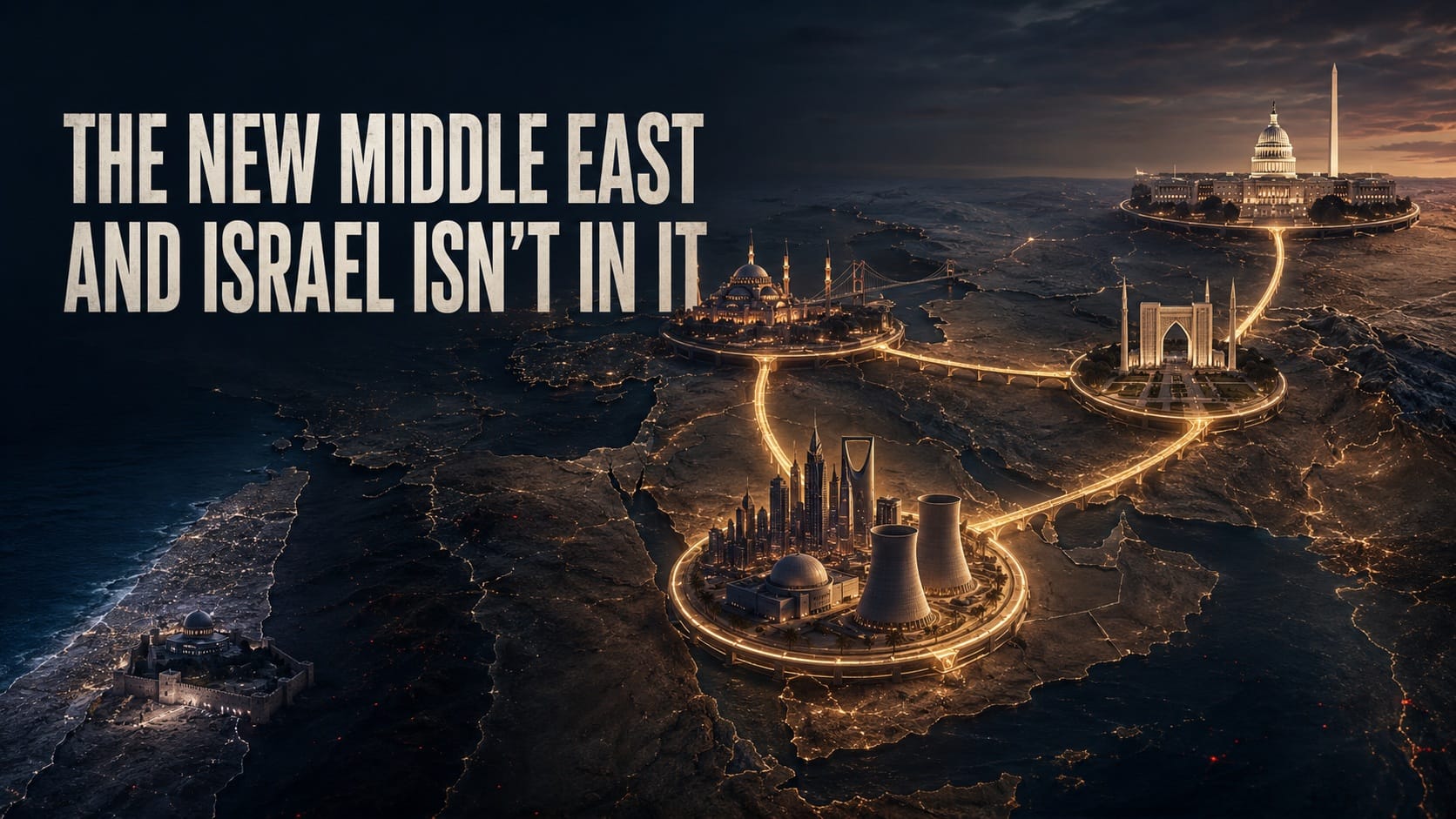
What was actually signed on July 22
“We are changing the Middle East and becoming a regional power,” Netanyahu said in March 2026, at his first press conference after the war with Iran began. He repeated the formula all year, and it had a single audience: Washington. Israel breaks the Shiite axis, America recognizes it as the center of a new regional order, and alliances form around it.
He delivered half of that. The Shiite axis is broken: Iran’s nuclear program destroyed, Ali Khamenei killed, Hezbollah’s leadership decapitated.
The other half went differently. Israel did not end the war. On June 15, while declaring the war’s objectives met, Netanyahu acknowledged that he did not know the exact text of the U.S.-Iran memorandum. An Israeli official told NBC that Jerusalem was never shown the document — this after Trump had said a copy was handed over. American sources say the opposite: the prime minister was kept informed throughout, never asked for the full text, and considered the deal acceptable if it were carried out. The two accounts agree on one point. Israel was not at the table. Trump stopped the shooting; Pakistan brokered the deal.
On July 7, Trump lifted sanctions on Turkey and said publicly that he would consider selling it F-35s — after Netanyahu had asked him not to. On July 21, he approved an agreement opening a legal path for Saudi Arabia to enrich uranium, and asked for no recognition of Israel in return.
Netanyahu asked for a new Middle East. Trump is delivering one. What is replacing the Shiite axis is not Israel.
The Event
On July 21, Trump approved a civil nuclear agreement with Saudi Arabia. The public announcement was set for July 22. The thirty-year accord is to be signed by U.S. Energy Secretary Chris Wright and Saudi Energy Minister Prince Abdulaziz bin Salman, then sent to Congress.
The core of it: Saudi Arabia gets the right to build a uranium enrichment plant if a joint study finds it economically justified. There is no outright ban on enrichment. There is no requirement to accept the IAEA Additional Protocol and its intrusive inspections. Congress has roughly ninety days to object, but stopping the deal would take a joint resolution plus a two-thirds majority to override a presidential veto. That threshold is out of reach.
This is routinely described as a step toward a Saudi bomb. It isn’t. There is no plant. There is no study. There is no enrichment.
The significance of July 22 lies elsewhere. Three bargains that held the region together are now gone. They did not all break on the same day — the first stalled after October 2023, and the third needed July 7 as much as July 22. But July 22 is the day none of them could still be described as intact.
Nuclear Technology for Recognition of Israel
Biden offered the Saudis a package with three parts: American security guarantees, help building a nuclear power industry, and — in exchange — normalization with Israel. The trade was explicit: technology and protection for recognition.
After October 7, 2023, the talks stalled. Trump cut the package apart: he gave the nuclear half and dropped the demand for recognition.
Israel lost the thing that mattered most. The Saudis wanted reactors and guarantees, and until now the only way to get them ran through Jerusalem — because that was how Washington framed it. It is no longer framed that way. The Saudis got the nuclear deal without giving anything up, and Israel has nothing left to trade.
Ynet reported that during the war bin Salman was prepared to offer the full package — recognition, a ceasefire, the return of the hostages, Saudi troops deployed in Gaza — in exchange for an Israeli commitment to a credible path to a Palestinian state within five to seven years, and that Netanyahu refused. It is a single Israeli source, so treat it as a report rather than an established fact. The outcome does not depend on whether it is true.
Technology for a Renunciation of Enrichment
The informal rule was simple: if you want American reactors, give up uranium enrichment and spent-fuel reprocessing.
Legally, neither the NPT nor U.S. law requires that. Most American nuclear cooperation agreements contain no such prohibition. There is one model: the 2009 agreement with the United Arab Emirates. It was dubbed the “gold standard,” and ever since, Washington has tried to impose it on everyone seeking American technology.
The Emiratis accepted three conditions. No enrichment or reprocessing facilities on their soil, on pain of termination. Signature of the IAEA Additional Protocol, which lets inspectors show up unannounced, take environmental samples, and demand information. And imported fuel, in return for a guarantee of supply. On those terms they built Barakah, and for sixteen years they honored them.
The rule held not because it was law but because no one tested it. Jordan is the clean case: it refused the enrichment ban outright, invoking the same NPT provision Iran has invoked for twenty years, and its negotiations dragged on for years. Egypt and Turkey never had to refuse — their agreements with Washington predate 2009 and contain nothing of the kind, which means the question arrives for them at renewal. Nobody, in short, found out whether Washington would settle for less.
The Saudis found out. It would.
There is a direct consequence. The Emirati agreement stipulates that its terms shall be no less favorable than those of American agreements with other countries in the Middle East, and that Washington will, at Abu Dhabi’s request, discuss amendments. The Saudi deal triggers that clause automatically. Whether the Emiratis invoke it is a political question: Barakah runs on imported fuel, and Abu Dhabi has no present need to enrich. But the inequality is now a matter of treaty text, not expert commentary.
As long as the rule applied to everyone, it functioned as a standard. The moment an exception appeared, it became a voluntary choice that exactly one country had made. The next buyer — the Emiratis themselves, Turkey, Egypt, Jordan, South Korea — will open from Saudi terms, not Emirati ones. That is the real event of July 22.
Israel Says No, Washington Proceeds
The July 7 decision on Turkey and the July 22 decision on Saudi Arabia were made publicly, back to back, over Jerusalem’s head. In both cases Netanyahu objected in advance and out loud, including on American television.
This is not a rupture. Military aid, deliveries, and coordination continue. What has changed is that an Israeli objection is no longer a condition. A major American decision on the region taken without Jerusalem’s consent used to be a problem that had to be managed. Now it is simply a decision.
Pakistan: What the 2025 Pact Is Actually Worth
On September 17, 2025, Saudi Arabia and Pakistan signed a mutual defense treaty: an attack on one is an attack on both. The full text was never published. The argument ever since has been about one question — did Riyadh acquire a Pakistani nuclear umbrella?
The Belfer Center and the Middle East Institute say no. Pakistan’s nuclear forces are aimed at India, there is no sign of reorientation toward the Middle East, and Islamabad’s earlier defense treaties carried no nuclear guarantees. Chatham House considers the precedent itself significant: a state outside the NPT has extended defense commitments to a third country for the first time. There is no way to settle it. There is no text.
After the war of February–April 2026, the argument stopped mattering. Pakistan produced the April 8 ceasefire and hosted the memorandum that followed — the document is named for Islamabad. The Washington-Tehran channel still runs through Pakistani and Qatari mediators. What counts now is not the arsenal but the fact that Pakistan is the only party talking to both the Americans and the Iranians.
What Riyadh bought in September was not a warhead. It was a broker. That is cheaper, it works in peacetime, and it requires no one to publish anything.
Turkey: A Different Logic
The Saudis behave like buyers: they acquire status, hedge, and haggle. Turkey behaves like a claimant.
A Dor Moriah expert panel (February 2026, fourteen participants) judged Turkish statements about readiness to join a nuclear race to be part of a consistent line rather than rhetoric, and proposed a frame: a country claiming leadership of the Sunni world will not stay non-nuclear in a region where the Jewish state has the bomb and the Shiite state was moving toward it. That is an assessment of intent, not a documented program, and it should be held as a hypothesis.
The material side is visible. American B61 warheads are widely reported to be stored at Incirlik, though Washington has never confirmed it officially; the Turks maintain and guard the facility but do not control the weapons. At Akkuyu, construction of the first unit is finished and commissioning is under way: dummy fuel assemblies loaded, cold hydraulic testing complete, hot tests this month, and — per Rosatom chief Alexey Likhachev — fuel loading and physical startup this fall, on a schedule already pushed back from 2023. In December 2025, Russia added $9 billion in financing. In April 2026, Rosatom opened substantive talks with Turkish companies on equity participation; the 2010 intergovernmental agreement allows it to sell up to 49 percent, and Likhachev said interest had intensified because of the Iran war. Meanwhile Ankara is selecting contractors for plants at Sinop and in Thrace — South Korea, China, and the United States are all in the running — and plans small modular reactors. Add the lifted sanctions and an open road to the F-35.
The difference from the Saudi case is straightforward. Saudi capability rests on a single agreement, which can be rewritten or revoked. Turkish capability is being assembled from three directions at once: Russia, the West, and East Asia. None of them can take it away alone.
The trilateral accord bringing Turkey into the Saudi-Pakistani pact remains unsigned. The draft has been with all three parties for about a year, Turkish Foreign Minister Hakan Fidan confirms the talks, and there is no consensus. Reporting this month puts Bahrain and Jordan among interested parties. That is a trend, not a fact.
Iran Has No Bomb. The Saudi Deal Went Through Anyway
In 2018, bin Salman set out a simple proposition: if Iran gets a bomb, we get one too. In 2026 the reverse happened. On February 28, joint U.S.-Israeli strikes destroyed Iran’s nuclear program and killed Ali Khamenei. On March 8, his son Mojtaba was named supreme leader. On April 8, Pakistani mediation stopped the fighting, and on June 17 the two sides signed the Islamabad memorandum, extending the truce by sixty days to attempt a final agreement.
The memorandum is now dead. There were never direct talks under it: the American team sat in Doha with Qataris and Pakistanis, no Iranians at the table. Strikes resumed on July 7 and have run every night since. On July 17, Iranian missiles killed two American service members in Jordan and a third in Iraq. On July 18, Deputy Foreign Minister Kazem Gharibabadi announced that Iran had suspended its commitments, accusing Washington of having abandoned its own first. Asked about it, Trump said he couldn’t care less.
That is the setting for July 22. Washington signed away the enrichment standard on the eleventh consecutive night of American strikes on Iran, with the memorandum in formal suspension and the president flying to Dover to receive the bodies of the dead. This is not background to the argument. It is the argument’s strongest evidence: the United States gave up the standard to hold Riyadh at the precise moment it was demonstrating maximum coercive power against Tehran. If Saudi enrichment were a concession forced by Iranian leverage, this is the week it would not have happened.
If this had been about Iran at all, Saudi demand for enrichment should have weakened after February. It did not weaken. It was granted. Which means the Saudi nuclear bet is driven not by the Iranian threat but by its own logic of status and autonomy.
So what does enrichment actually give Riyadh? Not a bomb: between enriched uranium and a warhead lies an entire industry the kingdom does not have and will not have for years. It gives two other things.
The first is the right itself — the one Iran spent twenty years pursuing and the Emiratis gave up. Permission to enrich uranium means the kingdom is no longer being treated as a client.
The second is its own fuel. The Emirati model left Abu Dhabi dependent on imports, and imports can be cut off. The Saudis have taken that lever out of Washington’s hands.
The second matters more than the first. Riyadh has already tested how far it is willing to go against the United States: according to the New York Times, in May the crown prince refused the U.S. military the use of Saudi airspace for the operation escorting tankers through Hormuz. That is not how a client behaves.
Hence the meaning of July 22. The United States gave up the standard in order to hold on to a partner that had begun to drift. This is not a reward for loyalty. It is the price of a relationship that has stopped coming free.
Conclusion
July 22 did not bring a Saudi bomb any closer. It devalued two other things: the American guarantee and the Israeli objection.
Destroying Iran’s program did not close the region’s nuclear question. It changed the cast. The Saudis are buying status, the Pakistanis are selling brokerage, the Turks are accumulating competence. Status can be taken back. Brokerage depends on circumstances. Competence stays.
Since the Madrid conference and Oslo, Israel has counted because the road to Washington ran through it. The road now runs elsewhere. Israel still has a great deal to offer the region — capability, intelligence, technology. What it has lost is the power to withhold.
The new Middle East is being built. Just not by Israel, and not for it.