
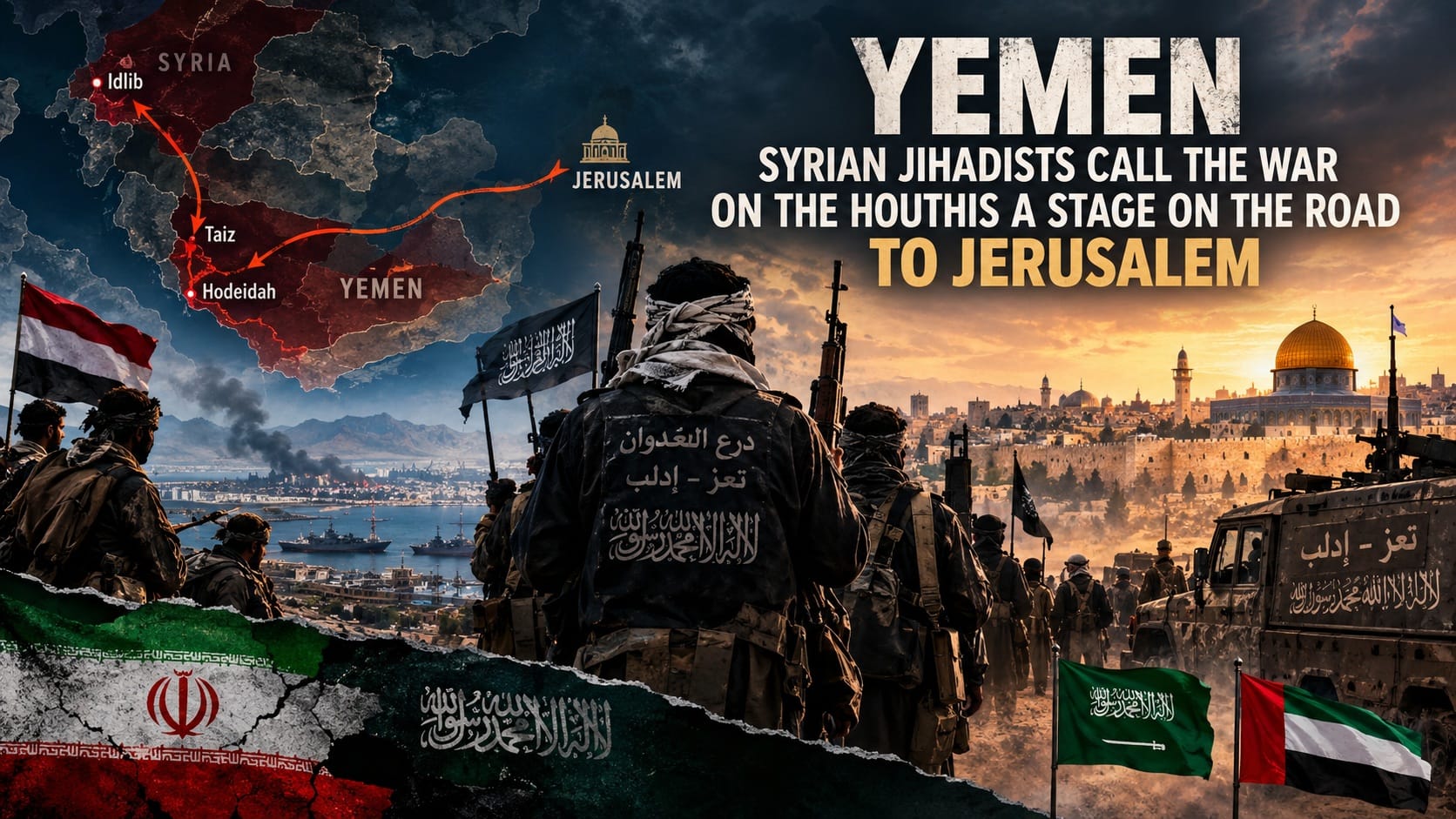
The fighting in Yemen since September 3, 2026, runs along a sectarian line. The Houthis, Zaydi Shias backed by Iran, opened an assault west of Taiz and south of Hodeidah after the 2022 ceasefire collapsed in July, and they face the internationally recognized government and the Presidential Leadership Council, backed by Saudi Arabia and the UAE. AFP counted more than 300 people killed in four days as of September 6, 2026.[1] Government forces said on Saturday that they had retaken ground in Hodeidah province and in western Taiz, including a hilltop in Jabal Habashi lost the day before.[2]
Jihadists in Syria have given the operation the name of the campaign that toppled Assad, Deterrence of Aggression, and have painted a prayer inscription on their vehicles alongside the names Taiz and Idlib, according to a Hebrew-language digest of September 7, 2026. They treat Syria and Yemen as linked arenas from which the armies of Islam will rise at the end of days, count the removal of Iranian influence as a stage toward the caliphate and the capture of Jerusalem, and mark Hodeidah as the next target.[3]
The line has been in circulation since Assad fell. The Times of Israel, on December 9, 2024, described footage from a Damascus mosque in which an armed man surrounded by gunmen said they were coming for Jerusalem.[4] Ahmed al-Sharaa, now president of Syria, declared in 2018 that Jerusalem awaits them, according to the Anti-Defamation League.[5]
The Anti-Defamation League assembled the rest of the chain on September 2, 2026, and reported that on January 22, 2025, graduates of special forces linked to Syria’s new Ministry of Defense marched in Deir ez-Zor chanting “Khaybar, Khaybar, O Jews! The army of Muhammad will return.” The same chant ran in January 2026 as government-aligned forces entered the Sheikh Maqsoud and Ashrafiyeh neighborhoods of Aleppo, and again at demonstrations across the country in April 2026. In August 2026, Syrian army soldiers outside the Damascus Citadel were filmed threatening to make blood flow in rivers, the Jerusalem Post reported, citing Al Araby TV.[6]
Saraya Ansar al-Sunnah, founded on February 1, 2025, seeks the destruction of the Alawite and Shia communities. A June 29, 2025, report to the US Commission on International Religious Freedom describes it as a Sunni jihadist group that targets those communities.[7] Between February and June 2025, the group claimed killings of Alawite civilians in Arzah, Hama, Tartus, and Homs, and the bombing of the Mar Elias church in Damascus. It also claimed a role in the March violence against Alawites in Latakia, and it called for harsher punitive attacks on Alawites and on former regime officials released from prison, per the Jamestown Foundation.[8]
The Lasta Shajara campaign, launched on May 31, 2026, demands a social and economic boycott of Alawites. In its study of July 31, 2026, the rights group Syrians for Truth and Justice cited wording from the campaign such as “Do not consume meat slaughtered by an esoteric Nusayri or Druze.”[9]
Inside Yemen the sectarian line runs differently. In its report of October 11, 2024, the UN Panel of Experts recorded an arrangement between the Houthis and al-Qaeda in the Arabian Peninsula to stop fighting each other, transfer weapons, and coordinate attacks on the forces of the government in Aden, which Arab News described on November 3, 2024, as cooperation in security and intelligence with each side offering the other safe haven.[10] A UN monitoring assessment of February 2026, cited by the Congressional Research Service on May 12, 2026, puts al-Qaeda strength in Yemen at 2,000 to 3,000 and calls the relationship with the Houthis covert and pragmatic.[11]
The weakening of Iran and Hezbollah, together with the jihadist overthrow of Assad, removed the Shia axis of resistance, and a Sunni one has taken its place. The new axis keeps the same geography: Damascus, Idlib, Taiz, Hodeidah. Its own people have named the destination. They called the removal of Iranian influence a stage on that road, and Riyadh and Abu Dhabi are covering that stage for them.
Sources, links checked on September 7, 2026.
1. Congressional Research Service, Yemen In Brief, May 12, 2026. https://www.everycrsreport.com/reports/R48942.html
2. AFP via the Times of Israel, September 6, 2026. https://www.timesofisrael.com/more-than-300-fighters-killed-in-yemen-clashes-over-last-4-days-amid-houthi-offensive/
3. Arab News, September 4, 2026. https://www.arabnews.com/node/2617843/middle-east
4. Hebrew-language digest, September 7, 2026, outlet not stated.
5. The Times of Israel, December 9, 2024. https://www.timesofisrael.com/liveblog_entry/video-shows-gunmen-in-damascus-mosque-vowing-to-march-on-jerusalem/
6. Anti-Defamation League, September 2, 2026. https://www.adl.org/resources/article/antisemitic-and-anti-israel-chants-expose-troubling-reality-syria
7. The Jerusalem Post, citing Al Araby TV, August 2026, as reported by the Anti-Defamation League on September 2, 2026.
8. Report to the US Commission on International Religious Freedom, June 29, 2025. https://www.uscirf.gov/sites/default/files/6.29.25%20AAUS%20Report%20on%20Violence%20in%20Syria%20By%20Community.pdf
9. Jamestown Foundation, January 16, 2026. https://jamestown.org/saraya-ansar-al-sunnahs-micro-insurgency-in-syria/
10. Syrians for Truth and Justice, July 31, 2026. https://stj-sy.org/en/syria-lasta-shajara-you-are-not-a-tree-campaign-hate-speech-and-overt-incitement-to-sectarian-exclusion/
11. UN Panel of Experts on Yemen, report S/2024/731 of October 11, 2024, as rendered by Arab News on November 3, 2024. https://www.arabnews.com/node/2577909/middle-east
