
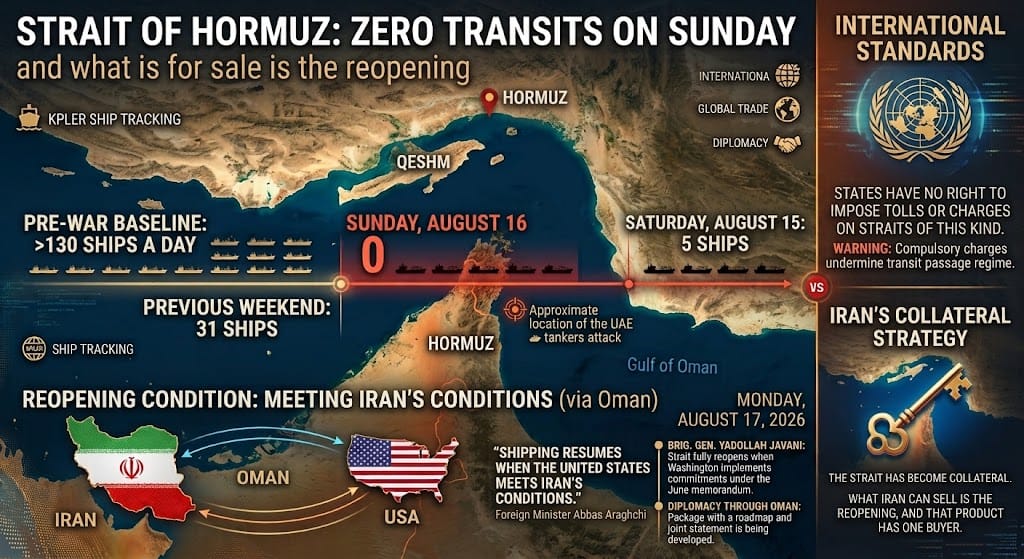
Five commodity vessels crossed the Strait of Hormuz on Saturday. None crossed on Sunday. The weekend before, the same two days carried thirty-one. Reuters published the figures from the ship-tracking firm Kpler on Monday, August 17. Before the war began on February 28, more than 130 ships a day made the passage.
Kpler itemizes Saturday’s traffic: an empty very large crude carrier, its automatic identification system switched off. An Indian-flagged gas carrier taking the Iranian route. A small tanker leaving with Iranian fuel oil. Ships sailing dark do not appear in the count. Movement stopped after the United Arab Emirates reported last week that three vessels operated by Abu Dhabi National Oil Company had been attacked in transit.
Brigadier General Yadollah Javani, head of the Revolutionary Guard’s political bureau, set the condition for reopening. In an interview on Monday he said the strait will fully reopen when Washington implements its commitments under the June memorandum. Foreign Minister Abbas Araghchi said the same thing on Saturday, in fewer words, to local media: shipping resumes when the United States meets Iran’s conditions.
The mechanism under discussion runs through Oman. Iranian Foreign Ministry spokesman Esmaeil Baqaei said on August 17 that the work has taken time because of security complications he attributed to US and Israeli action, the number of parties involved, and attempts to disrupt the process. The outcome, he said, will be a package containing a road map and a joint statement. Araghchi’s first foreign trip after the war was to Muscat.
The legal ground against transit fees is already staked out. Arsenio Dominguez, secretary general of the International Maritime Organization, said in April that states have no right to impose tolls or charges on straits of this kind. On August 6, associations representing shipowners and operators published a letter they had sent to the United Nations, warning that compulsory transit charges, or service fees that function as tolls, would break with established practice and set a precedent that undermines the transit passage regime. International law does allow charging for services rendered: pilotage, navigational assistance, environmental protection.
Turkey spoke separately. In an interview with the Qatari broadcaster Al Jazeera, Recep Tayyip Erdogan said he wants passage through Hormuz to be “free of charge and exempt from all fees,” calling that the more appropriate approach and good for world trade. Economists have spent the spring comparing Iran’s fee plans to Turkey’s practice in its own straits. The Turkish president has now publicly rejected the analogy.
Iran pays for the closure as well. Iran International reports that Tehran acknowledges a drop of roughly 30 percent in non-oil trade, while data from Iran’s trading partners show steeper falls, with trade with China down to about a quarter of last year’s level. Health Minister Mohammad-Reza Zafarghandi said India, Iran’s main supplier of pharmaceutical raw materials, halted shipments and tied their resumption to free passage for Indian vessels.
With traffic at zero, there is no one to charge. The toll model lost its payers before it started working, and the ships still moving run dark and pay nobody. What Iran can sell now is not passage but the reopening, and that product has one buyer. The price is set in memorandum obligations, not in dollars per tanker. The strait has stopped being revenue and become collateral.