
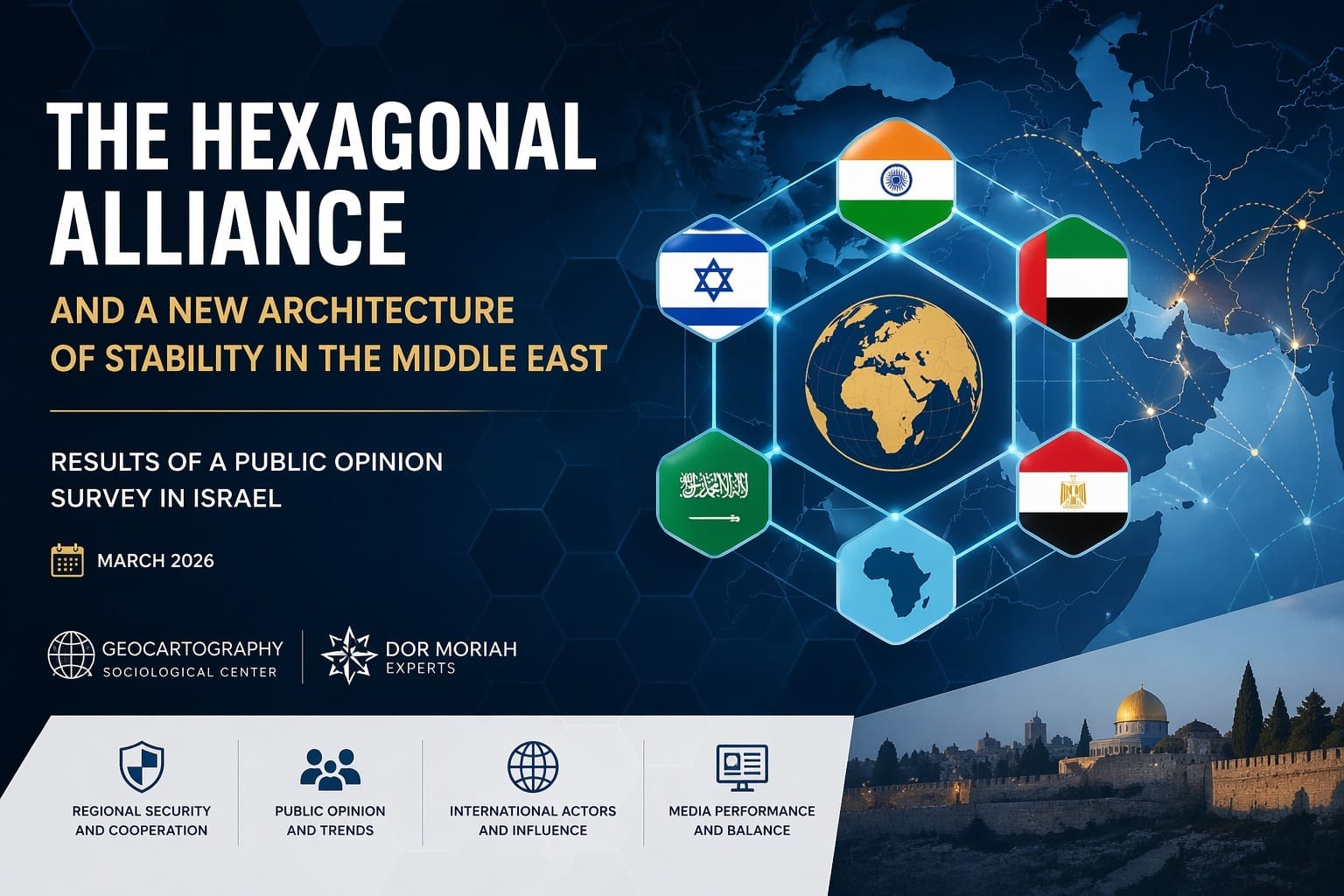
Results of a public opinion survey conducted in Israel by Geocartography, March 2026, using a questionnaire developed by Dor Moriah analysts.
The survey examines how Israelis perceive the “Hexagonal Alliance” — Prime Minister Netanyahu’s proposed regional grouping — and assesses public views on the role of international actors and the quality of Israeli media coverage of regional affairs.
Survey parameters: N = 1,010 respondents (nationally representative sample of the adult population of Israel, Jewish and Arab communities included); online survey; margin of error ±3.1%.
Main Findings
1. The United States as the anchor of regional order
Despite the increasingly contested nature of the international environment, Israeli public opinion continues to identify the United States as the primary guarantor of regional stability (44.1%). Gulf states rank second at 23.2%, a position driven largely by secular respondents, who are notably more inclined to credit them with a stabilizing role.
2. The “Hexagonal Alliance”: broadly positive reception
The initiative to build a regional coalition stretching from India to the Horn of Africa receives a predominantly favorable reading from the Israeli public:
- 60.6% of respondents expect the Alliance to strengthen Israel’s security.
- 31.1% characterize it as a promising diplomatic strategy — not merely a political maneuver.
- Confidence in the initiative’s near-term realization is highest among religious and traditional respondents, reaching 55.4%.
3. Countering Iran and Turkey
Respondents broadly expect the Alliance to constrain both major hostile axes in the region:
- Expected weakening of the Shia axis (Iran): impact index +39.7.
- Expected weakening of the Sunni axis (Turkey, Hamas): impact index +28.9.
- Across all groups, anticipated pressure on the Iranian axis is rated higher than on the Turkish one.
4. Media coverage: a persistent perception of bias
Israeli public opinion on domestic media coverage of regional affairs is moderately but consistently critical:
- The net balance of coverage quality ratings is negative across all demographic groups.
- Coverage of Iran is rated the most balanced among the countries surveyed (balance index +7.7).
- Coverage of China is rated the least balanced and is associated with the lowest level of public familiarity (−12.2).
5. Russia: distant and poorly covered
Survey data point to a pattern of disengagement from Russia’s regional role and skepticism about how Israeli media represent it:
- Only 2.6% of respondents — within the margin of error — identify Russia as a potential contributor to regional stability, compared to 44.1% for the United States and 23.2% for Gulf states.
- Coverage of Russian policy is perceived as unbalanced (balance index −7.6). Nearly 40% of respondents were unable to assess its fairness, the second-highest rate of uncertainty after China.