
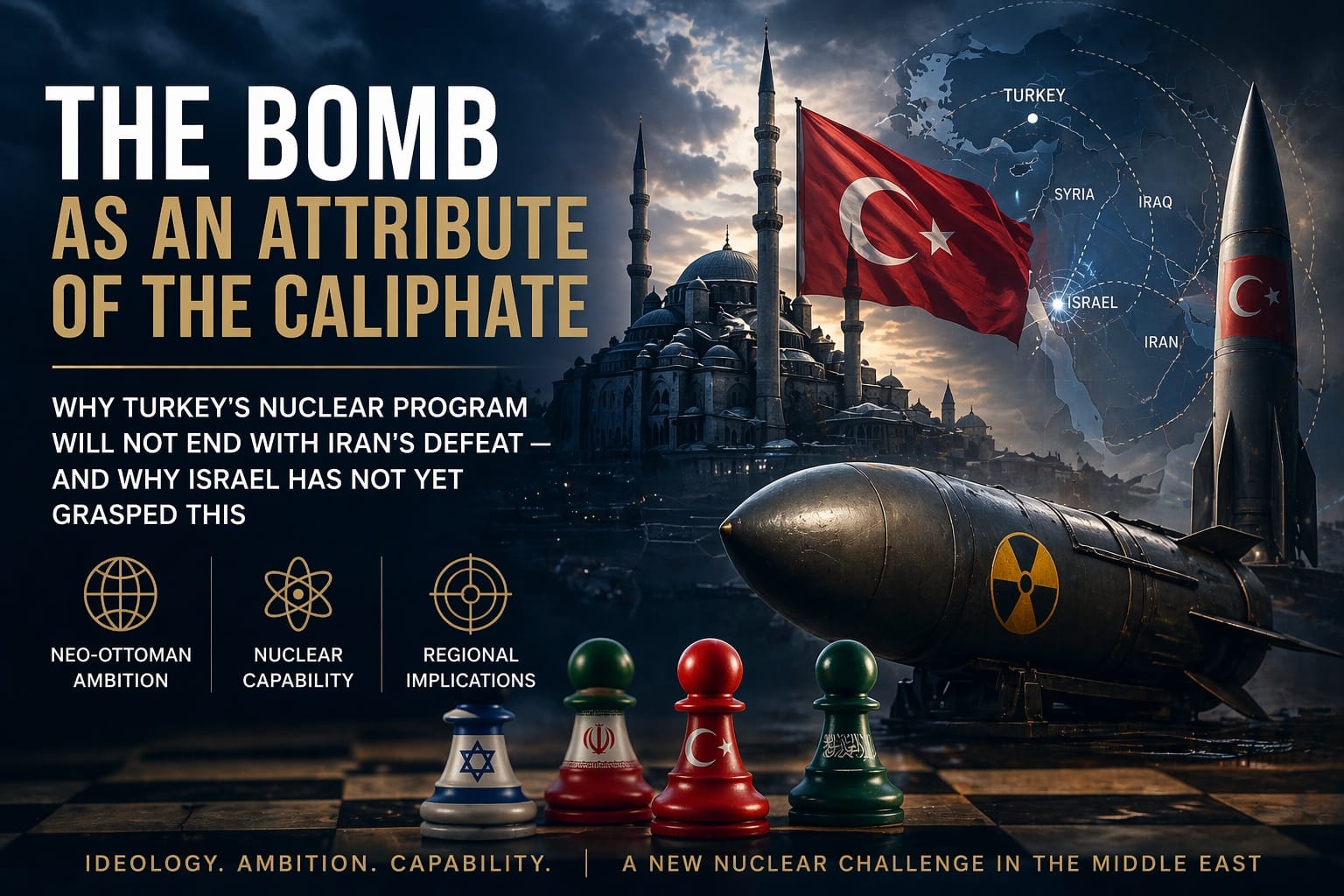
Why Turkey’s nuclear program will not end with Iran’s defeat — and why Israel has yet to grasp it
Five days after the active phase of the war with Iran ended, on April 14, 2026, Turkish Foreign Minister Hakan Fidan stated that Israeli strikes in Syria pose a “serious risk” to Ankara, and that Israel’s current restraint reflects its focus on the Iranian conflict — a focus that, in his words, “may prove temporary.”
In the Israeli press, the remark passed as yet another Erdoğan-era provocation. In reality, it was something else: a public clarification of a position Fidan had already articulated on February 9 in an interview with CNN Türk. If new nuclear weapons appear in the region, Turkey, he said, would “inevitably be forced to enter a nuclear race.”
Jerusalem read the February statement through a familiar lens: Turkey is reacting to Iran. Remove Iran — and the problem disappears.
This is a mistake. More importantly, it is a revealing one. It shows that Israel’s public discourse continues to interpret the Turkish nuclear question in categories that no longer apply.
Not a Response, but an Attribute
In February 2026, the Dor Moriah analytical center convened a panel of fourteen experts[1] — political scientists, historians, military analysts, sociologists, legal scholars, and specialists in religion, including rabbis — deliberately assembled across the widest possible ideological spectrum, from left-liberal to right-religious positions.
All fourteen, independently, reached the same conclusion: Fidan’s statement was not rhetorical improvisation. It was a component of a coherent program.
They identified three grounds for this assessment.
The first is legal: as the global nonproliferation regime erodes, public discussion of nuclear weapons by major powers increasingly functions as a self-fulfilling mechanism.
The second is technical: approximately fifty U.S. B61 tactical nuclear bombs are already deployed on Turkish territory under NATO nuclear-sharing arrangements. The transition from “nuclear host” to independent capability is far less demanding than is commonly assumed.
The third — and decisive — ground is ideological.
A religious scholar on the panel proposed a term: Sunni nuclear sovereignty.
Its logic is straightforward when followed step by step.
Israel — a Jewish state — possesses nuclear weapons. Iran — a Shi’a state — is moving toward them. Pakistan — a Sunni state — is geographically removed and strategically oriented toward India.
Turkey, which claims leadership of the Sunni world, cannot remain the only major Sunni power without nuclear status in a configuration where both Jews and Shi’a are armed. Not because it is under attack. Because nuclear-free leadership in a nuclearized region is an oxymoron — incompatible with any serious claim to a caliphal role.
On this basis, a rabbinical expert on the panel reached the same conclusion by a different route: even if Iran were fully neutralized, Turkey’s nuclear program would continue.
Because Iran was never its foundation. The foundation is the neo-Ottoman claim itself.
Why This Is Not Pakistan — and Not Saudi Arabia
Comparison with other Sunni nuclear trajectories clarifies the specificity of the Turkish case.
Pakistan’s program, achieved in 1998, was reactive — a response to India — and remains defensive in function. Islamabad does not project its nuclear capability as a pan-Islamic asset, does not extend a nuclear umbrella to the Sunni world, and does not link it to any claim of civilizational leadership. The bomb serves the state, not the ummah. For all of Pakistan’s public Islamic rhetoric, this is technically a South Asian program, not a Middle Eastern one.
Saudi Arabia operates within a different logic altogether: that of a client, not a claimant. Riyadh may seek to acquire nuclear status if circumstances demand — most likely through a Pakistani transfer — but it does not construct an ideology around it. For the Saudi monarchy, the bomb is insurance, not doctrine.
Turkey is different.
At the International Asian Political Parties Conference on April 12, 2026, Erdoğan declared:
“Just as we entered Karabakh, just as we entered Libya, we will do the same to them. Nothing stops us. We only need to be strong enough.”
In this formulation, Israel is incidental — a variable slotted into a pre-existing structure. The structure matters more than the specific object. Turkey enumerates its successful interventions and projects them forward. This is not the language of a state defending its perimeter. It is the language of a state projecting power. In that logic, nuclear status is not a response. It is the next step.
A second indicator reinforces the point: Turkey’s Tayfun Block 4 hypersonic missile program — with a range of approximately one thousand kilometers, capable of striking any point in Israel, including the Dimona nuclear complex — is being developed and tested in exactly the same timeframe in which Fidan is publicly discussing nuclear competition. Delivery systems and strategic status are advancing in parallel, as elements of a coordinated program.
Neo-Ottomanism and the Muslim Brotherhood
The ideological architecture of Turkey’s nuclear trajectory rests on two distinct but converging sources.
The first is neo-Ottomanism — the reactivation of imperial memory as a framework for contemporary regional policy. In this perspective, Turkey is not a nation-state in the European sense, but the successor to a civilizational center that lost its status in the aftermath of the First World War and Lausanne and is now engaged in restoring it. Nuclear capability, in this logic, is not merely military — it is symbolic: an attribute of sovereignty at the level appropriate to a great power, not a province. The symbolic dimension is no less significant than the military one.
The second is the network of political Islam centered on the Muslim Brotherhood and the Turkey–Qatar axis. This is a supra-state identity: confessional solidarity as a political principle, grounded in Sunni universalism. Within this framework, Turkey is not one Islamic state among others, but the leader assuming responsibility for the ummah. Nuclear status in this logic is not state insurance. It is a guarantee for the Sunni world.
In practice, these two logics have fused.
A May 2025 Dor Moriah survey found that 56.7% of Israelis identify Turkey’s support for Hamas, jihadist groups in Syria, and the Muslim Brotherhood as the core dimension of the Turkish threat. The public, in other words, correctly perceives the elements. What is missing is not data but a framework to integrate them into a coherent picture. At the level of fragments, the diagnosis is accurate. At the level of systemic understanding, it has not yet formed.
The Technical Corridor
If the ideological driver is stable, the question becomes technical feasibility. And here Turkey occupies a position that strategic analysis outside a narrow expert circle rarely acknowledges.
The fifty American B61 bombs at Incirlik Air Base are formally subject to dual-key NATO arrangements — Turkey does not legally possess them. Operationally, however, they are deployed on Turkish territory, maintained jointly, and their hosting infrastructure is under Turkish control. This is not a step toward an independent program, but a significant portion of the technical corridor leading there has already been traversed: storage facilities, transport logistics, radiation monitoring, trained personnel — all of it already exists.
Beyond Incirlik, Turkey operates a mature missile program: Tayfun, Gökdoğan, Bozdoğan, and ongoing development of both cruise and ballistic delivery systems. Its civilian nuclear sector is advancing through the Akkuyu reactor, built by Rosatom. A transition from civilian infrastructure to a military nuclear doctrine is not a departure from a blank slate — it is the acceleration of existing capacities.
A national security expert on the panel adds a less obvious dimension: Israel’s missile-defense architecture has been historically optimized for eastern and southeastern ballistic threat vectors. The emergence of a Turkish vector — approaching from the north-northwest — would require systemic adaptation of sensors, procedures, and air-defense positioning. This is not a hypothetical vulnerability; it is a structural gap that a Turkish strategic program would directly exploit.
Strategic Implications for Israel
Interpreting Turkey’s program as reactive is not merely analytically incorrect. It is strategically dangerous.
It creates the illusion that eliminating Iran resolves the problem. If the concept of Sunni nuclear sovereignty holds, the opposite is true: removing the Iranian threat does not close the file. It transforms it.
Three operational implications follow that remain unarticulated in Israel’s strategic discourse.
First. The regional nuclear file does not close with Iran’s defeat. It is reprofiled. The Shi’a threat vector is replaced by a Sunni one — and the latter is structurally more durable. The Iranian program had a doctrinal core tied to a specific regime in Tehran and was, in principle, reversible through regime change. Sunni nuclear sovereignty is a program tied to regional leadership as an objective. It is far more resistant to external disruption.
Second. The timelines differ fundamentally. Iran was measured in years. Turkey is measured in decades — assuming no external accelerants. Potential accelerants include: a crisis in NATO architecture, a U.S. withdrawal from Incirlik, a sharp deterioration in Russian-Turkish relations cutting off access to Rosatom’s technology, or, conversely, strategic rapprochement with Moscow. Any of these could compress the horizon substantially. Stable assessment requires continuous monitoring of variables that were secondary in the Iranian case and are primary here.
Third. The Israeli deterrence toolkit developed against Iran applies poorly to Turkey. Turkey is a NATO member. A sanctions regime at the scale applied against Tehran is politically unavailable. A military strike on Turkish infrastructure is implausible under any foreseeable scenario. What remains is the toolkit Israel has least experience with: long-duration diplomacy without terminal guarantees, engagement through Washington and European capitals, the construction of regional configurations in which Turkey is constrained rather than deterred. This requires a different strategic culture — one that Israel has not developed.
A Concept Not Yet Formulated
The expert panel’s central finding is precise: Israel’s public discourse on Turkey is not behind events. It is behind the conceptual framework needed to interpret them.
The data are available. What is absent is the frame in which those data read correctly.
The familiar model — threat as a reaction to provocation — does not apply to Turkey in 2026.
Sunni nuclear sovereignty offers an alternative frame. In this frame, nuclear weapons are not instruments of state policy. They are attributes of civilizational and confessional status. A program grounded in that logic is resistant to external pressure in ways the Iranian program was not: it cannot be resolved by removing its supposed trigger, because the trigger was never Iran. It was the claim itself.
Confronting such a program requires a qualitatively different kind of strategy — not crisis management calibrated to a specific threat, but long-duration engagement with the ideological substrate that generates the threat in the first place.
Fidan’s remark about Israel’s “temporary” restraint should be read not as a threat, but as a signal of sequence.
Iran first. Turkey next.
Israel has yet to articulate its response.
Igor Kaminnyk — ORCID: 0009-0008-0981-965X
[1] https://dor-moriah.org.il/en/turkiye-and-israels-security/