
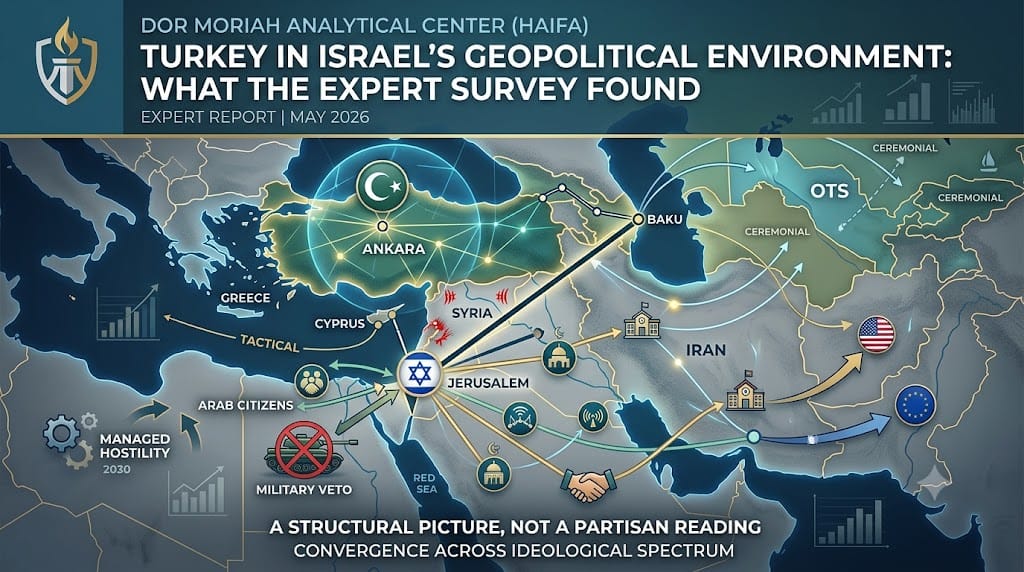
Expert survey conducted in May 2026.
Eleven experts — from the secular left to the religious right — agreed on more than they disagreed on. That convergence across the ideological spectrum is the central finding: this is a structural picture, not a partisan reading.
Turkic solidarity is overrated as a threat. No expert considers a Kazakh exit from the Abrahamic framework likely. The baseline scenario is continued multi-vectorism, possibly with reduced publicity. Astana’s Israeli track — technology, investment, water — is structurally decoupled from the Ankara-Jerusalem political axis, and is durable for that reason. The Baku-Jerusalem link is judged the hardest constant in the region: it rests on the Iranian factor, and Turkey cannot substitute for Israel’s defense and intelligence cover. The OTS is 70 to 80 percent a ceremonial platform with no mechanism for binding decisions; its real component is narrowly logistical. The limit on Turkish influence is set not by Israeli pushback but by the sovereign pragmatism of post-Soviet elites and the asymmetry of Ankara’s economic resources — Turkey lacks the capital base to convert cultural affinity into dependence.
European pressure cannot be relied on. The EU is judged an ineffective check on Turkey: the sanctions procedure is blocked by Council consensus, and Athens’ démarches yield declaratory rather than operational results. The partnership with Greece and Cyprus is an axis of convenience, not an alliance — a convergence of tactical interests, not a mutual-defense pact. Israel’s openings run around Brussels, not through it: energy, defense supplies, intelligence cooperation. Anti-Turkish coalitions in Europe are viable only as issue coalitions and require a trigger — a direct incident or the blocking of a NATO decision.
The United States is an unreliable check. CAATSA (the Countering America’s Adversaries Through Sanctions Act, 2017) remains a discretionary instrument the administration systematically declines to use; the pendulum dynamic of U.S.-Turkish relations is itself a structural vulnerability. Washington can trade away part of Israel’s objections for Turkish cooperation on Gaza, Syria, or NATO. The one conclusion shared across experts of every camp: Israel must hedge through its own deterrent configuration rather than count on American pressure.
The main threat is networks, not tanks. The hierarchy of threats is nearly unanimous: ideological and proxy patronage (Hamas, the Muslim Brotherhood) ranks first, the pan-Turkic vector — which the experts consider overrated — ranks last. The military veto on a Turkish contingent in Gaza is solid and rests on a consensus that reaches beyond the coalition, but it erodes through the “soft entry” — humanitarian, educational, and religious functions (Diyanet, TIKA, TDV). This is described as a Trojan horse: Ankara does not help; it occupies the field and accumulates political capital. A prohibition-only strategy backfires, handing Turkey the image of the “blocked benefactor.” The working countermeasure is to build an alternative, transparent, non-religious reconstruction infrastructure.
Blind spots in Israeli analysis. The experts flagged several underrated vectors: Turkish secular cultural exports, which cultivate long-term sympathy among Israel’s Arab citizens; lawfare through the ICC, the International Court of Justice, and the UN General Assembly; the Syrian lever after Assad — where, rather than in Gaza, the real risk of a direct military incident lives; and Turkish naval positioning in the Red Sea and the Gulf of Aden, oriented toward the Gulf of Eilat.
Outlook to 2030. The consensus trajectory is “managed hostility”: cold functionalism, diplomatic relations at the chargé level, demonstrative political confrontation alongside a genuine avoidance of rupture and the preservation of trade through workaround channels. A full break and strategic trust are equally unlikely. The principal escalation risk is the Syrian file, not Gaza.
Expert Survey Report