
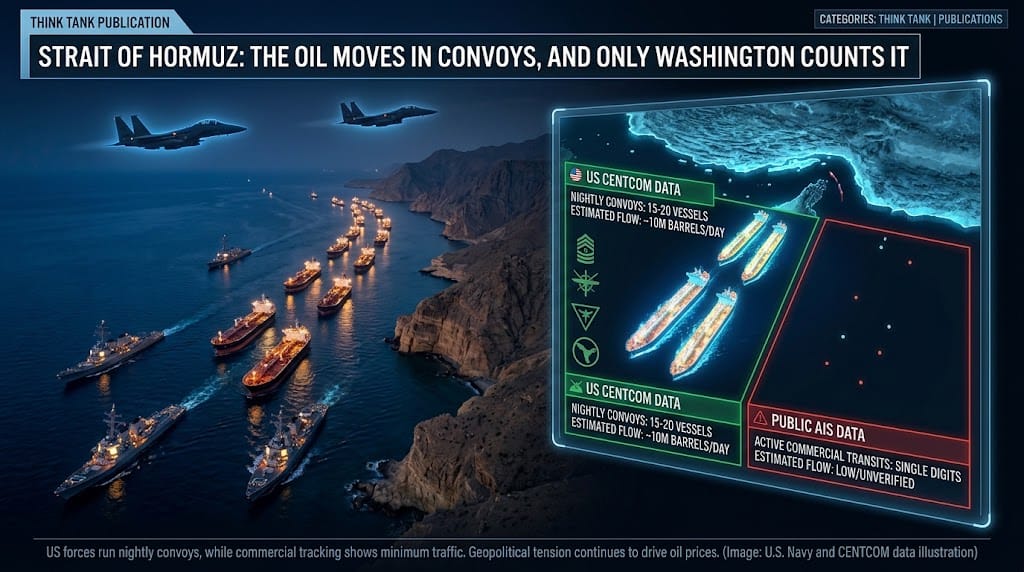
For several weeks the US military has been running 15 to 20 tankers a night through the southern channel of the Strait of Hormuz, hugging the coast of Oman. About 10 million barrels of oil a day reach world markets through that corridor, roughly half the pre-war volume. Axios reported the operation on August 19, citing two US officials.
The scheme goes beyond escorting laden tankers. A task force builds two lists each night: one outbound convoy into the Arabian Sea, one inbound convoy into the Gulf, where empty tankers load at ports in the UAE, Bahrain and Kuwait and leave by the same southern lane. US Air Force fighters cover the convoys against Iranian cruise missiles and drones. On Monday night, one official said, US forces shot down eight drones and two cruise missiles.
The corridor became possible after a two-week Central Command campaign that the same officials say degraded Iranian radar and maritime surveillance. Iran has lost visibility of traffic in the southern channel. It has not lost the means to strike: drones, cruise missiles, fast boats.
Public data does not show this picture. Kpler counted nine commercial vessels with active AIS transponders crossing the strait on Wednesday, August 19, against a ten-day average of eleven. Five crossed last Saturday and none on Sunday, against 31 the weekend before. Ten million barrels a day and nine ships a day do not reconcile at any tanker size.
Trump said on Tuesday that no talks with Iran were under way and that the strait was open. He repeated it in the Economic D-Day post: “the naval blockade remains in full force and effect. The Hormuz Strait is open and operating. All water mines have been removed or detonated.” Tehran denies it and says the waterway stays shut until Washington accepts Iranian terms.
The market is not trading 10 million barrels. Brent settled Wednesday at $91.62 and WTI at $85.83, both the highest since July 24. Dennis Kissler of BOK Financial tied the move to continuing geopolitical tension and to the Emirati decision to cut financial ties with Iran.
US Ambassador to Israel Mike Huckabee, interviewed Tuesday by Israel’s Channel 12, called the Iranian economy weak and Iranian behavior unpredictable. “Now whether that changes their behavior, that’s what we don’t know. Let’s hope it does. But if it doesn’t, there could come at some point a time in which another combat operation could take place,” he said. Trump meanwhile is talking the route down. “The Hormuz Strait is not going to be quite as important as it was in the past,” he said, pointing to record numbers of pipelines under construction.
The strait has stopped being a public route. A military operation replaced it, its throughput reported by two anonymous officials while commercial tracking services count single-digit crossings on the same days. Insurers, charterers and traders now buy the word of Central Command instead of data. Reopening the strait will not restore that.
