
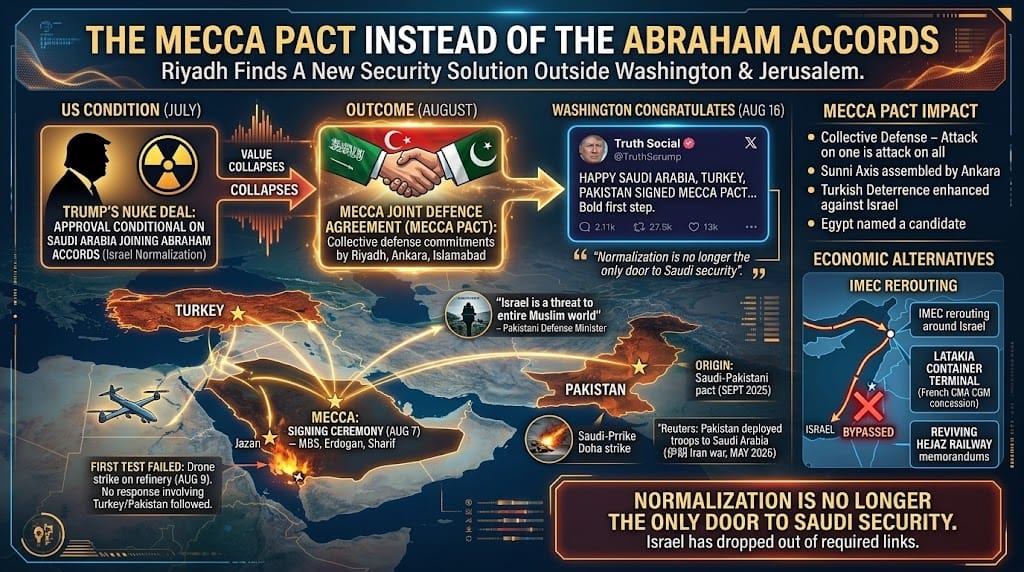
On August 16 Donald Trump wrote on Truth Social, his own social platform, that he was happy Saudi Arabia, Turkey and Pakistan had signed the Mecca Pact, formally the Mecca Joint Defence Agreement, which shows “how Countries will finally be able to defend themselves in a more meaningful way.” He closed by calling it a big, bold and important first step. Crown Prince Mohammed bin Salman, Recep Tayyip Erdogan and Shehbaz Sharif signed the text in Mecca on August 7. An armed attack on any one of the three counts as an attack on all three.
Twenty-four days earlier the same president had set Riyadh a price. Energy Secretary Chris Wright and his Saudi counterpart signed a civil nuclear agreement on July 22. On July 23 Trump wrote that the deal would be approved but was “totally subject to Saudi Arabia joining the very respected and successful Abraham Accords.” CNN reported that White House press secretary Karoline Leavitt confirmed the same day that the agreement was off unless Riyadh normalized relations with Israel.
In the three weeks between the two posts Riyadh obtained a collective defense commitment, and Washington did not supply it. The Mecca Pact extends the Saudi-Pakistani mutual defense agreement signed in Riyadh on September 17, 2025, eight days after an Israeli airstrike targeted Hamas leaders in Doha. That pact is not confined to paper. Reuters reported on May 18, 2026 that Pakistan deployed a jet squadron and thousands of troops to Saudi Arabia during the Iran war.
On August 8, a day after the ceremony, Pakistani Defense Minister Khawaja Asif told a Pakistani outlet that “Israel is a threat to the entire Muslim world” and called for “a united military front” against it. The pact itself names no adversary, and Turkish officials insist the text is defensive and aimed at no particular country.
The Sunni axis Ankara is assembling now gains a financial giant and a nuclear power. That sharply enhances Turkish deterrence against Israel. Foreign Minister Hakan Fidan compared the clause to NATO’s Article 5 and named Egypt a natural candidate to join.
The machinery works poorly so far. On August 9, two days after the ceremony, a Houthi drone set fire to the Saudi Aramco refinery at Jazan, the blaze was extinguished with no casualties, and no response involving Turkey or Pakistan followed. Pakistani officials separately maintain that the 2025 pact carried no nuclear umbrella.
Routes are moving faster than guarantees. The India-Middle East-Europe Economic Corridor, announced at the G20 in September 2023, ran from the Gulf through Jordan and Israel to Haifa. In June 2026 Turkey and Saudi Arabia signed a memorandum on a rail link through Jordan and Syria, reviving the Hejaz railway, and the Mediterranean endpoint of that alternative is already taken. France’s CMA CGM won a thirty-year concession on the Latakia container terminal on May 1, 2025, committing 230 million euros.
The July 23 condition still stands on paper, and there is nothing left to buy with it. The guarantee Riyadh was supposed to earn by recognizing Israel it arranged on August 7 without Washington and without Jerusalem, and on August 16 Washington congratulated it for doing so. Normalization is no longer the only door to Saudi security. Israel has dropped out of the required links.
