
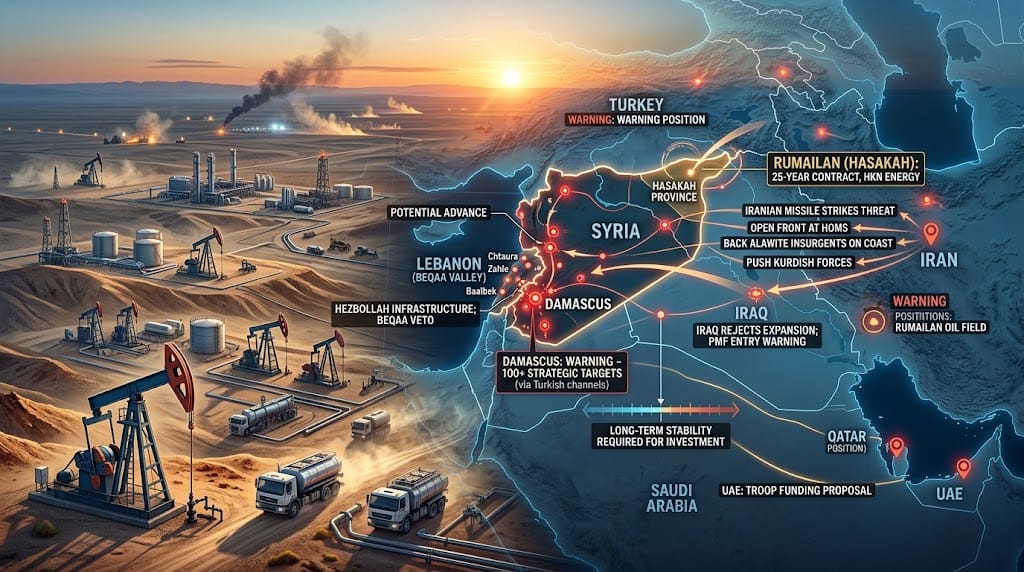
If Damascus sends troops into Lebanon against Hezbollah, Iranian missiles will land on Syria rather than Lebanon: more than 100 strategic sites in the opening salvo alone, the presidential palace first among them. Tehran passed that warning to Damascus through Turkish channels. U News, a Lebanese outlet tied to Hezbollah, published the account on August 13 in a series of Telegram posts citing sources, and Tasnim, part of the IRGC media network, picked it up.
All of this rests on a single source. The number of targets, the escalation Iran promised, the operation described below, and the Emirati offer to pay are known only from U News. Ankara, Baghdad, Doha and Riyadh have confirmed none of it.
Damascus was not the only address. The warning went to four other capitals, with the addition that the fighting would not stay inside Lebanon’s Beqaa Valley and would move onto Syrian ground. Iran listed the means: trouble along the Syrian-Iraqi border, a front around Homs, Alawite insurgents on the coast, and Kurdish forces encouraged to move on Aleppo again.
The operation being deterred came with map coordinates. Syrian units would cross at Masnaa toward Chtaura and Zahle, a second column would advance from the eastern highlands to Baalbek, and Tripoli would be declared a Syrian zone of influence. The target was Hezbollah’s rocket infrastructure in the Beqaa, and the aim was a retreat or new security terms. Figures linked to the U.S. Embassy in Beirut pushed the scenario, U News said.
The only confirmation that a Syrian move against Hezbollah is under discussion came from outside the Iranian information chain, and it came from Washington. Speaking to Fox News about how Damascus would handle Hezbollah, Donald Trump said Ahmed al-Sharaa “would be more precise than Israel” and “will not demolish buildings.” Al-Sharaa publicly rules out any intervention in Lebanon and says he is ready to talk to Hezbollah. A month before the U News report, the Israeli public broadcaster Kan reported that he had offered Trump plans for action against Hezbollah that Washington could activate, and a Syrian security source told the broadcaster that “there’s a gap between what’s said publicly and what’s discussed behind closed doors.”
The regional roles divide cleanly. The United Arab Emirates would fund the operation and cover troop salaries; Qatar refuses; Saudi Arabia does not object so long as the move weakens Hezbollah without igniting the region. Baghdad delivered its own answer rather than leaving it to Tehran. Hamid al-Shatri, head of Iraq’s national intelligence service, went to Damascus, told Syrian officials that Iraq rejects any expansion into Lebanon, and warned that Popular Mobilization Forces units could cross into Syria.
Meanwhile, in Hasakah province, an American operator is drilling. Damascus took physical control of the eastern fields on January 18, 2026, after brief clashes with the Syrian Democratic Forces, a ceasefire, and an agreement to fold the SDF into state institutions. That agreement is not finished, and Rumailan shows where it stands. The state oil company signs the contract, an SDF appointee still runs the field and reports its output, and 8 percent of production goes to Jazira Petroleum Services, a company affiliated with the Autonomous Administration. HKN Energy came in on a 25-year investment contract in June 2026 and now pays all of them.
Rumailan is the country’s largest field, with 1,322 wells, and it matters nationally. Its director put output at 70,000 to 80,000 barrels a day in February, down from 110,000, while Syria’s total this year runs near 105,000 against 380,000 before the war. Most of what Syria still pumps comes out of the ground HKN is surveying now, with seismic trucks crossing the province and sending pulses into the strata ahead of the drill.
Iran is no longer the only thing standing in the way. Qatar refused to fund the operation, and Baghdad threatened to send Popular Mobilization Forces units into Syria. Now there is an opponent with no politics in it: an American company holding a 25-year contract and needing one thing above all, that Damascus and the SDF do not fight over Rumailan. The Iranian list of means ends in the same place. The Kurds move on Aleppo again, the January agreement breaks, the field stops. Abu Dhabi will pay for the march into Lebanon. It will not pay for an idle field.
