
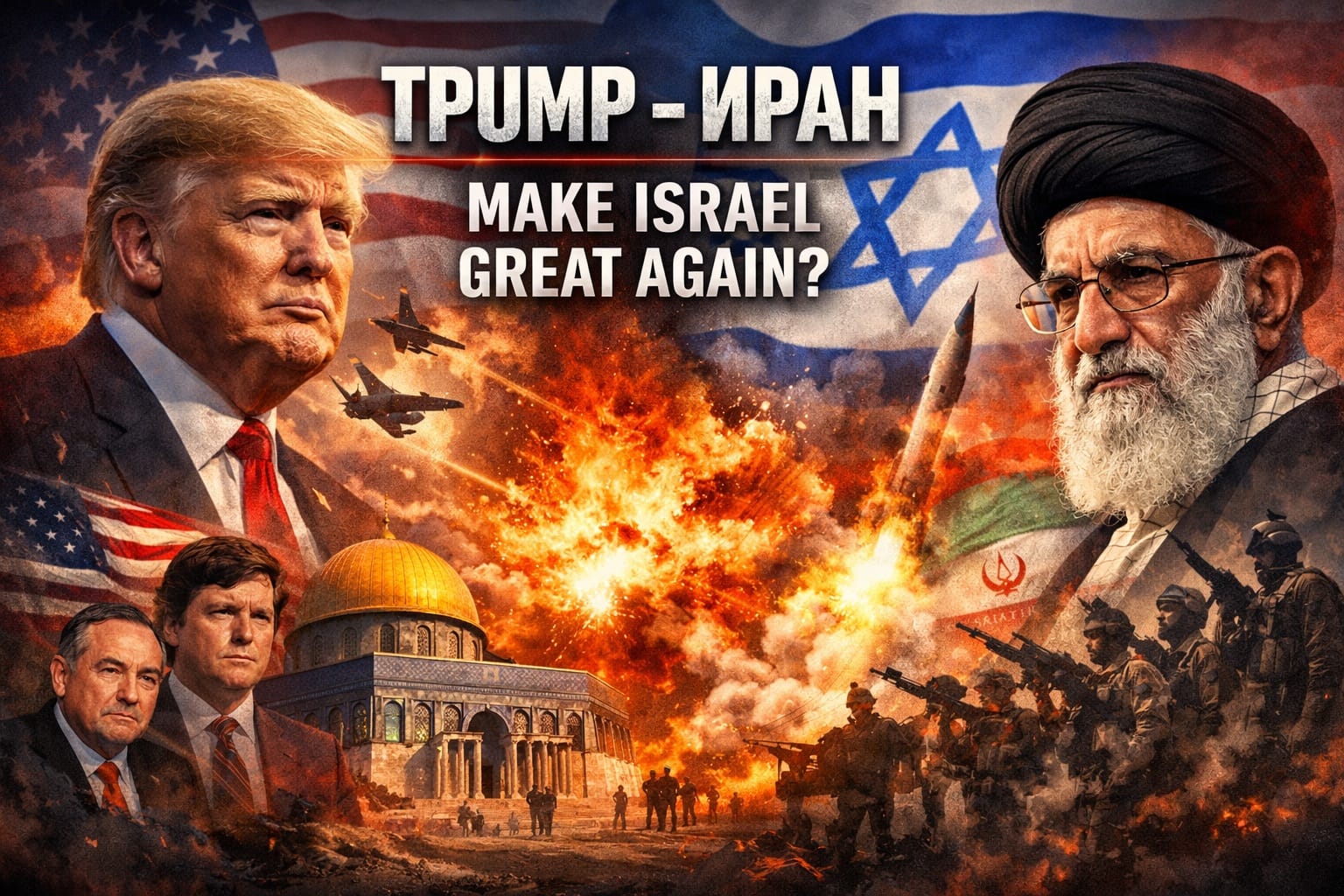
U.S. Ambassador to Israel Mike Huckabee’s interview with Tucker Carlson has become a major news event in its own right.1 It has provoked a backlash within the Republican Party at home and threatens to reshape international dynamics, particularly in the Middle East.
How will Huckabee’s eschatological declaration — that Israel has a “biblical right” to land stretching “from the wadi of Egypt to the great river, the Euphrates” — affect the triangular standoff between the United States, Iran, and Israel? And how will Trump respond to yet another complication surrounding his military-political decision on whether to strike Iran?
The interview drew condemnation from 14 Muslim-majority states,2 whose foreign ministers jointly denounced Huckabee’s words as “dangerous and inflammatory.” Saudi Arabia branded them “extremist rhetoric.” Egypt called them a “flagrant violation of international law.” Jordan dismissed them as “absurd and provocative.” The Arab League warned that such statements “inflame religious and national passions.”
How much will this scandal affect Trump’s resolve to strike Iran?
The narrative that “Trump is fighting Israel’s war, not America’s” is poison for a president who has built his brand on national sovereignty. The scandal hands Trump political cover for restraint: the Carlson wing of MAGA will frame any decision not to strike as a “sovereign choice” rather than weakness.
Among younger right-wing Christians within the Republican Party, support for Israel is no longer treated as a moral or biblical imperative. Like their liberal peers, they grew up further removed from the Holocaust, face severe economic pressures, and the war in Gaza gave these sentiments the final push they needed to surface openly.
A Hollowed-Out Congress and Midterms Around the Corner
The MAGA split is compounded by institutional paralysis.
Congress is experiencing an unprecedented exodus:3 68 lawmakers are departing ahead of the midterms, 31 of them not into retirement but into other offices. Senators and representatives from both parties prefer governors’ mansions. Outgoing Senator Dick Durbin has called his colleagues “observers.” Congress is passing fewer laws than at any point since the early twentieth century.
Technically, the president can launch a military operation without congressional approval. But politically, the absence of legislative legitimacy renders any escalation toxic. In 2002, Bush secured a vote that distributed accountability. In 2026, Trump faces a legislature that cannot even elect a Speaker without drama. Representatives Ro Khanna and Thomas Massie are already threatening to force a vote on Iran.
The midterms, meanwhile, are a matter of simple arithmetic. Swing-district voters vote with their wallets. A war in the Gulf would instantly spike oil prices and derail the economic agenda. Trump himself has acknowledged that Republicans risk losing one or both chambers. Nor does he have a sellable narrative: in January he threatened strikes over human rights abuses, then pivoted to the nuclear program, then hinted at regime change. Each rationale is weak on its own; together they project chaotic improvisation. Bush in 2003 at least constructed a unified narrative — however false. Trump has nothing comparable.
Israel and the Question of Trump’s Independence
If domestic factors are holding Trump back,4 the primary force pushing toward a strike is Israel. The critical question is: how independent is Trump in his decision-making?
The picture is troubling. Negotiations with Iran are being led by Steve Witkoff and Jared Kushner — Trump’s son-in-law, a man with no diplomatic experience but ties to Israel so deep that Iran’s Foreign Ministry spokesman declared: “Our negotiating partner is America. It is for America to decide whether to act independently or under destructive outside pressures.” Epstein files declassified in January 2026 contain testimony from an FBI informant alleging that Kushner served as the “central conduit” of Israeli influence over the Trump presidency. These claims are unverified and come from a single source, but they feed a narrative that Carlson and his wing are actively exploiting.
Netanyahu demonstrated in June 2025 just how effectively he can draw Trump in: Israel struck Iranian nuclear facilities first, and the United States followed.
This time, Netanyahu needs full-scale American involvement from the outset.
Netanyahu visited Trump on February 11 and attempted to tighten the terms of Iran negotiations to the point where any agreement would become impossible.
Trump, however, “insisted” that talks continue, telling Netanyahu: “Let’s give it a shot.” This shows that Israeli pressure is powerful but not absolute. Trump is capable of resisting — the question is for how long.
Escalation scenarios remain on the table. A preemptive Israeli strike that provokes an Iranian response against American assets. Iran’s parliamentary speaker, Ghalibaf, has already declared that in the event of an attack, “all American bases in the region will become legitimate targets.”
An intelligence leak alleging a nuclear breakout. Western and Arab sources have already claimed that Iran is hours or days away from acquiring enough fissile material for a nuclear weapon; Witkoff has said one week.5 Iran has rebuilt attacked facilities faster than Washington expected.6
Electoral Calculations
Israeli elections fall virtually simultaneously with the American midterms. Knesset elections are scheduled for October 27, 2026 — exactly one week before the U.S. congressional vote.
Netanyahu has considered moving elections to June,7 hoping to enter the campaign with a diplomatic achievement — normalization with Saudi Arabia or Indonesia.
For the Iran scenario, this creates a double alignment of electoral cycles. Netanyahu needs a war, or at least a show of force, every bit as much as Trump needs peace. Chatham House notes that following the weakening of the “Axis of Resistance” and the absence of a decisive victory in Gaza, Netanyahu’s government has turned to the West Bank as a pressure valve for mobilizing the electoral base.
A strike on Iran that draws in the United States would allow Netanyahu to go to the polls as the “wartime prime minister” defending the nation against a nuclear threat.
The midterms thus restrain Trump, but for Netanyahu they create a double deadline — both American and domestic. The logic: act before autumn, while Trump can still be brought on board and the Israeli electorate can still be mobilized.
The Nuclear Dissonance: Bombing Iran, Arming Saudi Arabia
The most devastating argument against the legitimacy of a strike is not political but logical.
In November 2025, the Trump administration announced a framework agreement on nuclear cooperation with Riyadh. The Arms Control Association (ACA), having reviewed the report submitted to Congress, found that the deal lacks standard nonproliferation safeguards and effectively opens the door for Saudi Arabia to enrich uranium — the very technology over which Trump threatens to bomb Iran.
The UAE adopted the “gold standard” when building its Barakah nuclear plant — a blanket prohibition on enrichment and reprocessing. No such requirement is being imposed on the Saudis. Crown Prince Mohammed bin Salman has publicly stated that Saudi Arabia will pursue nuclear weapons if Iran acquires them. Pakistan, which signed a mutual defense pact with Riyadh, has already declared through its defense minister that its nuclear program “will be made available” to Saudi Arabia if needed.
Senator Ed Markey has called the deal a threat to turn the region into a nuclear arms race. The agreement is due to be submitted to Congress in late February, with a 90-day window for rejection.
The dissonance lays bare the truth: for the Trump administration, Iran policy is not about nonproliferation. It is a tool of geopolitical leverage and commercial bargaining. How can you bomb one country for enrichment while selling enrichment technology to its principal rival? Any strike against the backdrop of the Saudi deal destroys moral legitimacy — before the international community, before Congress, and before voters.
The Allies Who Said No: London, Ankara, and the Gulf Monarchies
War requires not just political will but operational infrastructure.
The United Kingdom has refused to grant access to RAF Fairford — home to the U.S. heavy bomber fleet in Europe — and Diego Garcia in the Indian Ocean.8 The reason is legal: Attorney General Lord Hermer warned that facilitating a preemptive strike without a UN mandate would violate international law. Trump responded with coercion — withdrawing support for Starmer’s deal to transfer the Chagos Islands to Mauritius and writing on Truth Social that the bases were needed “to eradicate a potential attack by a highly unstable and dangerous regime.” Senator Lindsey Graham declared that London was on “the wrong side of history.” Starmer has not budged.
Turkey has consistently blocked the use of Incirlik. Foreign Minister Fidan has publicly opposed a strike. Erdogan met with Iranian Foreign Minister Araghchi, positioning Ankara as a mediator. Turkish intelligence exposed an Iranian spy ring monitoring the base — Ankara is protecting the facility but has no intention of handing it over for offensive operations. A 560-kilometer border with Iran and dependence on Iranian gas (15–20 percent of consumption) make a war on the doorstep an existential threat.
The UAE has stated it will not allow its territory or airspace to be used for military operations. Presidential adviser Anwar Gargash has called for a “long-term diplomatic solution.”
Saudi Arabia officially favors a peaceful resolution — though defense minister Khalid bin Salman reportedly told Trump he “should take military action” or risk “strengthening the regime.” Riyadh’s position is ambivalent, but fear predominates: a strike on Iran would jeopardize Vision 2030, foreign investment, tourism, and oil infrastructure. Saudi Arabia has closed its airspace to an Iran strike. Iran’s 2019 attack on Saudi Aramco facilities remains a vivid reminder.
Qatar and Oman are active mediators. Qatar — despite Iranian missiles hitting its Al Udeid base in June 2025 — remains the only Gulf state whose foreign minister has traveled to Tehran for talks. Oman hosted indirect negotiations on February 6.
Chatham House9 has articulated the key shift: regional states overestimated the Iranian threat and underestimated the Israeli one. Israel’s September 2025 attack on Doha demonstrated a willingness to breach the unspoken rules of regional security. For the Gulf monarchies, the principal threat is no longer a weakening Iran but an expansionist Israel. Huckabee’s words about the land “from the Nile to the Euphrates” only reinforced that fear.
Gulf states fear not only war but a strike that is “too successful”: the collapse of Iran guarantees no stability — the experiences of Iraq, Libya, and Syria show that what follows is chaos, migration waves, and extremism. Even a weakened Iran retains the capacity to inflict serious damage on Gulf oil infrastructure. And closure of the Strait of Hormuz would be catastrophic for Qatar and Kuwait.
Without allied bases, B-2 and B-52 bombers must fly from the continental United States, dramatically increasing transit time and requiring massive in-flight refueling. For a sustained, multi-week campaign, this is a significant operational constraint. But the larger point is this: Trump is left almost entirely alone. Even his closest partners regard a strike as illegitimate.
The Balance of Probabilities: Make America First — or Make Israel Great Again?
Six factors — the MAGA split over Israel, congressional paralysis, the midterms, the nuclear dissonance of the Saudi deal, allied refusals, and Gulf reluctance — form a powerful wall of deterrence. The most likely scenario: continued “maximum pressure” without crossing into hostilities, aimed at extracting some kind of deal from Iran before the elections.
But the wall is conditional. One Trump adviser told Axios: “The boss is getting fed up. Some people around him warn against going to war with Iran, but I think there is a 90 percent chance we see kinetic action in the next few weeks.” CNN reports that the military is prepared to strike as early as this weekend, though Trump has not yet made a final decision.
The fundamental question — one that neither analysts nor advisers nor Trump himself can answer — is: whose war is this, America’s or Israel’s? If the MAGA split deepens, if the “Make Israel Great Again” narrative becomes an electoral liability, if the Gulf, London, and Ankara continue to distance themselves — it will become ever harder for Trump to explain to Americans why their sons are flying off to bomb Iran.
But if Netanyahu decides to act unilaterally — and the window before the November midterms is closing — none of the six constraints will stop the chain reaction.
Six factors explain why Trump does not want to fight and why Israel is finding it ever harder to compel him. But in the Middle East, rational calculations have a habit of being overridden overnight. And the key to the outcome may lie not in Washington but in Jerusalem — in the hands of a man bound by neither the midterms, nor the MAGA split, nor the opinions of the Gulf monarchies.
Footnotes
- “Israel’s attack on Qatar shows why it’s time for a Gulf defence union,” Chatham House, September 2025.
- “Mike Huckabee’s Israel comments condemned by Arab and Muslim countries,” The Guardian, February 22, 2026.
- “Huckabee’s remarks on Israel’s biblical rights to region spark wave of Arab anger,” The National, February 22, 2026.
- “Congress midterms: Lawmakers quit in record numbers,” The Washington Post, 2026.
- “Trump pushes U.S. toward war with Iran as advisers urge focus on economy,” Reuters, February 21, 2026.
- “Steve Witkoff: Iran a week away from enough enriched uranium,” The Washington Times, February 22, 2026.
- “Fact check: Is Iran rebuilding its nuclear sites?” Fox Baltimore, 2026.
- “Netanyahu set election date,” Srugim (Hebrew), 2026.
- “UK has not agreed to let US strike Iran from British bases,” Sky News, 2026.