
Why Salaried Armies Keep Losing to Mobilizational Islam
When Houthi forces entered Mokha on September 10, they took more than a port on Yemen’s Red Sea coast. They broke through a military zone that Gulf governments had spent years and billions of dollars trying to hold. Mokha had been outside Houthi control since 2017 and served as headquarters of the Joint Forces, a patchwork of anti-Houthi formations that included Tariq Saleh’s National Resistance, the Southern Giants Brigades and Tihama units. After Mokha fell, government forces abandoned positions around the Hanish Islands, and the war arrived at the edge of Bab al-Mandeb.
For several years, the Dor Moriah Analytical Center has studied social mobilization and the financial instruments that sustain religious solidarity networks. We treat these movements as solidarity orders, in which recruitment, territorial governance, taxation and financial rules work as a single system. Viewed that way, the fall of Mokha was predictable.
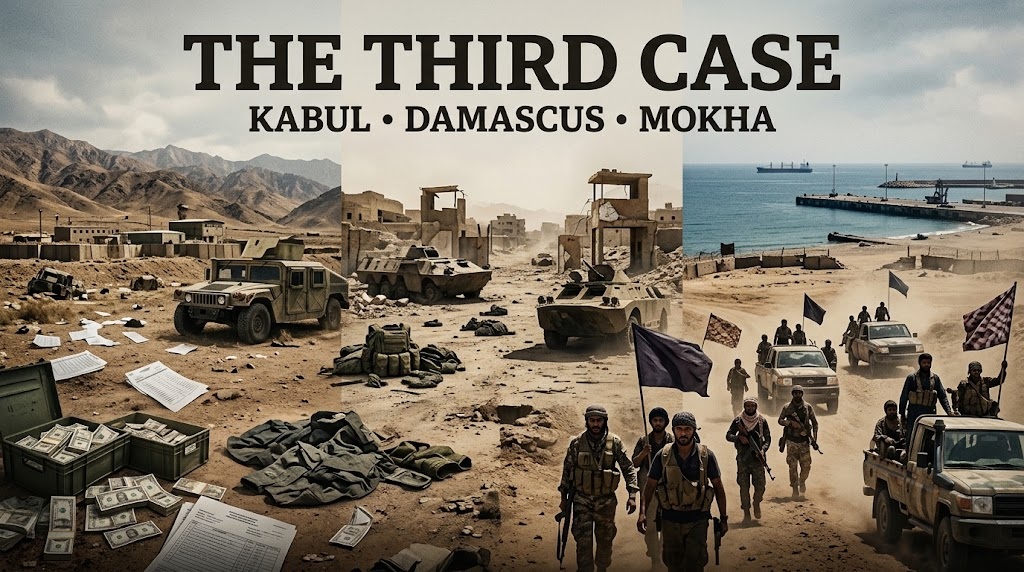
In our view, it marks the third time in five years that the same thing has happened. In August 2021, the Taliban took Afghanistan in a matter of weeks, overrunning an army the United States had spent two decades building and paying for. In December 2024, Ahmed al-Sharaa’s forces swept from Idlib to Damascus in eleven days, and Assad’s army, on paper one of the largest in the region, dissolved almost without a fight. Now Yemen’s western coast has followed. Each time, a mobilizational form of political Islam defeated formalized state structures sustained by outside money.
By mobilizational Islam we mean movements in which religious identity, military recruitment, territorial governance and financial rules are bound into a single solidarity order. That sets it apart from party-based or electoral political Islam and from transnational jihadism: its strength lies in holding territory and building its own authority there. Doctrinally, the three movements have little in common, from the Taliban’s Deobandi Sunnism to the Salafi-jihadist roots of Hayat Tahrir al-Sham to the Houthis’ Zaydi Shiism. Structurally, they are built the same way.
An Army on the Payroll
The forces defending the Yemeni coast were hardly neglected. The United Arab Emirates spent years raising, arming and financing them. When Abu Dhabi pulled out of Yemen at the start of 2026, Saudi Arabia inherited the burden: Riyadh took over salaries and launched a reorganization meant to fold formations with different histories and loyalties into a single structure. For 2026, the kingdom budgeted nearly $3 billion for Yemeni soldiers and civil servants, including about $1 billion for southern fighters previously paid by the Emirates. Total Saudi spending on Yemen this year exceeded $4 billion, according to estimates cited by Reuters.
The army on the payroll bore little resemblance to the one holding the line. Reports from the western front described inflated rosters and soldiers who existed only on salary records. A Western source told CNN that some units at Mokha were at roughly a fifth of their paper strength. On August 4, Defense Minister Taher al-Aqili stopped routing salaries through unit commanders, shutting down the mechanism that turns a padded roster into a revenue stream. Five weeks later, the front collapsed.
Afghanistan followed almost the same script. Washington spent some $88 billion on the Afghan security forces. American inspectors documented “ghost soldiers” on the rolls for years, and the U.S. rolled out a biometric payroll system for the same reason al-Aqili acted. Payroll reform came too late to change the army, because the payroll was only ever a symptom.
In Syria the money came from Iranian credit lines and Russian backing, yet the architecture was identical. Assad’s army ran as a patronage network: soldiers drew salaries no one could live on, while the officer corps fed on extortion and smuggling. On December 4, 2024, with the offensive already underway, Assad decreed a 50 percent pay raise for the military. Four days later, he fled Damascus. Throwing cash at an army that has already stopped fighting is a reflex all three regimes shared.
What Actually Wins
The victors had foreign backing too. The Houthis have received extensive Iranian assistance, including missiles and drones. The Taliban relied on Pakistani sanctuary for two decades. HTS operated under a Turkish umbrella and struck when Russia was tied down in Ukraine and Hezbollah had been bled by Israel. Both sides had outside support in all three wars.
What separated them was how the money moved. On the losing side, it arrived from abroad and flowed down through commanders who stayed loyal for as long as they were paid. When the payment chain broke, or the payer changed, as it did in the handover from Emirati to Saudi funding, the structure lost its footing. On the winning side, mobilization was embedded in a political order the movement itself controlled: taxation, courts, territorial administration, religious language, a narrative of resistance to foreign intervention. The Houthis spent more than a decade building that order in northern Yemen. The Taliban built it through shadow governance across Afghanistan. Al-Sharaa built it in Idlib, where his Salvation Government collected taxes and trained disciplined units for years. These movements have money, often plenty of it, and the order decides how it is raised and spent.
Finance as Part of Mobilization
The same divide runs through how each side handles finance. Saudi Arabia operates through global capital markets, issues bonds and sukuk and can borrow on a scale few states in the region can match. Its Islamic finance sits inside the Western financial system. As early as the late 2000s, Muhammad Taqi Usmani criticized most sukuk structures as interest-bearing debt in all but name. That access to capital lets Riyadh pay its allies almost without limit, and it is exactly what keeps them clients.
The Houthis went the other way. Law No. 4 of 2023 banned usurious transactions across all civil and commercial dealings in territory they control and voided provisions of international agreements that permitted interest. Yemeni bankers and industrialists warned parliament of deposit flight, a liquidity crunch and isolation from external settlement, and the withdrawals did begin. Sanaa absorbed the cost. Since 2021, the Taliban have pushed Afghanistan’s banks toward interest-free principles, even as the sector reeled from frozen reserves and a cash shortage.
By any economic measure, this is self-harm. Politically, it serves the mobilizational order. The interest ban does the same work as the religious language of recruitment: it shows that the movement will pay a real price for doctrinal coherence and owes nothing to an outside creditor. A regime that gives up liquidity for principle tells its fighters it is not for sale. A regime whose army lasts only as long as the transfers do sends a message of its own, and its soldiers read it well before its sponsors do.
Conclusion
Three cases in five years add up to a pattern. An externally financed army assembled from formations of shifting loyalty breeds clientelism, and more money only deepens it. Some $88 billion in Afghanistan, Iranian and Russian resources in Syria and more than $4 billion in Saudi money in Yemen produced the same result. The winning formula is an order that binds mobilization, power and money together from within. For the Gulf states and their Western partners, the strategy of buying allied armies has run its course. For the region, the lesson is that mobilizational Islam now has a model that has worked three times against superior resources.
