
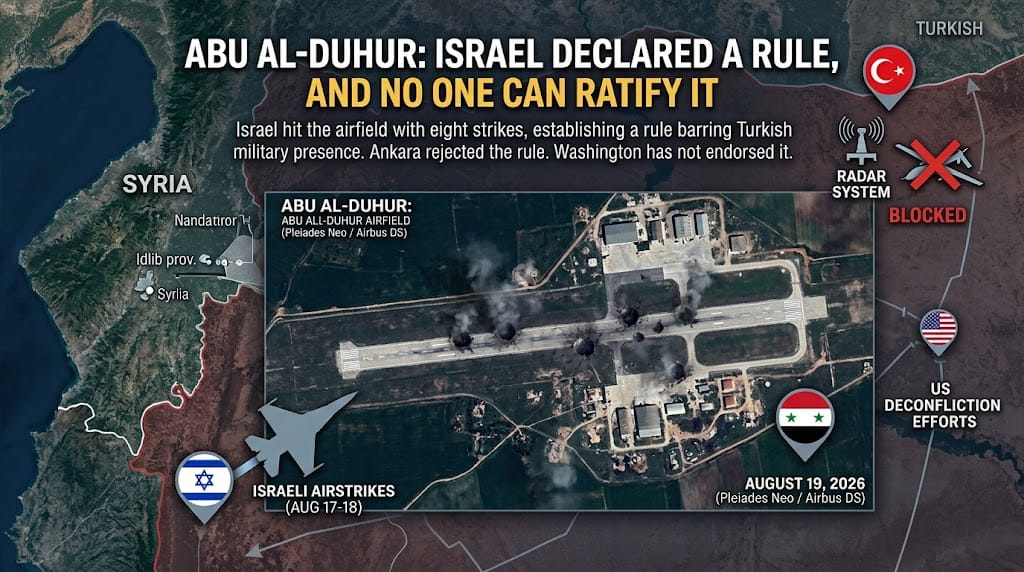
“Don’t be fooled,” a senior Israeli security source told Al-Monitor on August 21. “Turkey intended to place radar systems and attack drones at the Syrian air force base under Syrian cover. The information is very solid. The Turks know that we know, and the Syrians do too. Turkish military forces will not be deployed on Syrian soil. We have no intention of allowing this to happen.”
Eight strikes hit the runway and storage buildings at the Abu al-Duhur airfield in Idlib province overnight on August 17 and 18. No one was hurt. The field had not operated as a military airbase since 2013, and the Syrian Observatory for Human Rights, a Britain-based war monitor, reports that Turkey had been rehabilitating it. A Turkish delegation visited the base days before the strike. On August 14, Mossad chief Roman Gofman discussed Turkish deployments by phone with Syrian Foreign Minister Asaad al-Shaibani.
“Israel and Syria agreed to a status quo in security matters, which Syria was on the verge of breaching by permitting Turkish troops to deploy at an airbase near Aleppo,” Prime Minister Benjamin Netanyahu’s office said in an English-language statement late on August 18. Defence Minister Israel Katz wrote on X that Erdogan is dragging Turkey into dangerous adventures in Syria and that Israel will not let any actor threaten its security.
The field was not chosen for its distance from Israel. It sits roughly 300 kilometres north of the Israeli border and about 70 kilometres from the Turkish one. Ynet’s military analysis notes that Turkish detection and air defence systems placed there would reach across northeastern Syria, northern Iraq including the Kurdish region, and toward western Iran. The strike protected a route, not a border.
Ankara rejected the account entirely. Turkey’s Defence Ministry said on August 20 that no Turkish military delegation was at the base before or during the strike, and that Turkey will keep supporting Syria’s effort to build its own military capability. The Turkish presidency’s communications directorate called the claims from Netanyahu’s office an attempt to legitimise unlawful strikes on Syrian sovereignty.
Zekai Aksakallı, a retired lieutenant general who commanded Turkey’s special forces and now chairs OYAK, the armed forces pension fund and industrial holding, spoke live on CNN Türk. He said Israel has no capacity to match Turkey and that Turkey is not like other countries. He then described twenty six years of service in conflict zones that began with a rifle and an old pair of binoculars. These remarks are rendered from the Turkish broadcast, which has no published English version.
Tom Barrack, the US special envoy for Syria and ambassador to Turkey, told Reuters the strike “reflected a perception, whether accurate or misplaced, that Turkey might in the near future increase its presence at that base.” Turkey received no warning, watched aircraft head north, and could have responded. Washington began assembling a deconfliction mechanism for Israel, Syria and Turkey.
The rule has now been said out loud. No Turkish forces on Syrian soil. A rule like that lasts exactly as long as someone keeps enforcing it, and enforcing it means striking a country Washington is helping rebuild, against a NATO member Washington declines to call a threat. Iran never contested the rule aloud, because it could not. Ankara contested it the day of the strike.
