
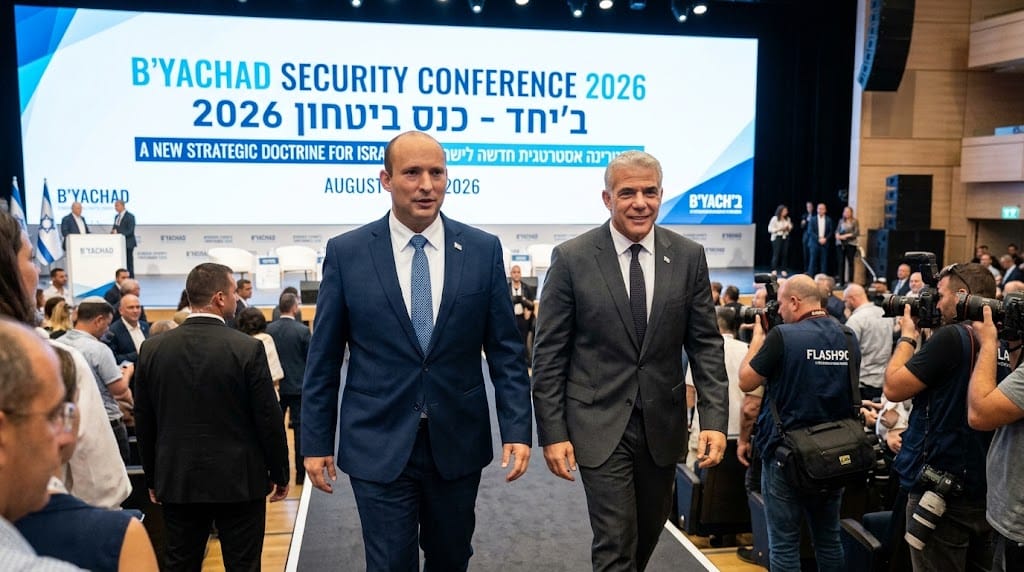
“If Hezbollah fires at us, we strike Iran. A strike by the Iranian octopus’s tentacles inside Israel’s borders will exact a price inside Iran’s borders,” Naftali Bennett said on August 19 at the security conference of B’Yachad, the joint list he formed with Yair Lapid’s Yesh Atid in April. The former prime minister and former defense minister was presenting the doctrine he will carry into the October 27 election.
Bennett organized the speech as a list of failed assumptions and their corrections. The Hebrew term he used, konseptzia, refers to a strategic premise that collapsed, first in 1973 and again on October 7. Assumption one holds that Iran fires at Israel in response to Israeli strikes in Lebanon. The correction reverses the direction of payment. Assumption two holds that Qatar is a complicated country. The correction designates it an enemy state. Assumption three lets Turkey and Qatar sit on the Board of Peace, the body overseeing postwar Gaza. The correction removes both, brings in Egypt, and keeps Israeli freedom of action intact.
The fourth correction is domestic. Bennett proposed treating the half million illegal weapons inside Israel as a security problem rather than a criminal one, deploying the Israel Defense Forces and the Shin Bet, Israel’s domestic security service, and declaring storage sites closed military zones.
Then came the conscription numbers. The IDF is short roughly 20,000 soldiers while some 100,000 healthy young haredi men do not serve. Yoram Cohen, a candidate for Yashar, the party of former IDF chief of staff Gadi Eisenkot, had floated an exemption covering 30 percent of the haredi draft cohort. Bennett’s answer, as reported in Hebrew by Ynet, was that exemption quotas, committees and frameworks always end in nothing, buying one more round at the expense of whichever naive politician signs them, with no haredi actually drafted.
Lapid, the list’s number two, opened his section by charging the government with “negligence, arrogance, and amateurism” in the handling of Israel’s diplomatic collapse. He set out six goals in order. First, relations with the United States and the return of bipartisan standing. Second, Europe, NATO, and public opinion in Spain, France and Ireland. Third, Diaspora Jewry as a strategic asset. Fourth, regional integration built on Egypt and the United Arab Emirates. Fifth, tying economic policy to foreign policy. Sixth, rebuilding public diplomacy.
For the first goal Lapid cited the July vote in the US House of Representatives. An amendment by Thomas Massie to cut off aid to Israel failed 314 to 104. Of the 104 votes in favor, 103 came from Democrats.
From there he went to the US-Israel memorandum of understanding on military assistance, signed in 2016 under Barack Obama. It provides $38 billion over ten years, made up of $3.3 billion a year in Foreign Military Financing and $500 million a year for joint missile defense programs, and it expires in 2028. This is the bilateral American-Israeli document, not the American-Iranian memorandum.
Abandoning it, Lapid said, is “a serious mistake by Netanyahu,” and Israel should fight for it rather than let it lapse. Since May, Benjamin Netanyahu has publicly sought to zero out the Foreign Military Financing grants while keeping part of the missile defense component. He backed Representative Marlin Stutzman’s resolution calling for a successor framework built on trade rather than aid, and repeated the position in Washington in late July.
On Qatar the two men agree, and Lapid introduced his own enemy state bill in February. On Saudi Arabia they agree as well, treating a peace agreement as a central objective while ruling out uranium enrichment on Saudi soil at any price. They diverge at one point, Turkey. Bennett removes it from Gaza. Lapid wants a mechanism that keeps the two militaries from colliding directly. “We do not need to create more and more regional conflicts, but to prevent them,” he said.
The memorandum expires in 2028, talks on its successor are already open, and the government seated after October 27 will conduct them. Netanyahu has converted American aid from something Israel defends into something Israel negotiates. Lapid can demand a fight for the memorandum, but he cannot name a figure. In the same vote he uses to prove the reserve of support, 103 Democrats voted to end the aid. What has been given up comes back on someone else’s terms.
