
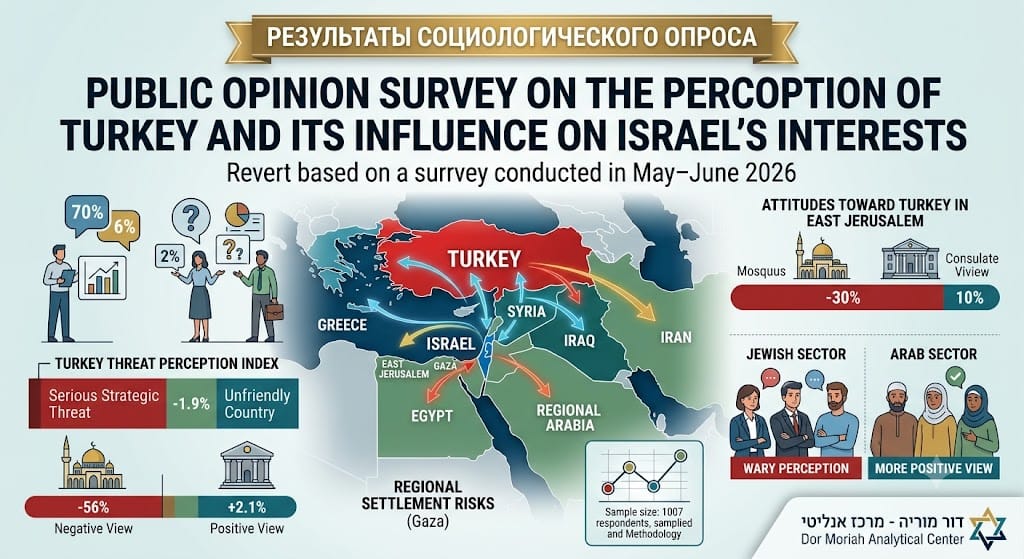
Most Israelis see Turkey as a source of threats and risks to the country’s security — above all in the context of East Jerusalem, Gaza, and a regional settlement. But anxiety does not translate into appetite for a hard line: responses are dominated by a preference for control and restriction rather than escalation. These are the findings of a survey conducted by the Dor Moriah Center in May–June 2026 among 1,007 respondents.
Turkey as a threat
Public opinion is colored by wariness and hostility. The most common response is “a serious strategic threat,” chosen by 34.4% of respondents. Another 28.5% regard Turkey as an unfriendly country, though not a direct threat to Israel’s security. Positive assessments are rare: only 4.9% see Turkey as friendly or as a country with the potential for friendly relations.
The topic itself is on most people’s radar: 18.3% follow it regularly and another 41.4% occasionally.
East Jerusalem — the sharpest divide
Turkey’s diplomatic activity in East Jerusalem draws a predominantly negative reaction: 38.6% rate it very negatively and another 21.7% somewhat negatively. Positive ratings total just 11.3%.
Attitudes toward Turkish education, culture, and religious projects in the city are somewhat softer but still negative on balance: 55.4% negative against 14.0% positive. Most respondents are unwilling to permit such activity freely — 45.5% believe it should be allowed only under limited conditions and strict control, and another 26.0% concede it may have benefits but insist on Israeli oversight.
Gaza and the regional settlement
A possible Turkish role in a post-war settlement in Gaza is more often viewed through the lens of threats: 36.7% believe it would create serious risks to Israel’s security and could strengthen hostile forces, while 28.2% see risks that international guarantees could contain. The structure of responses is much the same for the scenario of a stronger Turkey amid possible U.S.–Iran talks.
The main fault line is national
The most persistent divide runs between the Jewish and Arab sectors. Turkey is called a serious strategic threat by 39.9% of Jews and only 5.0% of Arabs. Strict control of Turkish activity in East Jerusalem is backed by 52.4% of Jews against 9.3% of Arabs. The most alarming scenario of a stronger Turkey in the regional process is chosen by 45.3% of Jews and 8.1% of Arabs. In the Arab sector, both the share of positive assessments and the share unable to answer run markedly higher.
Differences by level of religiosity surface most strongly on questions of threat and control. The religious and Haredi are more likely than others to call Turkey a serious threat (44.6%), to favor a strict regime of restriction in East Jerusalem (64.5%), and to see serious risks in a possible Turkish role in Gaza (56.0%).
Pragmatism and restraint
A negative view of Turkey does not automatically translate into support for confrontation. Asked what position Israel should take in the disputes between Greece and Turkey, 41.3% say Israel should avoid involvement, and only 35.8% favor more active support for Greece. On how Azerbaijan would behave in the event of a conflict, the dominant expectation is neutrality (36.4%).
Some responses register not only a stark perception of threats but also a pragmatic streak: 28.2% allow that the risks of Turkish involvement in Gaza could be contained with international guarantees, and 25.4% see in Turkey’s cooperation with the United States both risks and opportunities for regional stability.
The survey was conducted by the Dor Moriah Center in May–June 2026. The sample of 1,007 respondents is representative of internet users aged 18 and over; the Jewish and Arab sectors were represented in proportion to their share of the population. The maximum sampling error is ±3.1% at a 95% confidence level.