
Background: Gulf Monarchies, Israel, and the Muslim Brotherhood
The Muslim Brotherhood (MB) – a transnational Islamist movement – is viewed as a dire threat by many Middle Eastern regimes. Gulf monarchies such as Saudi Arabia, the UAE, and Egypt have outlawed the MB as a terrorist organization[1], fearing its revolutionary Islamist ideology. In contrast, Qatar (along with Turkey) has long been a patron of MB-affiliated groups. Qatar has “bankrolled Islamist movements for decades, becoming political Islam’s premier ‘sponsor’”. Doha hosted influential Brotherhood ideologues like Yusuf al-Qaradawi for years, and its Al Jazeera network often amplified MB narratives. Crucially, Qatar also bankrolls Hamas in Gaza – originally the Brotherhood’s Palestinian branch – by funding Gaza’s civil services and salaries (with Israel’s tacit approval). These Qatari funds “paid salaries and bought fuel in Gaza, reinforcing Hamas control”. Both Qatar and Turkey regard Hamas as a legitimate “resistance” movement rather than a terrorist group, providing its leaders safe haven (in Doha and Istanbul, respectively)
This alignment of Qatar/Turkey with the Brotherhood camp has brought them into conflict with the status quo bloc of the Middle East. In 2017, Saudi Arabia, the UAE, Bahrain, and Egypt imposed a blockade on Qatar, explicitly demanding it stop supporting the Brotherhood and Hamas. As Saudi Arabia declared at the time, Qatar “must cease all support for the Muslim Brotherhood and Hamas”. Though that Gulf rift was formally resolved in 2021, underlying tensions persist. Jordan (another monarchy) went so far as to ban the Brotherhood outright in 2025. In sum, there is a clear geopolitical fault line: a pro-Brotherhood axis (Qatar, Turkey, Islamist groups) versus an anti-Brotherhood coalition (most Gulf monarchies, Egypt, and increasingly Israel)
Israel’s stance has evolved in tandem. Hamas’s October 7, 2023 terror attack made plain that an MB-aligned threat endangers Israel’s security. Since then, Israel’s interests have largely aligned with those of the anti-Brotherhood Gulf states, even as it engages Qatar and Turkey diplomatically at times. The confrontation with Hamas has effectively linked Israel’s fight against terrorism with the Gulf monarchies’ fight against the Brotherhood’s influence. It is against this backdrop that Israel’s unprecedented strike on Qatari soil must be understood.
The September 2025 Israeli Strike in Doha
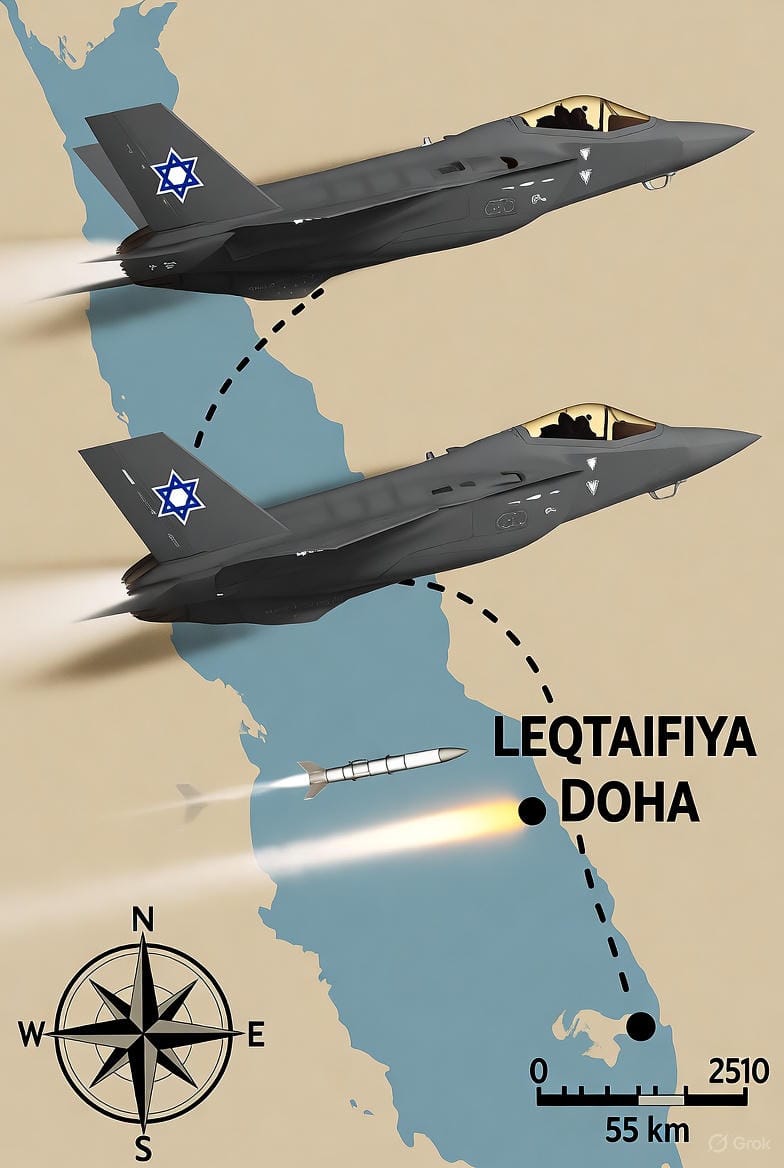
On September 9, 2025, Israel shattered diplomatic norms by launching a bold extraterritorial strike against Hamas leadership targets inside Doha, Qatar[2]. Multiple explosions rocked Doha’s upscale Katara and Legtaifiya districts, hitting a guarded residential compound suspected of housing senior Hamas officials. According to Israeli statements, the IDF and Shin Bet carried out a “precise strike targeting the senior leadership” of Hamas in Qatar – notably aiming for figures like Khalil al-Hayya and Zaher Jabarin, who were deeply involved in hostage ceasefire negotiations at the time. The message was unmistakable: The architects of the Oct. 7 massacre would “have no sanctuary – no matter where they hide”.
How the strike was executed also highlights possible regional coordination. As per reports, Israel deployed eight F-15 and four F-35 jets, which flew over the Red Sea and then fired ballistic missiles that arced through space over Saudi Arabia into Doha[3]. This innovative trajectory allowed Israeli forces to hit the target without directly entering Qatari airspace until terminal phase, breaching Qatar’s sophisticated air defenses with ease. The Wall Street Journal noted that Saudi airspace was overflown at high altitude – suggesting Riyadh’s radars either were informed of the operation or chose not to intervene. Indeed, U.S. officials later indicated they had warned Qatar shortly before the strike, likely to prevent inadvertent conflict (given the large American Al-Udeid airbase in Qatar)[4]. This implies that while the operation was kept covert, there was at least tacit coordination or deconfliction involving the U.S. (and by extension, possibly Saudi Arabia). Prime Minister Benjamin Netanyahu emphasized, however, that “Israel’s decision to act… in Qatar was a wholly independent decision”, taken by him and his security chiefs without American sign-off. Israel publicly assumed full responsibility for the strike, underlining that it was an Israeli initiative.
Casualties and impact: Hamas initially denied that its top leaders were killed, but acknowledged that five lower-ranking members died in Doha, along with some family members (including the son of Khalil al-Hayya). A Qatari security guard was also reportedly killed in the blast[5]. The strike thus failed to eliminate the highest Hamas figures, but it achieved a different objective: delivering a strategic shock. “You can hide. You can run. But we’ll get you,” Netanyahu said, rejecting any notion that the raid had “failed”. The operation conveyed that Israel will strike terrorists “no matter where they may be,” denying them immunity or safe haven anywhere on the globe. This principle, Netanyahu noted, dates back to Golda Meir’s pledge to hunt the perpetrators of Munich 1972 – a doctrine Israel continues to uphold[6].
Flanked by U.S. Secretary of State (and former Senator) Marco Rubio days later, Netanyahu reiterated the raid’s core message: if any country harbors terrorists, Israel reserves the right to act. He pointed out that after 9/11, the U.S. was applauded for pursuing Al-Qaeda in Afghanistan and even Pakistan; by the same token, “states do not have the right to shelter terrorists” with impunity. On the eve of the 9/11 anniversary, he delivered a direct warning to Qatar and others: “Expel them or bring them to justice. Otherwise, we will do it ourselves.”. In Netanyahu’s eyes, Doha had provided Hamas leaders with “luxurious villas and a safe haven” – a situation Israel would no longer tolerate. The Sept 9 strike in Doha was thus a deliberate signal that even wealth and distance won’t shield those deemed responsible for anti-Israeli terror.
Regional and international reactions were swift and mixed. Qatar’s government furiously condemned what it called a “cowardly and treacherous” attack, denouncing it as a flagrant violation of Qatar’s sovereignty and international law. Qatari Emir Sheikh Tamim bin Hamad Al-Thani labeled the strike “cowardly and treacherous” at an emergency summit, and Doha’s foreign ministry lambasted Netanyahu’s justification as “a shameful attempt to justify a cowardly attack”. Qatar noted pointedly that Hamas officials had been present in Doha as part of mediating ceasefire efforts at Israel’s and the US’s request – implying Israel betrayed a mediation arrangement. Within days Qatar convened an extraordinary summit of Arab and Islamic states on September 15, 2025, to rally opposition to Israel’s strike[7]. Publicly, a united front of Muslim-majority countries – including Qatar’s rivals – condemned Israel’s action. Saudi Arabia, the UAE, Egypt, Turkey, and others all issued statements criticizing the attack on Qatari soil. Even countries that normally align quietly with Israel found they had to “urge a review of ties” or at least voice outrage at the precedent of bombing an Arab capital. The Doha summit produced strong rhetoric (and talk of activating joint defense mechanisms) but stopped short of any concrete collective retaliation. In effect, the Arab states vented anger yet carefully avoided escalation.
Western reactions were cautious. The United States – which counts both Israel and Qatar as strategic partners – walked a diplomatic tightrope. Washington did not endorse the strike, worrying it could destabilize a key Gulf ally. Former U.S. President Donald Trump (back in office by 2025) remarked that Israel had to “do something” about Hamas but “must be very, very careful” with Qatar, pointedly calling Doha “a great ally to the United States.” The U.S. focus, as Secretary Rubio stated, was on the future – ensuring Qatar could still help secure a Gaza ceasefire and hostage releases despite the incident. Notably, U.S. officials reportedly provided Qatar with a heads-up before the strike, underscoring the delicacy of hitting a country hosting American forces. In the end, no Western power openly cheered Israel’s move, but there was also an undercurrent of understanding in some quarters (framed in the context of 9/11 analogies). Meanwhile, Israel insisted it would not hesitate to repeat such operations. When asked if Israel would refrain from further strikes on Hamas operatives in foreign countries, Netanyahu was unequivocal: “The principle that terrorists should not have immunity wherever they are… hasn’t changed.”
Possible Coordination with Gulf Monarchies
Despite their official condemnations, there are strong indications that certain Gulf monarchies quietly approved – or at least acquiesced to – Israel’s strike on Qatar’s Hamas haven. The very logistics of the attack imply tacit cooperation. Firing ballistic missiles into Doha required overflying or skirting the airspace of Saudi Arabia and possibly other Gulf neighbors. It appears Saudi air defenses stood down; there were no reports of interception attempts as the missiles traversed Saudi skies. Given Riyadh’s formidable radar coverage and U.S-supplied Patriot batteries, this suggests prior coordination or notification. It is plausible that Saudi Arabia (and perhaps Bahrain or the UAE) were silently informed via U.S. channels and chose not to object. This de facto green light aligns with the Gulf monarchies’ strategic interest in clipping the wings of Qatar’s Islamist clientele. For Saudi and Emirati leaders, who view the Muslim Brotherhood as a mortal enemy, an Israeli hit on Hamas’s Qatar-based leadership may have been privately welcomed – even if protocol demanded an official protest. Indeed, since 2011 these regimes have relentlessly targeted MB networks; Israel’s actions against Hamas fit their agenda of eroding Brotherhood influence in the region[8]
Earlier instances of Israeli-Gulf behind-the-scenes alignment lend credence to coordination. During Israel’s 2024 operations against Hamas figures abroad (e.g. a January 2024 drone strike killing Hamas commander Saleh al-Arouri in Lebanon, and a reported strike on Hamas chief Ismail Haniyeh in Tehran months later), Gulf intelligence services and Israel likely shared information on common threats. The Abraham Accords of 2020 had already formalized security cooperation between Israel and the UAE/Bahrain, and more quietly with Saudi Arabia. By 2025, Israel and the Gulf monarchies shared intelligence on Iran and extremist groups to an unprecedented degree, recognizing common foes in Hamas, Hezbollah, and their state backers. It stands to reason that this counter-Muslim Brotherhood cooperation also extended to Hamas. For example, when Saudi Arabia normalized relations with Hamas’s foe, the Palestinian Authority, it simultaneously kept Hamas at arm’s length – a stance in line with Israel’s. Thus, when Israel struck Hamas in Doha, Gulf leaders were likely of two minds: publicly outraged at the violation of an Arab state’s sovereignty, but privately relieved that Qatar’s freelancing was punished. As one regional analyst observed, “everyone [Arab leaders] agreed that Israel was wrong to bomb Doha… yet there was palpable schadenfreude beneath the surface in some Gulf capitals”[9].
There are hints that Riyadh and Abu Dhabi saw Israel’s move as a cautionary tale for Qatar. Soon after the incident, Saudi Arabia accelerated calls for a U.S.-backed Gulf security pact[10] – partly to constrain unpredictable actions (whether by Iran or even Israel), but also to ensure any future strikes on Gulf soil occur only in a coordinated framework. Notably, no Gulf state took concrete punitive steps against Israel beyond rhetoric. There were no breaks in diplomatic ties or cancellation of covert security contacts. This restraint suggests the Gulf monarchies did not truly wish to rupture relations with Israel over Hamas. They continue to view Iran and its proxies (as well as political Islamists) as bigger threats than Israel. In fact, behind closed doors, officials from Saudi Arabia, the UAE, and Egypt have long pressured Qatar to expel Hamas leaders. The Israeli strike achieved through force what Qatar’s neighbors had failed to accomplish through diplomacy – underscoring a convergence of Israeli-Gulf interests.
In summary, while open coordination is not acknowledged, Israel’s Doha operation can be seen as de facto aligned with the Gulf monarchies’ campaign against the Muslim Brotherhood network. It sent a message that even Qatar’s wealth and U.S. ties cannot completely shield Hamas. The episode likely intensified quiet intelligence sharing and understanding between Israel and Gulf security services. As a Western diplomat noted off-record, the strike “publicly embarrassed Arab leaders, but privately, many of those same leaders were nodding in agreement with Israel’s resolve.” The fault line between pro- and anti-Brotherhood states became sharper, possibly heralding deeper (if secret) coordination between Israel and the Sunni monarchies determined to check Islamist movements.
Qatar’s Influence in the U.S. and the “Qatargate” Scandals
One complicating factor in any concerted action against Qatar is its substantial influence in Western corridors of power – especially in Washington, D.C. Qatar has strategically leveraged its vast wealth and energy resources to build goodwill and influence in the United States. It hosts the U.S.’s largest Middle East airbase (Al-Udeid), making itself a linchpin of American military operations – a status that often earns Doha political latitude. Successive U.S. administrations have walked a fine line, valuing Qatar’s contributions (e.g. mediating hostage deals, providing LNG gas, and basing rights) even as they quietly acknowledge Qatar’s ties to groups like Hamas. This influence was on display post-strike: Washington urged caution precisely because “Qatar has been a great ally to the United States”, reflecting Doha’s successful positioning as an indispensable partner.
Beyond strategic assets, Qatar wields soft power and lobbying clout in the West. It spends generously on think tanks, universities, media, and lobbyists to shape narratives. For instance, Qatar donated hundreds of millions to prestigious U.S. think tanks (earning a controversial sway at institutions like the Brookings Institution), and has hired former high-ranking officials to advocate on its behalf. A notable case was retired U.S. General John Allen, president of Brookings, who was investigated by the FBI for allegedly lobbying for Qatar during the 2017 Gulf crisis – allegedly advising Doha on influencing U.S. policy in exchange for benefits[11]. (Although the DOJ probe was eventually closed, the scandal underscored Qatar’s behind-the-scenes influence operations.) Qatar’s state-funded media, Al Jazeera, also targets Western audiences (through AJ English and AJ+), building public sympathy for Doha’s viewpoints. These efforts translate into real political influence: during the 2017 Saudi-UAE blockade of Qatar, Qatar’s multi-million-dollar lobbying campaign in Washington helped temper the U.S. response and fend off isolation.
In Europe, Qatar’s influence-buying burst into a major scandal known as “Qatargate.” In late 2022, Belgian and EU authorities uncovered a corruption scheme in which Qatari (and Moroccan) interests allegedly paid bribes to European Parliament members to sway decisions in Doha’s favor[12]. Bags of cash were reportedly found with MEPs in a case that shocked Brussels. This exposed how far Qatar was willing to go to project “soft power” – in this case, outright corruption – to burnish its image or defend its policies in the West. The revelation of Qatargate in Europe embarrassed Qatar globally and strained its relations with EU states. Gulf monarchies likely took vindication from this, as they had long accused Qatar of underhanded tactics. It also gave Israel and the anti-Brotherhood camp ammunition to argue that Qatar’s agenda is nefarious and destabilizing beyond the Middle East.
Of particular note is U.S. Special Envoy to the Middle East Steve Witkoff, whose financial ties to Qatar raise potential conflicts of interest. In August 2023, Qatar Investment Authority, the country’s sovereign wealth fund, purchased Witkoff’s Park Lane Hotel in Manhattan for $623 million, providing substantial financial relief from a troubled real estate transaction[13]. Witkoff was the focus of Qatar’s extensive lobbying efforts during Trump’s first term, meeting with Qatari officials to discuss “business opportunities” according to foreign lobbying disclosures. Following his appointment as envoy, Witkoff has repeatedly characterized Qatar as “enormously helpful” in ceasefire negotiations and disputed characterizations of Qatar as aligned with Iran, despite reported Qatari financial support for Hamas[14].
These positions have prompted prominent Republicans, including major GOP fundraiser Eric Levine, to call for his dismissal, stating that his “performance is disqualifying because it demonstrates his utter incompetence”[15]. Hudson Institute analyst Michael Pregent has argued that Qatar effectively “purchased” Witkoff, who now advances Doha’s interests at the expense of American priorities[16].
Remarkably, in 2025 Israel faced its own “Qatargate” – a scandal uncannily similar in allegation (though different in nature) to the European one. Israeli media revealed that two of Netanyahu’s close associates – communications advisor Yonatan Urich and media consultant Eli Feldstein – were under investigation for allegedly accepting payments from Qatar to promote Doha’s interests within Israel. The Shin Bet and police probe, which Netanyahu decried as a “witch hunt,” found evidence that these aides took money (funneled via a U.S. lobbyist for Qatar) to push pro-Qatar messaging during the Gaza hostage negotiations in late 2023. Prosecutors allege the pair “worked to transfer messages to journalists” in Israel that portrayed Qatar sympathetically and minimized Egypt’s role as a mediator. In other words, Qatar may have effectively paid Israeli insiders to influence Israeli media coverage, ensuring Doha was credited as a benevolent mediator while sidelining rival mediators like Egypt. The suspects were arrested and face charges including bribery, money laundering, and breach of trust. It was further reported that one of them had been receiving a salary via an American lobbying firm registered under FARA for Qatar. This affair was swiftly dubbed “Qatargate” by the Israeli press.
The significance of Israel’s Qatargate is profound. It suggests that even as Israel and the Gulf states were aligning against Hamas and the Brotherhood, Qatar had managed to penetrate the Israeli establishment’s information sphere. As one analyst noted, the scandal “ties all bad things relating to Netanyahu together in one package” – linking his government to the policy of accommodating Hamas. It highlighted that Netanyahu’s administration had, for years, allowed Qatar to deliver suitcases of cash into Gaza (since 2018) as a means of quieting Hamas. Many now believe those Qatari cash infusions “strengthened Hamas” and indirectly enabled the deadly Oct 7, 2023 attack. In hindsight, critics accuse Netanyahu of “appeasing Hamas” via Qatar. The scandal angered not only the Israeli public but also Israel’s partners. Egypt, for one, was reportedly infuriated – as Cairo has consistently opposed Qatar’s role with Hamas. A former AP Middle East bureau chief warned that “risking [Israel’s] relationship [with Egypt] to curry favour with Qatar would be astonishingly short-sighted”, noting that President Sisi of Egypt is a “major enemy of the Muslim Brotherhood network… which Qatar has backed.” This underscores how Qatar’s meddling can undermine Israel’s relations with its natural allies against Islamism, like Egypt and the UAE.
For Gulf monarchies, the Israeli Qatargate likely reinforced their distrust of Doha. It proved that Qatar was willing to undermine both Israeli and Arab interests through influence peddling, all to boost its own standing. Gulf leaders, especially in the UAE and Saudi Arabia, who had been skeptical of Netanyahu’s dual-track approach (courting them while also dealing with Qatar), saw their suspicions confirmed. In their eyes, Qatar’s attempts to “buy” influence in Israel were akin to its bribery in Europe – a malicious strategy to protect Hamas and MB interests at others’ expense. This could have introduced some strain between Israel and the Gulf: for example, the UAE and Bahrain, which normalized ties with Israel in 2020, might have been unsettled to learn that Israel was simultaneously cutting side deals with Qatar to funnel money to Hamas. However, once the scandal came to light and Israel pivoted to a harder line (culminating in the strike on Doha), those Gulf states likely felt more assured that Israel was firmly on their side against the Brotherhood axis.
Indeed, Israel’s bold action against Hamas in Qatar in September 2025 can be seen as effectively closing ranks with the Gulf monarchies’ stance. It sent a public message that Israel would no longer indulge Qatar’s double game. The prior quid pro quo – where Israel tolerated Qatari cash to Gaza for short-term calm – was over. In its place, Israel embraced a doctrine much closer to that of the anti-MB Gulf states: zero tolerance for states harboring or financing Islamist militants. The coordinated diplomatic pressure after the strike (the Doha summit, etc.) may have publicly pit Israel against all Arab states including the Gulf, but behind closed doors Israel likely communicated to Riyadh and Abu Dhabi that the operation was aimed at Hamas, not at weakening Gulf security. Given their loathing for the Brotherhood, Saudi and UAE leaders could interpret Israel’s move as belatedly aligning with their long-held view that Qatar’s patronage of Islamist radicals must be confronted, not condoned.
Conclusion
Israel’s strike on Doha marked an unprecedented escalation – the first known direct attack by Israel on a Gulf state’s soil – and it underscored the shifting alliances in the Middle East. Publicly, it drew sharp condemnation and raised fears of a “new and perilous chapter” in the conflict[17]. Yet, in strategic terms, the operation highlighted a growing, if quiet, convergence of interests between Israel and the Gulf monarchies against the Muslim Brotherhood and its state sponsors. For years, Qatar (with Turkey) championed Islamist movements, while Saudi Arabia, the UAE, Egypt, and Israel found themselves on the same side of a regional cold war, opposing those movements[18]. The Doha strike of 2025 can be seen as a culmination of that trend – a coordinated (if unofficial) action sending a dual message. To Hamas and the Brotherhood: no refuge is truly safe. And to Qatar: its maverick support of Islamist causes now carries tangible risks, even at home.
However, this event also illuminates the constraints of such coordination. Qatar’s deep ties with Washington and importance to Western interests mean that Israel and the Gulf cannot simply isolate Doha without cost. U.S. caution – rooted in Qatar’s influence in Washington and its role as a “great ally” – serves as a reminder that Doha has powerful protectors. The “Qatargate” episodes in both Europe and Israel further reveal that Qatar’s influence-peddling can sow discord among those who oppose the Brotherhood. In Israel’s case, it nearly compromised the trust with Egypt and others[19]; in Europe’s case, it tarnished policymaking processes. Moving forward, Israel and its Gulf partners will need to navigate these complexities. They share a determination to check the Muslim Brotherhood’s reach – from Gaza to Doha to Ankara – but must do so without fracturing the necessary international consensus or provoking open conflict with Qatar.
From an analytical standpoint, the Israeli strike on Qatar’s soil may be viewed as a watershed. It demonstrated unprecedented Israeli-Gulf tacit cooperation against a common adversary, even as official relations remained outwardly cool. It also possibly strengthened the resolve of Gulf monarchies to press the U.S. for firmer security guarantees (to manage both Iranian threats and unpredictable fallout from actions like Israel’s)[20]. For Qatar, the episode was a sobering signal that its neighbors’ patience has limits – even the absence of formal war did not prevent a strike in its capital. Qatar’s influence in the U.S. and Europe might shield it diplomatically, but Israel showed that on the operational level, it is willing to act unilaterally when it perceives an existential threat.
In conclusion, the Israel-Qatar strike saga underscores a larger geopolitical realignment: Israel and several Arab states inching toward a coalition against Islamist extremism (and by extension, against Iran and its allies), while Qatar and Turkey find themselves more isolated in their support of the Brotherhood’s network. It’s a delicate balance – one where today’s covert partners could be tomorrow’s open allies or adversaries, depending on how the conflict with Hamas and the MB evolves. What is clear is that the influence of Qatar in Western halls of power and the Brotherhood’s deep roots across the region will continue to complicate this struggle. Nonetheless, the events of 2025 suggest that when it comes to confronting groups like Hamas, Israel and the Gulf monarchies are more aligned than ever before – even if that means striking in the heart of Doha to prove that “terrorists have no safe haven”.
[11] responsiblestatecraft.org