
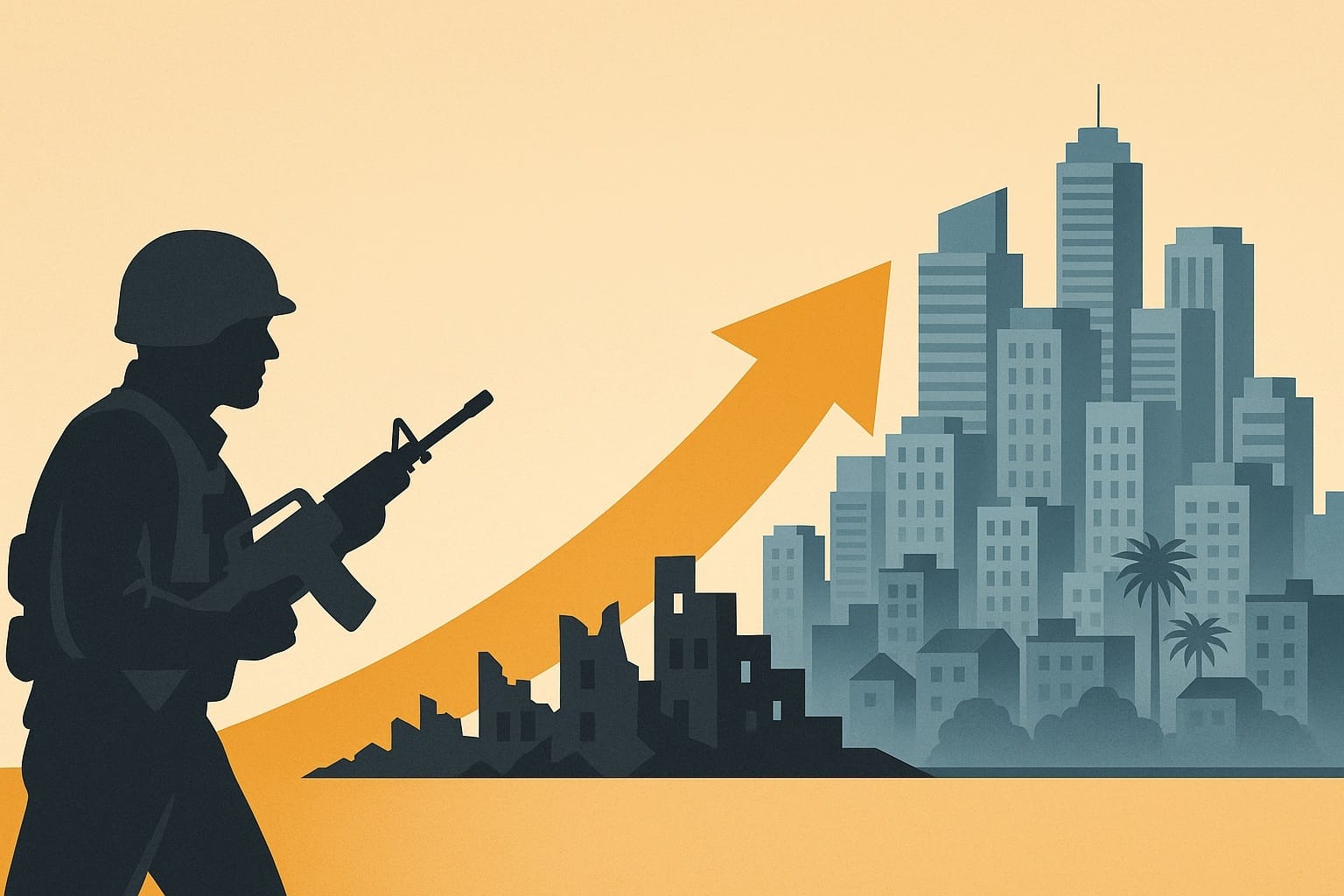
The Failure of Force
Seven decades of conflict and countless military operations haven’t brought us any closer to resolving the Gaza crisis. Each cycle of conflict, reconstruction, and renewed violence only strengthens radical forces. The evidence is clear: we’ve reached the limits of military solutions.
International data reveals a direct link between underdevelopment and violence. Research consistently shows that societies experiencing high levels of violence typically have lower human development indices. The critical threshold is an HDI of 0.7—below this marks “medium” development, while scores above indicate “high” development.
Conflicts trap regions in vicious cycles. They devastate human development, which in turn increases the likelihood of renewed conflict. Libya plummeted from 82nd place in global HDI rankings in 2012 to 108th by 2017. Syria collapsed from 128th to 155th.
The West Bank’s HDI declined from 0.716 in 2022 to 0.674 in 2023. The UNDP projects that Gaza’s human development will regress by more than two decades. With an HDI hovering around 0.5, Gaza sits squarely in the danger zone.
What if we could flip this dynamic on its head?
The Price of Doing Nothing
Every military operation in Gaza costs Israel billions of shekels (hundreds of millions of dollars). Operation Iron Swords alone has cost tens of billions. When you factor in air defense systems, reserve mobilization, and economic disruption, the costs are staggering.
But there are alternatives. Research shows that long-term investments in troubled territories deliver 3-5 times greater returns than military spending. The Marshall Plan transformed war-torn Europe into a prosperous region—and it cost less than the war itself.
Understanding Hamas’s Playbook
Hamas’s resilience doesn’t come from military strength—it comes from a sophisticated social system perfected by the Muslim Brotherhood since the 1920s. Four pillars support this system:
Clan solidarity forms the foundation. Extended families unite into hamulas—solidarity networks that provide mutual support and social protection. These aren’t just family ties; they’re comprehensive economic and social survival systems.
Local self-organization allows these hamulas to manage resources independently, create jobs, and resolve disputes. The state becomes irrelevant when communities become self-sufficient.
Decentralized leadership empowers each neighborhood and mosque with representatives who coordinate with central leadership while maintaining local autonomy.
Islamic finance avoids interest-based lending (riba), instead emphasizing profit-and-loss sharing that creates community buy-in and a sense of fairness.
How Hamas Controls Resources
Hamas has built an alternative aid distribution network that bypasses American-backed institutions like the Gaza Humanitarian Fund. Working through alliances with local clans and tribes, Hamas created “Clan Security”—a parallel structure that works alongside Hamas police forces.
This system allows Hamas to:
- Control all resources flowing into Gaza
- Reward cooperative clans while punishing dissent
- Build popular legitimacy through clan endorsements
- Sidestep international aid oversight
This social architecture—not weapons—is what keeps Hamas in power. Gazans support the system that feeds their families, provides healthcare, and educates their children, even as it oppresses them.
An Alternative That’s Already Working
Understanding Hamas’s playbook means we can build something better using the same clan-based principles—but channeled toward development instead of conflict.
We already have proof it works. In southern Gaza, Palestinian leader Yasir Abu Shabab openly coordinates with Israel while governing a de facto autonomous zone around Rafah. Abu Shabab condemned the October 7 attacks and has emerged as a real alternative to Hamas.
This isn’t theoretical—it’s happening right now. The challenge is scaling this model and creating systematic support for similar initiatives across Gaza.
Building, Not Destroying
Alternative resource distribution: Engage directly with clans and emerging leaders through transparent mechanisms that bypass Hamas completely. International aid flows directly to clan leadership, contingent on meeting specific development goals.
Empowering local alternatives: Provide financial and institutional support to groups like Abu Shabab’s that have proven they can cooperate effectively.
Competing security structures: Create new security frameworks rooted in traditional dispute resolution but operating under international oversight with modern standards.
Better social infrastructure: Build education, healthcare, and social protection systems that clearly outperform what Hamas offers.
Ethical banking: Develop a financial system compatible with both Islamic and Jewish law, enabling development without compromising religious principles.
Success means getting clans to switch their loyalty to more reliable, beneficial partners—not trying to dismantle the clan system itself. Abu Shabab’s experience shows that when alternatives prove superior, clans make rational choices.
The Goal: HDI Above 0.7
We propose a clear, measurable target: raise Gaza’s Human Development Index above 0.7. This means:
- Longer life expectancy
- Better education outcomes
- Higher per capita income
- Improved healthcare access
The beauty of this approach? It can’t be politicized. HDI calculations follow UN international standards that are independent of subjective interpretation.
A Municipal Framework
Gaza would be restructured into municipal zones that align with traditional clan territories and existing social networks. Each zone gets dedicated economic support from specific Abraham Accords partners—the UAE, Bahrain, Jordan, Saudi Arabia, or Egypt. This creates direct Arab state investment in the project’s success while diversifying funding sources.
The 4-S framework (Solidarity, Self-Organization, Self-Governance, Subsidiarity) and the unified HDI target above 0.7 remain consistent across all municipalities. This preserves territorial integrity and development standards while allowing for local specialization and cultural adaptation.
The 4-S Transformation Model
Instead of demolishing existing social structures, we transform them through:
Solidarity—Strengthening horizontal community connections.
Self-Organization—Supporting grassroots initiatives.
Self-Governance—Devolving authority to municipal structures.
Subsidiarity—Decentralizing resource management
This framework works with Palestinian clan society rather than against it.
What’s in It for Israel?
Security: Erode Hamas’s social foundation without reoccupying territory.
Economics: Address labor shortages through legal migration programs.
Financial: Reduce military spending and national debt.
Diplomatic: Lead innovative conflict resolution efforts.
Political: Frame this as violence prevention and regional development—not rewarding terrorism.
The Regional Vision: An Abrahamic Partnership without Muslim Brotherhood
Gaza represents phase one of a comprehensive regional transformation. The Abrahamic Regional Partnership includes Israel, the UAE, Bahrain, Jordan, Saudi Arabia, and Egypt—nations committed to new cooperation models. Several have already banned Muslim Brotherhood operations.
Within this framework, ethical banking for Gaza becomes part of a broader financial ecosystem that could transform how we approach troubled territories throughout the region.
Gaza becomes the proof of concept—transforming from a devastated enclave into a thriving region integrated with the broader economy. Success here creates a template we can scale from the Sinai to southern Lebanon.
UN agencies like UNICEF and UNDP could play constructive roles in this model.
The Implementation Roadmap
- Form an international working group including the US, Israel, Arab League, UN, and Palestinian Authority representatives
- Launch a pilot project in a designated Gaza district
- Establish an Islamic investment fund with a specialized mandate
- Engage community leaders in designing the system architecture
The Moment of Decision
We’re at an extraordinary convergence. Trump returns to the White House with a mandate for bold action. Saudi Arabia is seeking paths to regional stability. Israel needs sustainable security strategies.
The time for empty rhetoric is over. We need concrete action based on rigorous analysis and measurable outcomes. We can either perpetuate the cycles of conflict or build a model that transforms not just Gaza, but the entire region.
The choice is ours to make—right now.
This analysis represents expert recommendations from the Dor Moria Center to leadership in the United States, Israel, and Saudi Arabia for immediate implementation. The time for declarations has passed—we need concrete action that can reshape Middle Eastern history.