
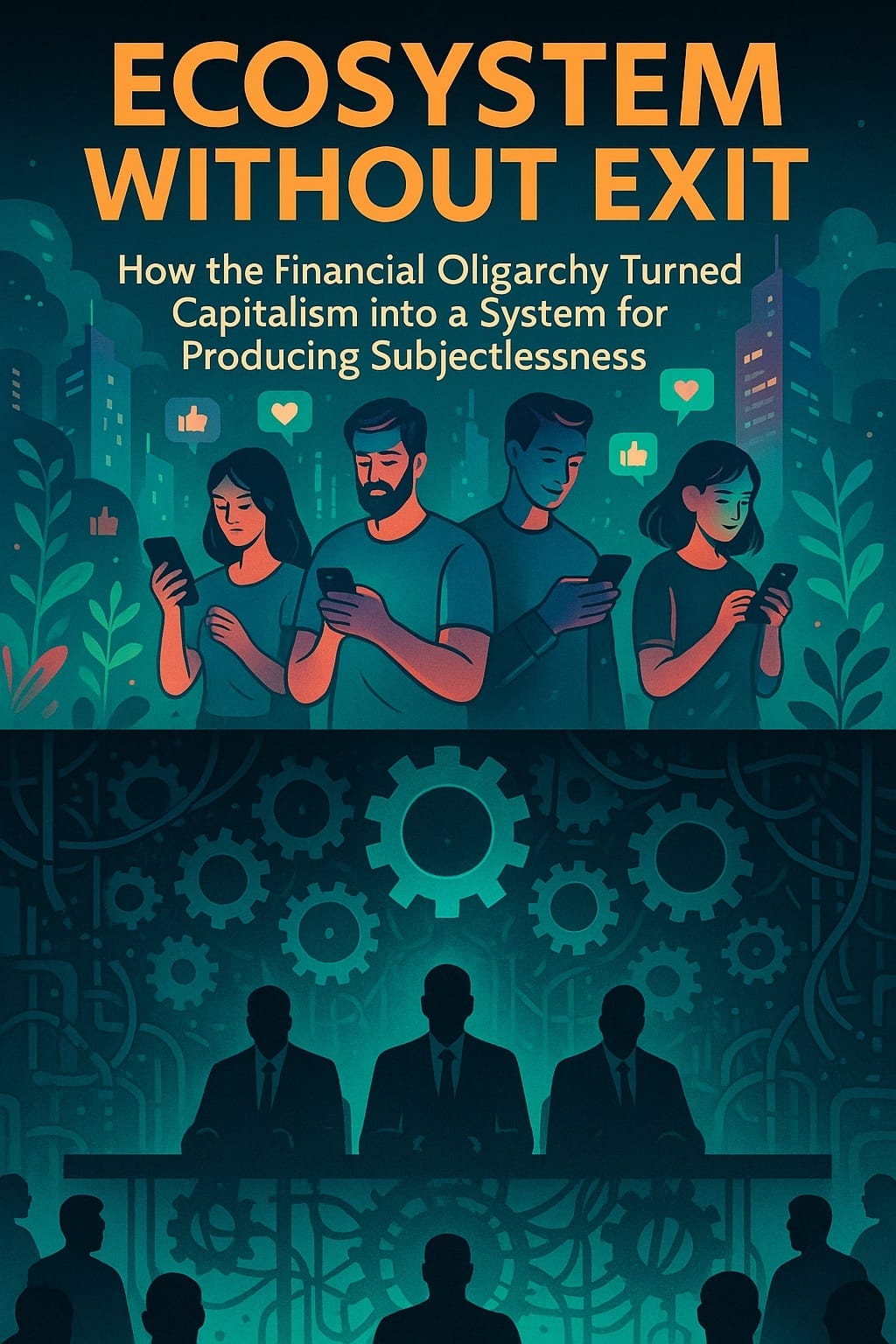
How Financial Oligarchy Turned Capitalism Into a System for Producing Subjectlessness
Wells’s Prophecy Fulfilled in Reverse
In H.G. Wells’s The Time Machine, humanity splits into two species: the beautiful, carefree Eloi living in gardens on Earth’s surface, and the grotesque Morlocks operating underground machines. The Eloi had no idea their comfortable existence was an illusion. The Morlocks fed, clothed, and protected them only to devour them.
One hundred thirty years after Wells’s novel, this division has come to pass—but the roles have been reversed. Today’s Eloi are us: billions of people immersed in the digital gardens of smartphones, social media, and streaming services. We enjoy the illusion of choice, freedom, and progress while remaining oblivious to the invisible machinery extracting value from our lives.
Today’s Morlocks don’t hide in underground caverns—they sit on the boards of BlackRock, Vanguard, and State Street. They aren’t physically hideous, but their system is morally grotesque. They don’t run steam engines; they run index fund algorithms controlling $24 trillion. They feed us cheap entertainment and easy credit to drain our life energy through interest, rent, and underpaid labor.
Just as Wells’s Eloi didn’t understand where their food and clothing came from, today’s Eloi don’t understand why they work harder than their parents yet live worse. Why education drowns them in debt. Why democratic elections never change economic policy. We don’t see that three financial companies vote our pension savings at shareholder meetings, determining the fates of corporations—and our own fates.
Over the past 30 years, since the collapse of the Soviet Union in 1991, this system of modern Morlocks has built an architecture of control resting on three pillars: concentration of capital in the hands of a narrow elite, corporate consolidation into oligopolistic structures, and capture of democratic institutions through the revolving door between finance and government.
This document is an attempt to descend into the modern Morlocks’ underground and expose the machines they operate.
Part I: The Architecture of Wealth Concentration
The Statistics of Accelerating Inequality
The numbers reveal unprecedented concentration: the top 1% in the United States controls 30.8% of national wealth, up from 22.8% in 1989. Within this elite, concentration is even more extreme—the top 0.1% owns 13.8% of all U.S. wealth. For the ultra-wealthy 0.01%, the entry threshold rose from €7.8 million in 1995 to €21.9 million by 2022 in real terms.
This trend is global. In Europe, the top 1% captures 12% of all annual national income—up from 10% in 1980. In the United States, that same 1% takes 20% of all income. Put simply: out of every €100 earned in Europe, €12 goes to the richest 1%. In America, out of every $100, the wealthiest 1% takes $20.
In terms of accumulated wealth, the gap is even more dramatic: in the U.S., the top 1% controls 30.8% of all national assets, while no other OECD country exceeds 27.1%—underscoring the exceptional nature of American inequality.
Comparing billionaire wealth growth to median income reveals the most dramatic divergence. Billionaire wealth grew by $2 trillion in 2024 alone—roughly $5.7 billion per day—three times faster than in 2023. The number of billionaires increased from 423 worth $1.9 trillion in 1996 to 2,781 worth $14.2 trillion by 2024.
Over the same period, median U.S. household income grew by just 49% across 48 years—barely 1% annually on average. The pandemic period illustrates this gap: while unemployment spiked and small businesses collapsed, the 12 wealthiest American billionaires increased their combined wealth by $1.3 trillion—a 193% increase from March 2020 to December 2024.
The Big Three: The Invisible Hand Running the Market
The concentration of power extends beyond individual billionaires’ fortunes. Three asset management firms—BlackRock, Vanguard, and State Street—control $24 trillion. BlackRock manages $11.5 trillion, Vanguard controls $10.4 trillion, and State Street holds $4.34 trillion.
This money belongs to millions of investors—from teachers with retirement accounts to billionaires with massive portfolios. But regardless of contribution size, voting rights at shareholder meetings transfer to the asset managers. Using these trillions, they have become the largest shareholders in 88% of S&P 500 companies.
This creates a triple concentration of power: the wealthy own enormous stakes directly, they also invest billions in index funds, and three companies vote all this money, amplifying the interests of big capital. The result: both the elite’s personal wealth and the middle class’s collective savings work to strengthen the financial oligarchy’s power.
The Rise of Passive Investing: Capitalism on Autopilot
Index funds are investment funds that automatically purchase shares of all companies in a given stock index (such as the S&P 500) in the same proportions. The system’s paradox is that the money belongs to millions of small investors who bought shares in these funds, but voting rights transfer to the asset managers.
In 2000, index funds controlled less than 5% of the U.S. stock market. By 2024, that share exceeded 50% and continues growing at 5-7% annually. Moody’s forecasts that by 2030, passive funds will control 80% of all assets under management in the United States. This means three companies, through their voting algorithms, will effectively govern the American economy without any democratic oversight.
The Big Three vote approximately 25% of shares in S&P 500 companies, and their influence is amplified by low retail investor participation. Academic research by Azar, Schmalz, and Tecu documented that such concentration reduces competition: when the same funds own shares in competing airlines, airfares are 3-11% higher than if those companies had different owners.
Millennials and Gen Z, comprising 50% of the workforce by 2025, invest primarily through mobile apps like Robinhood, which route funds to Big Three products by default. The automation of retirement savings through 401(k) plans creates “capitalism on autopilot“: monthly contributions automatically flow into index funds, strengthening the asset managers’ power without investors’ conscious choice.
At current rates, by the 2040s three companies could control more than half of voting shares in American public corporations.
The Trajectory Toward Total Concentration
Research by Bebchuk and Hirst provides precise mathematical projections: the Big Three asset managers will control 34% of votes in S&P 500 companies by 2028 and 41% by 2038. These figures are based on an observed annual decline of 0.84% in non-Big Three holdings.
Thomas Piketty’s mathematical model r>g (return on capital exceeds economic growth) predicts a return to 19th-century patrimonial capitalism. At current rates, by 2050 the top 0.1% could control 25% of global wealth, while the top 1% could hold over 50%. This is not linear extrapolation but the result of exponential accumulation through compound interest, inheritance, and rent extraction.
Credit Suisse forecasts that the number of billionaires will double by 2030, reaching 5,500 individuals with combined wealth of $25 trillion.
Corporate Consolidation: Eliminating Competition
The merger and acquisition boom since 1991 has created unprecedented market concentration across all major sectors. Since 2000, more than 790,000 M&A deals worth $57 trillion have been announced globally—meaning roughly 90 independent companies disappeared every day for a quarter century.
This consolidation represents systematic elimination of competition and creation of oligopolistic structures. Where dozens of independent players once existed, 3-4 corporations now dominate:
- Banking: Four megabanks control 70% of all U.S. deposits
- Technology: Google acquired over 200 companies (YouTube, Android); Facebook bought Instagram and WhatsApp; Microsoft absorbed LinkedIn, GitHub, and Activision
- Aviation: Four mega-carriers replaced dozens of airlines
- Media: Five conglomerates own what once belonged to hundreds of independent outlets
- Beer industry: Two corporations control 70% of the global market
- Healthcare: Between 1998 and 2023, more than 2,000 hospital mergers occurred; by 2023, 68% of all community hospitals belong to large systems
The Ownership Revolution and Class Division
Concentration of financial assets represents a fundamental shift in the nature of capitalism. The top 1% owns 54% of all shares in American companies (up from 40% in 2002), while the top 10% controls 81% of stock wealth. The bottom 80% of the population owns just 8% of shares.
This creates a self-reinforcing cycle: returns from stock appreciation and dividends concentrate among those already wealthy, and through compound interest, the gap accelerates rapidly—capital begets capital in geometric progression.
Asset structure reveals class division. For the middle class, a home is the primary asset: the bottom 50% hold more than half their wealth in real estate. But for the elite, real estate represents just 13% of the portfolio (for the top 0.1%, only 9%). The wealthy hold their wealth in stocks, bonds, and businesses—assets that grow faster than inflation and generate passive income.
When the stock market rises 20%, the rich get much richer. When the real estate market falls, the middle class loses its primary wealth while the elite barely notices the decline.
Part II: Social Destruction and Atomization
The Erosion of Social Mobility
The American Dream—the idea that hard work allows you to climb the social ladder—is statistically dead for most. A child born into a poor family in the U.S. has only a 7.5% chance of reaching the top 20% by income in adulthood. In Denmark, that figure is 11.7%; in Canada, 13.5%.
More dramatically: 70% of children born into the poorest 20% will remain in the bottom 40% for life. The probability of falling down is now higher than climbing up. For white men born into middle-class families, the probability of staying middle-class or rising is 63%. For Black men, it’s only 33%.
Intergenerational income elasticity—a measure of how much parents’ income predicts children’s income—is 0.47 in the U.S. (1.0 would mean complete transmission of inequality). This is worse than most developed countries. Scandinavia shows 0.15-0.20, meaning much greater mobility.
Education has become the main barrier. The gap between costs and outcomes has reached absurdity. Average cost of four-year higher education: $35,331/year at private universities, $10,662/year at public ones (for state residents). Over 40 years, costs have risen 1,200%—eight times faster than wage growth.
The Privatization of Education: The Debt Trap
The result is $1.7 trillion in student debt, affecting 43 million Americans. Average undergraduate debt: $37,338; for master’s degrees, $70,000-100,000. Medical school leaves an average debt of $200,000-300,000.
This debt burden has cascading effects:
- Delayed home purchases (average age of first purchase rose from 28 to 36)
- Delayed marriage and childbirth (average age of first child rose from 23 to 27)
- Inability to accumulate wealth (median savings for millennials at 35 is 40% lower than boomers at the same age)
- Pressure to choose “safe” corporate careers over entrepreneurship or public service
Education has transformed from a social elevator into a mechanism for perpetuating inequality. Wealthy families buy access through “donations” to universities. The middle class goes broke. The poor either don’t attend or accumulate crushing debt.
The Housing Crisis: A Basic Need Made Unattainable
The housing market has transformed from a place to live into a financial asset for speculation. The median home price rose from $177,900 (2000) to $495,100 (2024)—a 178% increase. Over the same period, median household income grew only 49%.
Home price-to-annual income ratio rose from 3× (1970s) to 7× (2024). This means buying requires seven years of a family’s full income (before taxes and expenses)—mathematically impossible for most.
Institutional investors—BlackRock, Blackstone, Invitation Homes—buy entire neighborhoods of houses at 20% above market price, converting them to rentals. In some suburbs of Atlanta, Phoenix, and Las Vegas, institutional investors own 30-40% of single-family homes. Local buyers can’t compete with corporations’ cash offers.
Rental as a control mechanism. Average rent rose 30% from 2019 to 2024. In major cities, typical rent consumes 50-60% of after-tax income (the recommended maximum is 30%). This leaves minimal savings, creating a vicious cycle: unable to save for a down payment, people keep renting, transferring wealth to landlords.
Homeownership for millennials: 42% versus 68% for boomers at the same age. Forecasts for Gen Z are bleaker still. For the first time in American history, a generation is emerging for whom owning a home is an unattainable luxury rather than a middle-class norm.
Household Debt: Financial Fragility
62–67% of Americans live paycheck to paycheck. This means no reserves: one unexpected medical procedure, car breakdown, or layoff equals immediate crisis.
The average American carries $21,800 in credit card debt alone. Average interest rate: 21-25%. With minimum payments, repayment takes 15-20 years and doubles the debt through interest.
Total U.S. household debt reached $17.5 trillion (2024):
- $12 trillion in mortgages
- $1.7 trillion in student loans
- $1.6 trillion in auto loans
- $1.1 trillion in credit card debt
- The rest: medical debt, personal loans
Medical bankruptcies: 530,000 families file for bankruptcy annually due to medical bills—66% of all personal bankruptcies. This is unique to the U.S. among developed nations.
The destruction of retirement. The shift from defined benefit (guaranteed pension) to defined contribution (401k) transferred risk from employers to workers. 55% of Americans 55+ have $0 in retirement savings. Among those who have savings, median retirement funds equal $120,000 (enough for 3-4 years).
20% of people 65+ continue working (12% in 1980)—not by choice but necessity. The Walmart greeter has become a symbol of the American Dream’s failure: work until death or face poverty in old age.
The Atomization of Civic Life
The decline of union membership. 1950s: 35% of workers in unions. 2024: 10% (6% in the private sector). Amazon spends $4.2 million/year on “union avoidance consultants.” Walmart closes stores where workers attempt to organize.
The death of “third places” (Ray Oldenburg). Spaces outside home and work—bars, cafes, libraries, community centers—have disappeared or been privatized. Starbucks kicks out people sitting without purchases. The result: no places for spontaneous encounters, no community formation, no space for political discussion.
The collapse of local media. 2,500+ local newspapers have closed since 2000. “News deserts”: areas without a single local outlet. The replacement: Facebook’s algorithmic feeds. The result: no shared information space, everyone sees their own version of reality, fragmentation instead of common narrative.
The destruction of civic institutions. Robert Putnam’s Bowling Alone: people stopped participating in collective activities. Membership in civic organizations: down 60% since the 1970s. Church attendance: down 50% since the 1990s. Volunteering: down 40% since the 2000s.
The loneliness epidemic. 61% of young adults (18-25) feel “seriously lonely” (Cigna, 2020). Average number of close friends dropped from 3 (1990) to 1 (2020). 25% of Americans report having no one to discuss important matters with.
Mental health. 13.2% of adults take antidepressants (CDC, 2020). Among women 40-59: 24%. Suicides have risen 30% since 2000. “Deaths of despair” (alcohol, drugs, suicide): 150,000/year in the U.S.
Part III: Mechanisms of Ideological Domination
Media Concentration: Controlling the Narrative
In 1983, 90% of American media was owned by 50 companies. By 2024, that same 90% is controlled by 5 conglomerates:
- Comcast (NBCUniversal)
- Disney (ABC, ESPN, Marvel, Pixar, Star Wars, 21st Century Fox)
- Warner Bros. Discovery (CNN, HBO, Warner Bros.)
- Paramount Global (CBS, MTV, Nickelodeon, Paramount Pictures)
- News Corp/Fox Corporation (Fox News, Wall Street Journal, New York Post)
This concentration means a handful of boards of directors control the information available to 330 million Americans. When five companies own nearly all television networks, newspapers, film studios, and streaming services, the boundaries of “acceptable discourse” narrow dramatically.
Media owners = financial elites. Disney’s board composition: BlackRock’s CEO, senior executives from Mastercard and Apple. Comcast: representatives from JPMorgan Chase, Goldman Sachs. These people sit on the boards of financial giants and media corporations simultaneously, creating a direct channel for capital’s influence over information.
The advertising model as censorship. 80% of traditional media revenue comes from advertising. The largest advertisers: pharmaceutical companies, the financial sector, oil and gas corporations. Critical coverage of these industries = loss of ad revenue. Result: self-censorship without formal directives.
The Fox News vs. Dominion case (2023): Fox paid $787.5 million for spreading lies about election fraud. But internal documents revealed management knew the claims were false yet continued broadcasting because truth hurt ratings. Profit > truth—an officially documented business model for the largest news network.
Think Tanks: Consensus Factories
Think tanks are presented as “independent research institutes,” but most are funded by corporations and billionaires to produce “scientific” justifications for their interests.
Heritage Foundation ($80 million/year)—far-right, funded by Coors, DeVos, Koch. Promotes deregulation, privatization, tax cuts. Project 2025—a detailed plan to dismantle the federal government.
American Enterprise Institute ($60 million/year)—neoconservative, funded by ExxonMobil, Chevron, Philip Morris. Denied the smoking-cancer link in the 1990s, climate change in the 2000s.
Cato Institute ($30 million/year)—libertarian, founded by the Koch brothers. Advocates abolishing minimum wage, Social Security, public education.
These institutions produce hundreds of “studies” annually, cited by politicians and media as “expert opinion.” But the authors are hired ideologues, and conclusions are predetermined: always in sponsors’ favor.
Liberal think tanks are also compromised. Center for American Progress is funded by Wall Street. Brookings Institution receives millions from corporations and foreign governments. “Independent” economic policy recommendations are written with input from those whose interests they’re supposed to regulate.
Political Influence: Legalized Corruption
Lobbying: $4.2 billion spent on lobbying in the U.S. (2023). This is legalized bribery—companies pay for access to legislators and for writing laws in their favor.
Top lobbies:
- Pharmaceuticals: $350 million/year (3 lobbyists per member of Congress)
- Financial sector: $600 million/year
- Oil and gas industry: $150 million/year
- Technology: Google $11.2 million, Amazon $19.3 million, Meta $19 million
“Revolving doors”—the movement of personnel between corporations and government. Approximately 50% of Congress members become lobbyists after leaving office (among committee leaders, up to 70%). Their salaries increase 10× after the transition.
Goldman Sachs has supplied Treasury Secretaries under four administrations:
- Robert Rubin (Clinton)—repealed the Glass-Steagall Act, returned to Citigroup
- Henry Paulson (Bush)—orchestrated the 2008 bank bailout, including Goldman
- Steven Mnuchin (Trump)—passed tax reform favoring the wealthy
BlackRock has hired 84 former regulators since 2004. Spent $42 million on lobbying since 2009. Holds meetings with the White House every two weeks.
Citizens United (2010)—a Supreme Court decision equating corporations with people and money with speech. Result: unlimited corporate financing of political campaigns through Super PACs. $6.9 billion spent on the 2024 elections—10 times more than in 2000.
Educational and Ideological Influence
Universities have transformed from centers of critical thinking into corporate training facilities. Harvard Business School receives millions from Wall Street. Finance professors consult for the same banks they should be studying critically.
University endowment funds are invested in the same hedge funds and private equity as billionaires. Harvard—$53 billion, Yale—$41 billion, Stanford—$36 billion. Their financial interests are aligned with capital’s interests.
Donations create dependence. The Koch Foundation department at George Mason University was renamed after Charles Koch following his $50 million donation. The donor gained a say in hiring professors.
Mainstream economics teaches neoclassical theory as the only truth. Alternative schools (Marxist, institutional, ecological economics) are marginalized. Students learn that markets are perfect and self-regulating, while government intervention is distortion.
World Economic Forum—the Young Global Leaders program has raised a generation of politicians: Macron (France), Trudeau (Canada), Kurz (Austria). Since 1993, the program has graduated thousands of future leaders indoctrinated with “stakeholder capitalism”—capitalism with a human face that in practice strengthens corporate power.
Elite Coordination Forums
The World Economic Forum (Davos)—the main coordination center for transnational capital. Annually, 2,500 participants pay enormous sums:
- Strategic Partners: $600,000/year
- Partners: $120,000/year
- Members: $60,000/year
- Plus $28,000 for a forum ticket
For this money, corporations gain direct access to heads of state, finance ministers, and central bank governors. With Klaus Schwab’s departure in 2025, the organization is led by Larry Fink (BlackRock CEO) and André Hoffmann (Roche vice chairman)—a symbolic transfer of power from old industrial capital to financial capital.
The Bilderberg Group—closed annual meetings without minutes or press. The 2024 meeting in Madrid gathered 131 participants: tech elite (Eric Schmidt, Peter Thiel, Sam Altman), financiers (Ana Botín, Henry Kravis, Goldman Sachs), politicians (NATO Secretary General, EU finance ministers, national security advisors).
Decisions made at Bilderberg mysteriously become government policy within 6-12 months.
Council on Foreign Relations (CFR)—functions as the American branch of the global elite. 250 corporate members pay up to $100,000 annually. The publication Foreign Affairs shapes foreign policy consensus, while closed briefings connect Wall Street to the State Department.
The network power of corporate directors. Research on board interlocks revealed: 746 individuals control 30% of seats on Fortune 500 boards—over 5,400 positions in the hands of fewer than a thousand people. 78% of the top 50 S&P 500 companies are directly connected through shared directors.
When one person sits on the boards of JPMorgan, ExxonMobil, and Boeing simultaneously, they become a node for transmitting strategic information and coordinating interests across sectors.
Part IV: The Ecology of Co-optation
How the System Turns Threats Into Decorations
Having described the architecture of control, a question arises: why don’t alternative projects—cooperatives, Fair Trade, organic agriculture, even cryptocurrencies—become threats? The answer: capitalism doesn’t suppress alternatives with brute force—it integrates them.
Three Stages of Co-optation
Stage 1: Isolation. A new alternative project is marginalized through underfunding, media neglect, and legal barriers. Banks won’t lend. Regulators create obstacles. Most die here.
Stage 2: Exoticization. If a project survives, it becomes an “interesting case” for TED Talks and academic conferences. Radicalism is defanged through admiration. “Look at these interesting people!”
Stage 3: Commodification. The idea becomes branding, scaled through capitalist mechanisms, losing its original mission. It becomes a niche product.
Cases of Co-optation
Organic Agriculture
1970s: radical critique of agrochemicals and capitalist agriculture. Communes, collectives, counterculture, visions of local decentralized ecological systems.
2024: a $200 billion market. Whole Foods is owned by Amazon. Walmart sells organic. Nestlé, Coca-Cola, General Mills own “organic” brands. Large agribusinesses buy organic farms. Monsanto/Bayer are alive and thriving.
Result: not the destruction of agribusiness, but the creation of a premium niche legitimizing the overall system. “See, you have a choice!” (if you can pay twice as much).
Fair Trade
The idea: direct connections with producers, bypassing exploitative supply chains, fair prices for farmers in the Global South.
Reality: Fair Trade certification = marketing tool. Nestlé, Starbucks sell Fair Trade lines while continuing exploitation in others. Premium pricing: 80% goes to middlemen, 20% to farmers.
Result: consumer indulgence (“I buy ethical”). Structural exploitation untouched. Nestlé uses Fair Trade for reputation management.
Crypto-Anarchism
2009-2013: Bitcoin as “freedom from states and banks.” Decentralization, anonymity, “be your own bank.” Libertarian utopia.
2024: Bitcoin—a speculative asset, not a medium of exchange. BlackRock launched a Bitcoin ETF. Traditional finance has integrated crypto. 90%+ of transactions = speculation, not use.
Result: “revolution” turned into a line item in a portfolio. A new asset class for financial capital.
ESG (Environmental, Social, Governance)
Environmental threat → profit source. ESG investment market: $35 trillion (2023). BlackRock, Vanguard sell ESG funds. The biggest polluters (Shell, BP) are in ESG portfolios.
Carbon credit market: $850 billion. Companies buy “indulgences” instead of cutting emissions.
Greenwashing: Shell advertises investments in “green” energy (1% of budget) while 99% goes to oil and gas. “Sustainability” as branding, not business model change.
The Structural Advantage of Scale
The problem with alternatives isn’t that they “don’t work well.” The problem is that scale itself is power, and alternatives structurally cannot achieve it.
Infrastructure power: AWS, Azure, Google Cloud control 65% of cloud hosting. “Sovereign” alternatives cost 10× more. Mondragón (80,000 workers, €12 billion revenue) can’t compete with Amazon on delivery speed—not because it’s worse organized, but because Amazon has its own logistics infrastructure.
Access to capital as a weapon: BlackRock lends to Amazon at 1-2%—nearly free money. Amazon can dump prices until monopoly. A cooperative gets credit at 6-8%, if at all. In a price war, the alternative is doomed.
Network effects: Facebook with 3 billion users has greater value than 1,000 alternatives with 3 million each. Even if an alternative is technically superior, it loses because “all your friends are on Facebook.”
Political power: $4.2 billion on lobbying (2023). Alternatives don’t write laws. Laws create barriers for alternatives.
The Systemic Function of “Permitted Dissent”
Paradox: the more successful an alternative, the less it threatens the system. Its success becomes proof of pluralism.
Mondragón has existed for 70 years. €12 billion in revenue is impressive. But that’s 0.04% of Fortune 500 revenue. Every critique of capitalism is met with: “What about Mondragón?” The existence of a successful cooperative legitimizes capitalism, neutralizing the argument that “the system doesn’t allow alternatives.”
To grow to €12 billion, Mondragón had to: hire McKinsey consultants, open non-cooperative branches in China, compete by capital’s rules. “Success” = integration into capital’s logic.
Rojava (autonomous region in northern Syria, 2 million population) inspires Western leftists. Democratic confederalism, gender equality. But no one tries to scale the model. Function: exotica for intellectuals, channeling energy toward solidarity with distant struggles instead of organizing at home.
The Zapatistas have held on for 30 years because they don’t try to take Mexico City. Localized in impoverished Chiapas. They don’t threaten national interests. Scaling = repression.
Part V: The Production of Subjectlessness
Why Understanding Doesn’t Lead to Action
Even if an alternative is theoretically viable, it needs a mass base—people with time, resources, and psychological energy. But the system systematically destroys these conditions.
Material Paralysis
Debtors don’t make revolutions. A student with $100,000 in debt goes to a corporation, not to activism. A 30-year mortgage chains you to your job. $1.7 trillion in student debt—a mechanism for disciplining a generation.
The gig economy: Uber—5 million drivers who never see each other. An algorithm distributes orders. One person’s strike is invisible. Coordination is impossible.
Compare: a factory in the 1930s—1,000 workers strike, production stops. Uber in 2024—1,000 strike, 4,999,000 keep working.
Time as scarcity: 40-60 hours of work, 2-hour commute, domestic survival. 1-2 hours left for escapism. Activism requires leisure. The exhausted don’t revolt.
Cognitive Paralysis
Information overload: 1,000 articles about climate collapse every day. Result: cynicism, apathy. “Doomscrolling” instead of action.
System complexity: BlackRock owns shares in 18,000 companies. Boycott Amazon? They own AWS—a third of the internet. Every action feels like a drop in the bucket.
Capitalist realism (Mark Fisher): “It’s easier to imagine the end of the world than the end of capitalism.” TINA (“There Is No Alternative”) is internalized at an unconscious level.
Psychological Paralysis
The loneliness epidemic: 61% of young adults feel lonely. Collective action requires trust. The lonely don’t have it.
Individualization of collective problems: climate crisis → “recycle.” Exploitation → “time management.” Systemic problems turned into personal responsibility. Shame instead of anger. Therapy instead of politics.
Consumer identity: “I’m vegan” instead of “I’m fighting agribusiness.” Lifestyle choice instead of political action. The system encourages this—consumption doesn’t threaten production.
The Absence of Resistance Infrastructure
Unions destroyed: from 35% (1950s) to 10% (2024). Third places gone: no meeting spaces. Local media dead: 2,500 newspapers closed. Institutional memory lost: young people don’t know how to organize a strike.
Part VI: The Dialectic of Deadlock
These aren’t two separate problems. The ecology of co-optation exists BECAUSE there’s no subject to destroy it. And the subject is impossible BECAUSE the ecology destroys it. A closed loop.
Why alternative success kills radicalism: For Mondragón to grow, it had to play by capital’s rules. “Success” = integration into capital’s logic.
Why radicalism survives only in marginality: The Zapatistas hold on because they’re local. Any attempt at scaling = repression or co-optation.
Funding as a leash: NGOs receive grants from elites. Condition: don’t question capitalism. “Acceptable” criticism: ESG, inclusivity. “Unacceptable”: expropriation. Those who play by the rules survive.
False Agents of Change
The precariat is too atomized. Climate activists are funded by elites; their rhetoric: “pressure governments,” not “destroy ExxonMobil.” 28 COP conferences → 0 change.
Electoral leftists—a pressure relief valve. Sanders, Corbyn channel anger into elections. When they come to power, they betray (SYRIZA), get blocked (Corbyn), or get overthrown (Allende).
The intelligentsia has academicized protest. Thousands of articles, conferences, careers within the system. Audience: other academics. Zero political effect.
Conditions Making a Subject Impossible
No common place: the factory created the proletariat. Today: remote work, gig platforms. No space for “we.”
No common time: a strike requires simultaneity. Today: different schedules, time zones.
No common enemy: you could see the feudal lord. Modern exploitation: BlackRock owns everything → you can’t boycott. An algorithm exploits → how do you fight an algorithm?
Repressive infrastructure: every communication is monitored. Algorithms suppress radical content. Militarized police. “Anti-terrorism” laws applied to activists.
Conclusion: Honesty as an Ethical Position
МWe don’t promise victory. We offer clarity.
For decades, leftists have said: “cooperatives will grow,” “the masses will awaken,” “the climate crisis will mobilize.” Reality: cooperatives remain a niche (70 years of Mondragón = 0.04% of the economy), the masses are more atomized than ever, and the climate crisis breeds cynicism, not mobilization.
A comforting lie is worse than an honest diagnosis. False hope → disappointment → demoralization. Honest diagnosis → sobriety → the possibility of seeing real opportunities.
The central question isn’t “how to defeat the system”—that was the 20th-century question, when a subject (the organized proletariat) existed. The 21st-century question is:
Can a subject capable of systemically changing capitalism emerge at all, or has the system learned to produce its own invulnerability through producing subjectlessness?
We don’t know the answer. Perhaps system collapse (ecological, financial, geopolitical) will create conditions. Perhaps a technological breakthrough will shift the balance. Perhaps the Global South will build an alternative.
But we cannot know this in advance. The only thing we can do is see reality clearly, without comforting illusions.
Asking the right question matters more than a thousand false answers. Recognizing the deadlock within existing strategies isn’t defeat—it’s the beginning of searching for what might work.
History hasn’t ended. Capitalism isn’t eternal—it’s destroying its own ecological and social conditions for existence. The question is what comes next: a consciously built alternative or chaos and new barbarism.
Act if you feel compelled. But act with open eyes, without illusions of quick victory. Act not because victory is guaranteed, but because living in truth matters more than living in comforting lies.
List of sources:
- Visual Capitalist — https://www.visualcapitalist.com/visualized-the-1s-share-of-u-s-wealth-over-time-1989-2024/
- World Inequality Database — https://wid.world/news-article/whats-new-about-wealth-inequality-in-the-world/
- The Conversation — https://theconversation.com/these-three-firms-own-corporate-america-77072
- World Inequality Report 2018 — https://wir2018.wid.world/executive-summary.html
- Inequality.org — https://inequality.org/facts/global-inequality/
- Pew Research Center — https://www.pewresearch.org/social-trends/2020/01/09/trends-in-income-and-wealth-inequality/
- Cambridge (Business and Politics) — https://www.cambridge.org/core/journals/business-and-politics/article/hidden-power-of-the-big-three-passive-index-funds-reconcentration-of-corporate-ownership-and-new-financial-risk/30AD689509AAD62F5B677E916C28C4B6
- Rolling Stone — https://www.rollingstone.com/politics/politics-features/2008-financial-bailout-809731/
- Wiley Online Library — https://onlinelibrary.wiley.com/doi/abs/10.1111/jofi.12698
- SSRN / Wiley Online Library — https://onlinelibrary.wiley.com/doi/abs/10.1111/jofi.12698
- Love Money — https://www.lovemoney.com/gallerylist/77379/from-rockefellers-to-rothschilds-how-five-oldmoney-dynasties-live-today
- Trilateral Commission — https://www.trilateral.org/about/
- Fast Company — https://www.fastcompany.com/90209537/the-web-of-board-members-that-link-american-corporations-mapped
- World Economic Forum — https://www.weforum.org/about/leadership-and-governance/
- Public Intelligence — https://publicintelligence.net/2024-bilderberg-participant-list/
- Council on Foreign Relations — https://www.cfr.org/membership/corporate-members
- GV Wire — https://gvwire.com/2018/07/09/how-blackrock-wields-vast-influence-over-government-and-the-economy/
- Asia Times — https://asiatimes.com/2021/03/biden-blackrock-and-climate-bubble-trouble/
- Gabriel Zucman — https://gabriel-zucman.eu/files/AJZ2019.pdf
- International Consortium of Investigative Journalists — https://www.icij.org/investigations/paradise-papers/paradise-papers-long-twilight-struggle-offshore-secrecy/
- Tax Foundation — https://taxfoundation.org/data/all/global/corporate-tax-rates-by-country-2024/
- The First Amendment Encyclopedia — https://firstamendment.mtsu.edu/article/media-concentration/
- Oxford Academic — https://academic.oup.com/joc/article/75/3/195/7978978
- PubMed — https://pmc.ncbi.nlm.nih.gov/articles/PMC7054854/
- Washington Examiner — https://www.washingtonexaminer.com/politics/3320366/federal-lobbying-hit-record-4-4-billion-in-2024/
- CREW (Citizens for Responsibility and Ethics in Washington) — https://www.citizensforethics.org/reports-investigations/crew-reports/a-bitter-pill-how-big-pharma-lobbies-to-keep-prescription-drug-prices-high/
- Tucson Sentinel — https://www.tucsonsentinel.com/nationworld/report/021325_lobbying_record/
- Washington Examiner — https://www.washingtonexaminer.com/politics/3320366/federal-lobbying-hit-record-4-4-billion-in-2024/
- The Washington Post — https://www.washingtonpost.com/business/2021/11/05/pharmaceutical-industry-drug-price-lobbying/
- OpenSecrets — https://www.opensecrets.org/news/2025/03/lobbying-firms-scored-record-earnings-in-2024/
- The Good Lobby — https://thegoodlobby.eu/who-funds-think-tanks-and-why/
- World Economic Forum (Social Mobility Report) — https://www3.weforum.org/docs/Global_Social_Mobility_Report.pdf
- OECD — https://www.oecd.org/en/publications/intergenerational-social-mobility_223106258208.html
- IDEAS/RePEc — https://ideas.repec.org/a/oec/ecokac/5km33scz5rjj.html
- Education Data — https://educationdata.org/student-loan-debt-statistics
- The Motley Fool — https://www.fool.com/money/research/average-household-debt/
- Bureau of Labor Statistics — https://www.bls.gov/opub/ted/2025/weekly-earnings-of-nonunion-workers-were-85-percent-of-union-members-earnings-in-2024.htm
- Bowling Alone — http://bowlingalone.com/
- Pew Research Center — https://www.pewresearch.org/2025/05/08/americans-trust-in-one-another/
- University of Chicago — https://chicagounbound.uchicago.edu/cgi/viewcontent.cgi?article=12151&context=journal_articles
- MIT Sloan — https://mitsloan.mit.edu/ideas-made-to-matter/heres-how-much-2008-bailouts-really-cost
- University of Michigan News — https://news.umich.edu/bailout-of-financial-sector-during-great-recession-was-a-bad-deal-for-taxpayers/
- IMF — https://www.imf.org/en/Publications/Books/Issues/2024/01/09/The-IMF-and-the-European-Debt-Crisis-529235
- Economic Policy — https://www.economic-policy.org/73rd-economic-policy-panel/covid-bailouts-to-save-the-economy/
- Public Integrity — https://publicintegrity.org/inequality-poverty-opportunity/covid-divide/companies-took-covid-19-aid-they-laid-off-90000-workers-anyway/
- The Washington Post — https://www.washingtonpost.com/graphics/2020/business/coronavirus-bailout-spending/
- Corporate Europe — https://corporateeurope.org/en/international-trade/2015/05/ttip-talks-despite-pr-still-under-cloak-secrecy
- NBER — https://www.nber.org/system/files/working_papers/w25914/w25914.pdf
- Cambridge (Business and Politics) — https://www.cambridge.org/core/journals/business-and-politics/article/hidden-power-of-the-big-three-passive-index-funds-reconcentration-of-corporate-ownership-and-new-financial-risk/30AD689509AAD62F5B677E916C28C4B6
- Impakter — https://impakter.com/blackrock-esg-antitrust-lawsuit-investments/
- The Conversation — https://theconversation.com/these-three-firms-own-corporate-america-77072
- Beyond Intractability — https://www.beyondintractability.org/bksum/putnam-bowling
- World Inequality Report 2018 — https://wir2018.wid.world/executive-summary.html