
Two national surveys conducted by the Dor Moria Center in 2025—June’s “Arab-Israeli Conflict: Israeli Public Opinion” and October’s “Trump’s Gaza Plan: Israeli Attitudes”—tell a consistent story of cognitive dissonance. Both studies surveyed over 1,000 respondents each. The surveys, based on questionnaires developed by the Dor Moria Analytical Center, were conducted by the Geocartography Sociological Center.
In just four months (June–October), polling shows Israelis backing mutually exclusive approaches: a maximalist annexation posture toward Palestinian territories and a U.S.-brokered de-escalation track. The tension isn’t just theoretical; it’s telltale of a society that’s lost the thread between stated aims and workable choices.
Awareness Without Understanding
Ninety-seven percent of respondents say they’ve heard of Trump’s Gaza plan—headline-level awareness is widespread. Yet only 9% report real familiarity with its contents. The remaining 88% operate on headline cues rather than detail: they’ve caught the gist, but haven’t engaged with specifics.
Among those who know the plan only by name, 48% still believe it would advance the Abraham Accords. A plausible read is brand-based reasoning—”Trump” plus “peace”—substituting for engagement with the trade-offs the plan actually entails.
Aims at Odds: Annexation vs. Diplomacy
In June 2025, one-third of Israelis (30.8%) supported full annexation of the West Bank and Gaza—the most radical of all proposed positions. Among religious Israelis, this figure reached 57%. The creation of a Palestinian state was supported by a mere 9.5%.
On its face, the public seemed to favor a forceful solution. But four months later, in October, 41% of these same respondents declared that Trump’s plan—which envisions a ceasefire, return of hostages, troop withdrawal, creation of a temporary Palestinian government, and amnesty for Hamas members—corresponds to Israel’s security interests. Half (48.3%) believe this plan will strengthen relations with Arab countries.
These findings are hard to square. Supporting full territorial annexation while endorsing a plan that envisions Palestinian self-governance is internally inconsistent. Backing the elimination of Palestinian autonomy while expecting improved Arab relations runs against regional realities.
A plausible read is episodic, stimulus-driven reasoning rather than strategy. “Annexation” signals strength—positive. “Trump’s plan” invokes American backing—also positive. The logical connection between these positions goes unexamined.
Victory Without Peace?
Another revealing contradiction: 56% of Israelis are confident that military victory over Hamas will ensure long-term stability. At the same time, in June, 62% stated that even after annexation, peaceful coexistence with Palestinians is impossible.
On balance, this suggests a belief in militarily-achieved “stability” that somehow coexists with permanent enmity. The gap between stability and peace remains unexamined—as though indefinite occupation without conflict were a coherent end state.
Among those 44% who don’t believe in the effectiveness of military victory, 28% propose a solution: permanent military presence in Gaza. That’s not strategy; that’s a policy loop. If military victory doesn’t work, the proposed fix is… more military presence.
Geopolitical Blind Spots: BRICS? China? Not on the Radar
The geopolitical blind spot in Israeli public opinion is particularly striking. Almost 40% don’t know how Trump’s plan will affect Global South countries—BRICS, Africa, Latin America. Only 14% see this as problematic.
More telling still: 71% of Israelis believe the plan can be implemented without the participation of Russia, China, and India. In a world where these countries drive economic and political processes in the Middle East—where China is the largest trading partner of all regional players, where Russia maintains military bases in Syria and is planning troop deployments at the request of Syria’s new leadership—Israeli respondents remain confident that U.S. support alone suffices.
That’s not optimism so much as a risky carryover from decades of U.S.-centric priors. Israeli public opinion remains anchored in the 1990s, when Washington truly was the sole superpower. But 2025 is a world of BRICS+, a world of multipolarity. Underweighting that reality means building plans on outdated foundations.
The Missing Ideological Lens
The most significant blind spot is ideological. This goes beyond misunderstanding the adversary—it represents a fundamental failure to assess the conflict’s nature.
First, the numbers: only 6.7% of Israelis believe Trump’s plan accounts for the Muslim Brotherhood factor—the transnational organization whose ideology underlies Hamas. Almost a third (32%) are certain this aspect is not considered at all, and another 35% believe it’s only partially addressed. Crucially, this gap does not register as alarming.
Now recall the June study: a third of Israelis (32%) perceive the conflict as an existential struggle between Judaism and Islam. If you recognize the religious-ideological dimension, the logical response would be to address ideology directly—understand its roots, identify the conditions under which it flourishes, develop counter-strategies.
Yet here lies the central paradox. Anyone familiar with the history of radical movements knows that extremist ideology thrives on poverty, humiliation, and lack of prospects. The Muslim Brotherhood began with charity and social work in Cairo’s slums for precisely this reason. Hamas controls Gaza not only through coercion but also by providing services—food, healthcare, education—filling the void left by absent state capacity. Radicalism is not airborne contagion; it’s despair in religious framing.
Notably, among religious Israelis—people who should best understand the power of faith-based motivation—only 0.8% view economic development of Gaza as a path to security. Less than one percent. Among secular Jews, the figure is slightly better at 5.7%, but still marginal.
Put differently: respondents acknowledge fighting a religious ideology that converts desperate populations into militants. They understand that Hamas is backed by the Muslim Brotherhood’s transnational network, built over nearly a century of ideological work. Yet they categorically refuse to consider undermining the socio-economic base on which this ideology depends.
Among those who doubt the effectiveness of military victory, only 15.7% propose countering the ideology of radical Islamism, and 6.8% suggest economic development for Gaza. Instead, 28% insist on permanent military presence. In other words: if military victory doesn’t work, the answer is sustained military occupation. Trump’s plan doesn’t address ideology—and that’s treated as unremarkable. The economic roots of radicalization go unaddressed—and that registers as normal.
Two Israels: Religious vs. Secular Fault Lines
Both studies confirm a disheartening fact: Israel is split into two societies with irreconcilable views on the future.
Religious Israelis:
- 20 percentage points less likely to consider Trump’s plan aligned with security interests (26% vs. 46% among secular Jews)
- Nearly 12 points more likely to believe in military victory (64% vs. 53%)
- Twice as likely to support annexation (57% vs. 23%)
- Six times more likely to propose permanent occupation as a solution (46.5% vs. 22% among secular Jews)
- Almost never consider economic development as a security factor (0.8%)
Secular Israelis:
- More pragmatic in assessing geopolitics
- More often support working with regional actors (18% vs. 7% among religious)
- Twice as likely to see the need for alternative Palestinian leadership (19% vs. 9%)
- More skeptical about military solutions
The challenge is demographic: the balance is shifting toward the religious sector, which is simultaneously the most maximalist and least engaged with external realities. This is a community that privileges theological frameworks over geopolitical calculus, and its influence on national policy is growing.
Consensus Fatigue
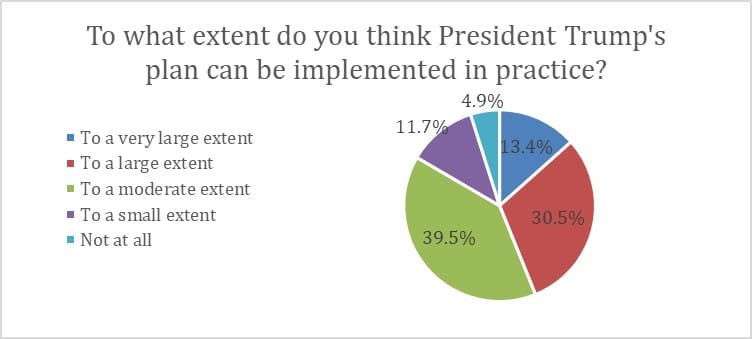
One thread runs through both studies: deep pessimism regarding any solutions. In June, 62% stated that even annexation would not lead to peace. In October, only 13% expressed confidence in the full feasibility of Trump’s plan.
Israeli public opinion trusts neither diplomacy, nor military force, nor annexation, nor negotiations. Yet respondents continue to endorse one approach, then another—not out of conviction in their effectiveness, but from fatigue and the need for movement. This is support for process over outcome, for action over resolution—anything to avoid stasis.
Conclusion: A Society Trapped in Its Own Contradictions
The two Dor Moria studies reveal not simply a societal split along ideological lines—they demonstrate a public that has lost the capacity to reconcile its stated preferences with available choices.
Israelis inhabit a world of cognitive dissonance: they want annexation and peace, believe in military victory yet doubt it brings stability, support diplomacy yet reject compromise, acknowledge the religious dimension of conflict yet ignore ideological drivers.
Ninety-seven percent have heard of Trump’s plan; only 9% understand it. This is a metaphor for the broader discourse: everyone has opinions, few have examined the trade-offs. Everyone demands solutions, no one is prepared for their consequences.
Most critically, this is a public that operates as though the 1990s never ended. While Israelis debate the merits of annexation versus military victory, the world is shifting. BRICS expands, China deepens its Middle East footprint, multipolarity becomes fact. Yet Israeli opinion remains anchored in the assumption that Washington’s backing alone suffices—underweighting Beijing, New Delhi, and Moscow.
This is a path to isolation—both from the international community and from internal coherence. A society unable to reconcile its desires with constraints, its fears with realities, risks remaining locked in perpetual conflict—not because solutions are unavailable, but because it cannot agree on what it wants.