
Two Conceptions of the State
The Dor Moriah analytical center has conducted sociological research for several years studying Israel’s social divisions. We identified a form of division that we’ve designated with the metaphor of the “ontological bubble.” This is a model describing the formation of two interconnected, simplified and antagonistic worldviews within a single state-forming ontology.
The Israeli-Palestinian conflict is typically framed as a clash between liberal democracy and Islamist terrorism. This model assumes a monolithic Israel that operates according to Western norms. The reality is far more complex: two incompatible ontologies are battling for control within the country itself.
Secular-liberal Israel centers on Tel Aviv and the old Ashkenazi elite. They see the state as a European democratic project where the conflict can be resolved through territorial compromise and where Palestinians possess human rights. Their legitimacy comes from international law.
Religious Zionist Israel lives in the settlements and follows leaders like Smotrich and Ben-Gvir. For them, the state fulfills a divine promise. The land from river to sea belongs to Jews by religious right, and Palestinians are the modern incarnation of the biblical Amalek. Their authority comes straight from sacred texts.
A pragmatic apparatus mediates between these worldviews—the military, intelligence services, Likud, and Netanyahu himself. This isn’t a third ontology but rather a management technology. These pragmatists switch between languages depending on their audience: democratic rhetoric for the West, security talk for the domestic electorate.
Until October 7, 2023, this pragmatic center held things together. Hamas’s attack shattered that balance completely.
Religious Zionists Take the Reins
The 2022 elections fundamentally shifted Israel’s power dynamics. Smotrich became both Finance Minister and minister overseeing Civil Administration in the West Bank. Ben-Gvir took control as National Security Minister.
After the terror attack in Huwara (February 2023), Smotrich didn’t mince words: “The village needs to be wiped out. The state should do it.” Ben-Gvir regularly brands Arabs as enemies. When Heritage Minister Eliyahu suggested using nuclear weapons against Gaza in November 2023, he was removed from cabinet meetings—but kept his job.
For religious Zionists, international law carries no weight. Only religious texts matter.
The Mass Shift
The October 7 massacre triggered a profound transformation in Israeli society. Today, 72% of Israeli citizens support using whatever force necessary, while 58% believe the current level of force is either sufficient or insufficient. Support for a two-state solution has plummeted from 43% in 2022 to just 24% in 2024.
Here’s the critical point: Israelis now widely claim that everyone in Gaza is a terrorist—even babies. This represents a collective abandonment of the liberal distinction between combatants and civilians in favor of wholesale categorization.
Israeli society has walked away from the very framework that underpinned its Western legitimacy. The liberal distinction between Hamas and ordinary Palestinians? It’s gone. Religious Zionists never believed in it, but now mainstream Israelis have junked it too.
The pragmatic apparatus didn’t resist this shift—it enabled it. The IDF abandoned its doctrine of minimizing casualties for total war. Netanyahu threw in his lot with the religious Zionist ontology. The liberal framework is politically dead.
Mirror Absolutes
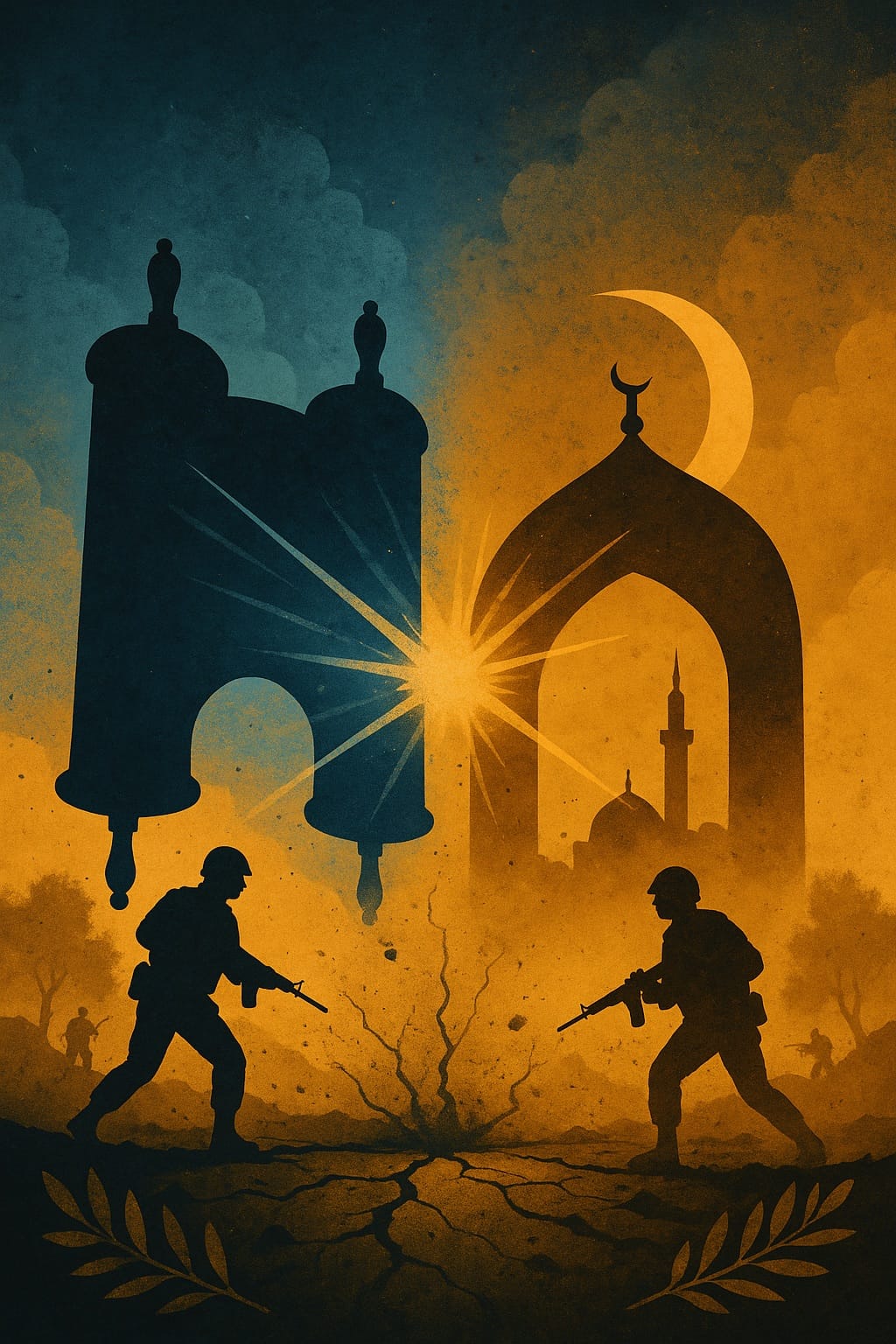
The religious Zionist ontology mirrors Hamas’s worldview perfectly, just with opposite signs. Both draw legitimacy from holy books—the Torah and the Quran. Both frame this as a sacred war where compromise means betraying God.
Hamas sees all of Palestine as waqf—inalienable Islamic land. Religious Zionists see all of Eretz Israel as God’s promise. Palestinians become the biblical Amalek in Israeli rhetoric. Jews become occupiers to be expelled in Islamist discourse.
The combatant-civilian distinction becomes meaningless to both camps. Hamas considers jihad every Muslim’s obligation. Religious Zionists view all Gazans as a collective threat.
Both sides sanctify martyrdom: shahada for Hamas, dying for the land for settlers. Both reject Western norms with equal fervor: jihad trumps the Geneva Conventions, the Torah overrules UN resolutions.
This isn’t civilization versus barbarism. These are twin religious absolutes staring at each other across the battlefield.
The October 7 Trap
We shouldn’t understand the October 7 massacre as mere military attack or simple terrorism—its military impact was negligible. Instead, it was an ontological sabotage, carefully designed to provoke Israel into actions that would validate Hamas’s narrative while destroying the liberal framework.
Here’s how it worked: Commit atrocities so horrific—rapes, families burned alive, babies kidnapped—that a measured, proportional response becomes psychologically impossible. Force Israel to unleash massive firepower. Deliberately blur the lines between civilian and military by operating from hospitals and schools. When Israel inevitably strikes these targets, showcase the casualties as evidence of genocide.
Israeli society, watching the West condemn them despite October 7, reaches a bitter conclusion: If we’re going to be accused of genocide no matter what, why play by rules our enemy ignores? Religious Zionists feel vindicated: “We told you this was an existential war. Now everyone can see it.”
The result? Israel ends up proving everything Western students believed about it. Hamas achieves ontological victory even in military defeat. Western youth see sixty thousand dead Palestinians as proof of “genocide” and “colonialism.” Within Israel, the liberal elite loses all credibility while religious Zionists gain strength.
It’s a perfect vicious cycle: Hamas commits an atrocity → Israel lurches rightward → massive retaliation follows → the West condemns → further radicalization → new Hamas recruits emerge.
When Language Dies
Liberal ontology once provided a shared vocabulary. Human rights claimed universality. International law offered neutral arbitration. Two states for two peoples suggested a territorial fix. The combatant-civilian distinction contained violence. Both sides could pretend to follow the rules, keeping negotiations alive.
That language has evaporated. The two religious ontologies share zero common ground. For Hamas, the entire land is waqf—compromise equals sin. For religious Zionists, the land is God’s gift—partition means betrayal. There’s no neutral referee: both sides dismiss the UN and international law. There’s no brake on the violence.
Within Israel, liberal voices have lost all credibility. “Peace Now” gets dismissed as the naivety that enabled the massacre. Western liberal Zionists face an impossible choice: supporting Israel means endorsing actions that violate their core values. Among Palestinians, moderates have been sidelined. Hamas has proven its point: nonviolence achieves nothing; only force delivers.
Trump’s Plan: Resurrecting a Corpse
On September 29, 2025, President Trump rolled out a 20-point plan to end the Gaza war. It calls for an immediate ceasefire, all hostages returned within 72 hours, amnesty for Hamas members who embrace “peaceful coexistence,” international stabilization forces, and Gaza run by a “technocratic, apolitical” Palestinian administration supervised by a “Board of Peace” that Trump himself would chair.
Through an ontological lens, this plan represents a textbook attempt to revive a framework that’s already flatlined. It completely misses the fundamental transformation that October 7 triggered.
The Technocratic Fantasy: The plan envisions “technocratic, apolitical” governance for Gaza. But this conflict left technical administration behind long ago. Religious Zionists see any Palestinian governance as theft of divine inheritance. Hamas views any non-Sharia government as betrayal.
The Neutral Arbiter Mirage: The “Board of Peace” assumes the international community can play referee. But both religious ontologies reject outside authority entirely. Hamas answers only to Allah. Religious Zionists answer only to the Torah.
Reason Meets Faith: Offering Hamas fighters amnesty for disarmament assumes they’re making rational cost-benefit calculations. But jihad isn’t a career choice—it’s a sacred duty. Abandoning jihad equals apostasy, a fate worse than death.
Territorial Tunnel Vision: Promising that Israel won’t occupy or annex Gaza resurrects the logic of land-for-peace. But Hamas considers all of Palestine to be waqf—indivisible Islamic territory. Religious Zionists see all of Eretz Israel as their divine inheritance from river to sea.
The responses confirm the ontological deadlock:
Islamic Jihad branded it a “recipe for continued aggression.” Gaza residents dismiss it as featuring unrealistic conditions Hamas could never accept.
A Palestinian source close to Hamas told AFP the organization “has begun examining Trump’s plan.” But another Palestinian source revealed to Sky News Arabic: “Some of the organization’s leaders view the framework as a ‘declaration of defeat.'” Hamas demanded “guarantees that the organization’s leaders abroad won’t be harmed in the future” and “clarifications regarding assurances that war won’t resume.”
Finance Minister Bezalel Smotrich launched a frontal assault on Trump’s plan: “A historic squandering of the world’s most justified opportunity to finally break free from Oslo’s shackles, a resounding political failure, willful blindness and turning our backs on every lesson from October 7th. A tragedy of leadership fleeing from Torah.”
Smotrich didn’t stop there. In an unusually lengthy statement, he accused: “Returning to the old concept of abandoning our security to foreigners and fantasies that someone else will do the work for us ‘without the Supreme Court and without B’Tselem.'” He branded the agreement “a return to the Oslo conception” and “so old-fashioned,” adding cynically: “Perhaps the enemy’s refusal will once again save us from ourselves, as has happened many times before?”
The Religious Zionism faction convened emergency consultations on September 30 at 2 PM. Smotrich is debating whether to resign over the “official recognition of Palestinian aspirations,” despite setting this as a red line just yesterday: “There will be no mention, not even a hint, of a Palestinian state that would endanger Israel’s existence.”
MK Amit Halevi from Likud, member of the Foreign Affairs and Defense Committee, turned on Netanyahu: “I suggest we don’t go overboard tonight with dreamy descriptions of papers and agreements. Better to face reality—nothing short of complete Israeli control of the Gaza Strip is relevant, sooner or later that’s what must happen.”
Yossi Dagan, head of the Samaria Regional Council, warned from Washington: “We must draw a red line and post a neon sign—the gap between the important speeches delivered at the White House and the sentences written in black and white in the American document for establishing a terror state in the heart of the Land of Israel.”
Netanyahu’s position reveals the paradox perfectly: he publicly endorses a plan that directly contradicts his coalition partners Smotrich and Ben-Gvir, who demand “voluntary migration” of Palestinians with no right of return. Classic pragmatic juggling—tell Trump and the West one thing while signaling something entirely different to the religious Zionist base.
Tony Blair’s fingerprints on the plan speak volumes. The architect of liberal interventionism from the Iraq debacle now tries to force an expired framework onto a conflict that’s morphed into religious war.
The Trump plan won’t fail because of implementation hiccups. It’s doomed by fundamental ontological incompatibility. It’s offering rational solutions to an irrational (in liberal terms) conflict, territorial horse-trading for holy war, international mediation for parties who recognize only divine authority.
The Campus Wars
Hamas, the Muslim Brotherhood, and Qatari money spent two decades working through groups like Students for Justice in Palestine to establish the baseline categories: Israel equals settler colonialism, Palestinians equal indigenous people, the conflict equals apartheid. By the early 2020s, these equations had become gospel on campus.
Post-October 7 events simply confirm what students already “knew.” They see sixty thousand casualties, flattened hospitals, Smotrich calling for villages to be erased, humanitarian aid blocked. The liberal framework would demand context: Hamas uses human shields, October 7 was barbaric, Israel has the right to defend itself.
But in the colonialism-apartheid framework, context changes nothing. Human shields? That’s what desperate oppressed people do. October 7 victims? Consider decades of occupation. Israeli self-defense? That’s just colonial punishment. The categories were fixed before anyone examined the facts.
Israel keeps trying to win the fact war—releasing videos of Hamas tunnels under hospitals, tallying rocket attacks. But they’re fighting in a coordinate system their enemy conquered twenty years ago. When Israel announces “we found Hamas’s command center under Al-Shifa Hospital,” Hamas counters with “you destroyed Gaza’s main hospital,” and guess which version the audience hears?
The “Israel equals colonialism” lens predetermines how every fact gets interpreted. Hamas won that battle two decades before October 7 happened.
Dead End
The liberal framework at least maintained the fiction that resolution was possible. Camp David (2000) collapsed, but the vocabulary for negotiation survived. Oslo (1993) rested on mutual pretense, but it created a process. Two states remained a pipe dream, but they pointed somewhere.
Once both sides abandon the liberal framework, nothing remains except total victory. Hamas can’t recognize Israel without committing apostasy—you can’t hand waqf to infidels. Religious Zionists can’t accept partition without betraying the Torah—God’s promise isn’t negotiable.
The pragmatic apparatus finds itself shackled to the triumphant religious ontology. Netanyahu can’t pivot back to liberal rhetoric without losing his base. The IDF can’t return to casualty minimization without facing a firestorm of criticism.
Trump’s plan represents the West’s final attempt to impose rational order on an irrational conflict. It won’t fail because someone botched the details. It’s failing because you can’t translate between religious absolutes and liberal compromises.
Every round strengthens extremists, weakens moderates, and proves the other side’s worst fears correct. This isn’t a war anyone can win. It’s an ontological stalemate where both sides are right about their enemy’s intentions.
Victory in Defeat
Liberal ontology has lost. Its universalism couldn’t overcome religious absolutes. Its procedures met opponents who reject the very concept of procedures. Its rationality crashed against those willing to sacrifice everything.
The religious ontologies haven’t restored traditional values—they’ve simply confirmed each other’s darkest stereotypes. Hamas proves that Zionists are genocidal. Religious Zionists prove that Palestinians want to destroy all Jews.
Both sides accurately read their opponent. This mutual accuracy makes escape impossible. Israel faces an ontological catch-22: the liberal framework guarantees military and PR defeat; religious logic delivers military victory but validates Hamas’s narrative and costs Western support.
Hamas wins the ontological war even while losing on the battlefield. In the West, the categories of genocide, colonialism, and apartheid have stuck. Within Israel, liberal elites have lost all influence while religious Zionists control the government. Tens of thousands dead become an investment in the next generation of fighters.
The October 7 massacre created the perfect double bind: any response validates the original accusation.
One question lingers: Is there a third way between liberal naivety and religious absolutism? Israel and Palestine have become the test case. The experiment has failed. Trump’s plan is one last desperate attempt to resuscitate a dead liberal framework. The world watches as two mirror-image religious absolutes validate each other through mutual annihilation.